
Nazism & Wokeness — Part 3: Book Burnings Still Exist, Just Without The Fire
From burning to banning.
Click here for the previous installment in this series.
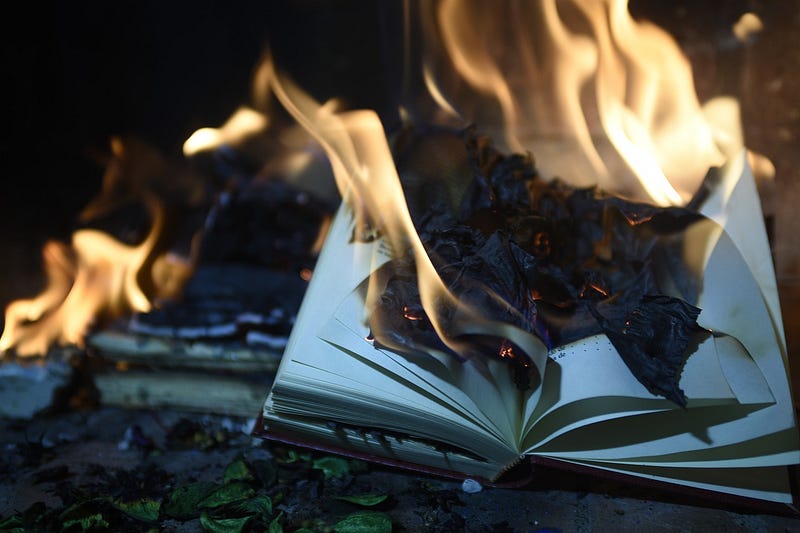
“The German Students’ Association of the Berlin universities assembled yesterday at the Hegelplatz and then, taking along several truckloads of 25,000 books and writings undermining the spirit of the German people, marched to the Opernplatz where they, in a symbolic action, threw these Un-German writings into the flames of a pyre.” — from V lkischer Beobachter , the official Nazi Party newspaper
On May 10, 1933, the Nazi-dominated German Student Union, along with other student groups, carried out public burnings of around 25,000 books deemed “un-German”. Books by prominent Jewish, liberal, and pacifist writers were thrown into the fires, as well as those by important literary and political figures like Bertolt Brecht, Erich Maria Remarque, and Ernest Hemingway.
Other public book burnings took place subsequently, with 34 university towns across Germany taking part in this atrocity.
Not long after these book burnings, the Nazi regime ransacked book stores, libraries, and publishing houses to get rid of books they considered dangerous.
Because of today’s social consequences of actually burning “problematic” books (although there have been some calls for just such a thing), banning them or calling for their cancellation have become more acceptable ways to purge our culture of ideas, especially if they were written by straight white men or because they fall into one or more of the now-excessively broad definitions of racism, sexism, or other form of bigotry.
Recently, the library system at Georgetown University, one of the oldest and most prestigious universities in the U.S., decided to give the pursuit of knowledge the finger and got rid of hundreds of their books shortly after a handful of delicate students found them “offensive.”
According to The Epoch Times:
“…a [student] staff member of the publication noticed a book that prominently featured a Native American woman on its cover on a bookshelf at McCarthy Library. This prompted other staff members to ‘examine every single book in the room,’ and they determined, by looking at book covers, that at least one-half, if not all of the shelved books contain ‘racism, sexism, misogyny, homophobia, fetishization, and pedophilia.’ The students continued their book hunt in another library in Reynolds Hall, where they located more ‘similarly problematic’ books.
‘We’d like to add that we haven’t even read the insides of these books…Again, the entire swath of evidence for the problematic nature of these books is based on the front and back covers,’ wrote Review’s editor-in-chief.”
While this event is shocking in itself, this purge being carried out by students at such a respected institution of learning carries with it a frightening weight that freezes the blood upon closer examination.
Have these kids not read any history books?
Assuming there are any left in the library to get rid of. The past is positively filled with human-on-human horrors.
Also, this event is only the latest in a series of modern attempts to cleanse our culture of controversial literature; the YA community has experienced an outbreak of hypersensitive backlash against authors who’ve written books that were considered offensive by a gaggle of folks who’ve apparently experienced no pain or discomfort in life.
A Place for Wolves by Kosoko Jackson, The Black Witch by Laurie Forest, The Continent by Keira Drake, and Blood Heir by Amélie Wen Zhao are all fairly recent examples books by “diverse” writers (Black, female, LGBT, etc.) that faced severe and fiery backlash for supposedly laundering all sorts of vile bigotry into the minds of young readers (they didn’t).
Jackson’s book was the only one listed here that was actually cancelled (Zhao canceled her book, only to republish it after intense scrutiny from a group of multicultural academics), but there’s still something worrying about the dogmatic attitudes that budding authors face simply for sharing their stories with the world. This is an attitude that can’t be easily dismissed with the usual advice that aspiring artists should embody from the outset of their dream jobs: “It’s just criticism. Get used to it, you’re gonna experience it for the rest of your career.”
No, this reaction to writing that’s perceived to conceal pernicious ideas is symptomatic of a deeper, more serious condition, a condition that’s apocalyptic to the fabric of a vibrant creative community that needs restless — yes, even dangerous — minds to thrive.
The reasoning behind this kind of cultural sanitization is devoid of any merit; in Wokeness, it’s not enough to simply ignore or critique literary works with outdated or even just plain bad ideas — we have to expel them from our collective awareness and ensure that they’re quickly forgotten.
The methods of elimination of fugitive books may differ from what the Nazis used, but the spirit lives on: “We believe that the ideas contained in these books are deadly to the human mind, so it’s upon us to get rid of them.”
The concept that one can live peacefully in a society that allows the dissemination of some disconcerting ideas isn’t a hard one to grasp, but is made so by movements hungry for authority and members, especially when said movements are guided by leaders who’ve done away with democracy to appoint themselves as the arbiters of which ideas are good and which are bad.
It’s exactly this sort of cultural liquidation that we fought against in World War II, and yet here it is popping up on our home turf, only a few decades later…
Stay tuned for future installments where I dive deeper into the sinister similarities between the anti-art dogmas of Nazism and Wokeness.


