
Politics | Board Games
Margaret Thatcher Hated Hippies | Stonehenge: An Anthology Board Game
The Dark Art of Politicizing Board Games

“The conclusion to my dissertation is genuinely going to be ‘games have always been political, you fucks’ - but maybe worded slightly more professionally.” — @nielsen_holly
Politicization comes in two flavors: politicizing a game itself, or politicizing something around the game or its creators. I don’t care much about that second one. Everyone on Earth has said something stupid about Hitler when they were in high school. But politicizing games themselves is one of my very favorite things.
“Politicizing” isn’t the right word all the time. I didn’t politicize Fog of Love. I just pointed out the horror of the uncertainty in relationships. And my Power Grid story wasn’t about electoral politics, just the coming automation apocalypse. Still, any game worth playing parallels something within the real world. Thunderbirds isn’t a parable about humanitarian aid unless you want it to be. But I really wanted it to be.
When Paizo released Stonehenge 12 years ago, gamers called it “the Sybil of board games”. This “Anthology Board Game” contained rules and pieces for six different games. The idea was inspired by the real Stonehenge. It could be whatever you think it is. A religious site. A monument. A market. A landing pad for ancient aliens. Whatever.
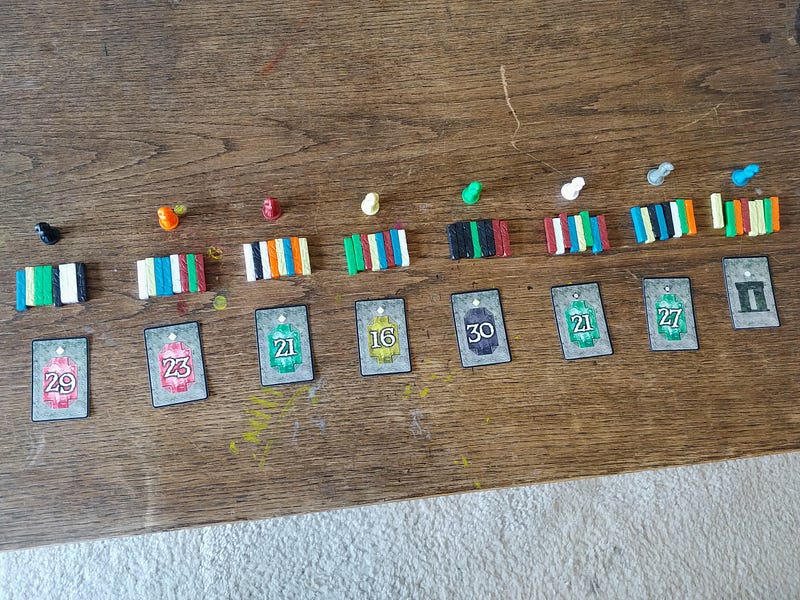
The only official solitaire Stonehenge game comes from the Nocturne expansion. Battle of the Bean Field is based on an infamous police raid on a hippie convoy in England. The backstory is that a caravan heading to Stonehenge for a festival was cut off by the police. After they cut cross-country to avoid roadblocks, the cops assaulted the convoy.

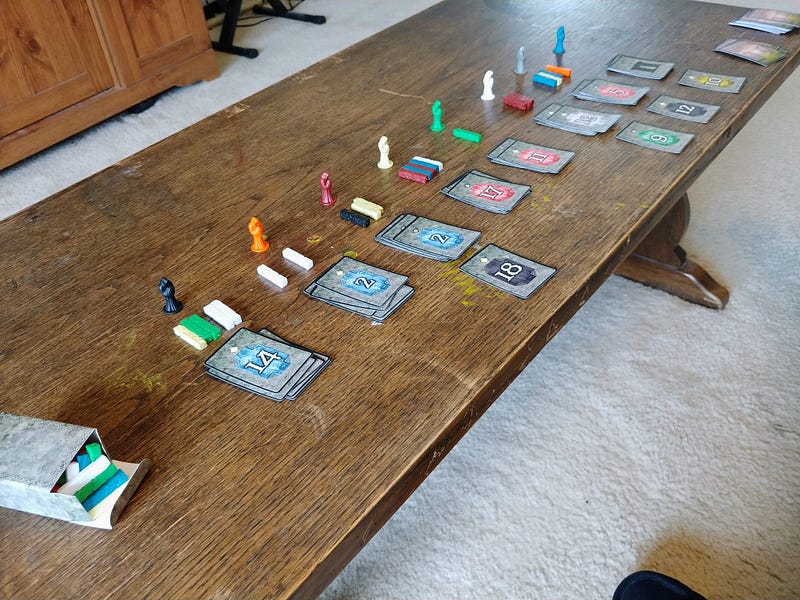
The game represents the struggle between the passengers of a stalled bus and the bobbies trying to arrest them. It’s a card drafting game. The druid figures represent the cops. There are 8 rods in front of each bobbie, representing a gaggle of hippies, as well as a Bobbie Card.
Each round, the player draws a stack of 8 cards, then draws and plays one card at a time. If the Bobbie Card is a Sun, you have to play a card equal to or above its value. If it’s a Moon, equal or below. If you play the right card on the right bobbie, you free all the hippies of the color you played. And you have to play that card somewhere. Predicting the odds of drawing the right card in the future is a big part of the game.
While fighting the bobbies, the player is consistently weighing who to save. Focus on saving multiple hippies with each card play? Or pass up those opportunities when you can save a hippie that might not be rescued later.
This all happened in the middle of, and because of, the Thatcherism boom. Margaret Thatcher hated hippies, and thought they were dead weight. Even if they weren’t taking from the government, they weren’t contributing to the economy. And Thatcher considered that an unforgivable sin. She was Britain’s first female Prime Minister, but she embodied the worst instincts of The Man.

The real battle wasn’t as bloodlessly abstracted. The bobbies laid into the hippies with nightsticks and riot shields, all the while screaming orders to get out of the vehicles. But they did this without giving the hippies a chance to surrender before dragging them out. The warnings were a formality.
Photographers shot pictures of cops beating a pregnant woman and busting open a guy’s skull. 16 hippies and 8 cops were hospitalized. All because The Man couldn’t stand knowing that not everyone wants to be a stationary wage slave.
The word “uncaring” is often used to describe both Thatcher and Thatcherism. Along with being an economic ideology, Thatcherism was also a social position. Thatcherites hated hippies because they refused to get haircuts and real jobs. They needed to be taught a lesson, along with gays, union strikers, and anyone else not on board with England’s new direction.
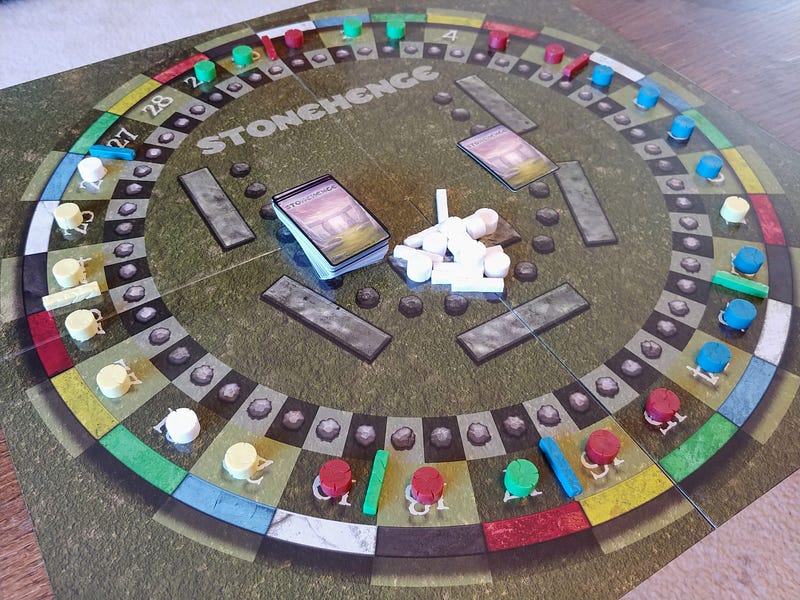
Battle of the Bean Field wasn’t the only Stonehenge game with political implication. The High Druid is an election game about druids choosing a new leader. Colleges of varying sizes have as many electoral votes as the number of druids in the college. The player with the most supporting druids in a college gets ALL the college’s votes.
The rub is that any tied players get eliminated from that college’s race. If you have the same amount of votes as anyone else, you can’t win. It’s like instant-runoff voting, but backwards. I guess druids would rather have an unpopular leader over a divisive leader.
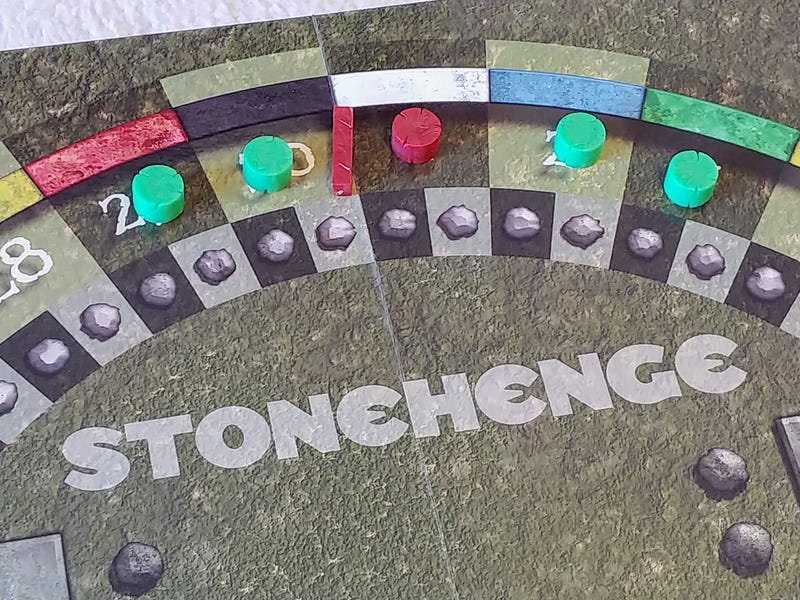
According to the rulebook, The High Druid’s designer was inspired by the US’s electoral college. The thing is, one of the actions you can take is to move a rod dividing two colleges. That means you’re growing one college and shrinking another.
Outside of massive population shifts, states don’t gain or lose electoral votes. The colleges in The High Druid are more like voting blocks then Electors. Then again, even if the designer couldn’t see this coming, it could easily represent the wildly inaccurate 2020 census screwing the electoral map.
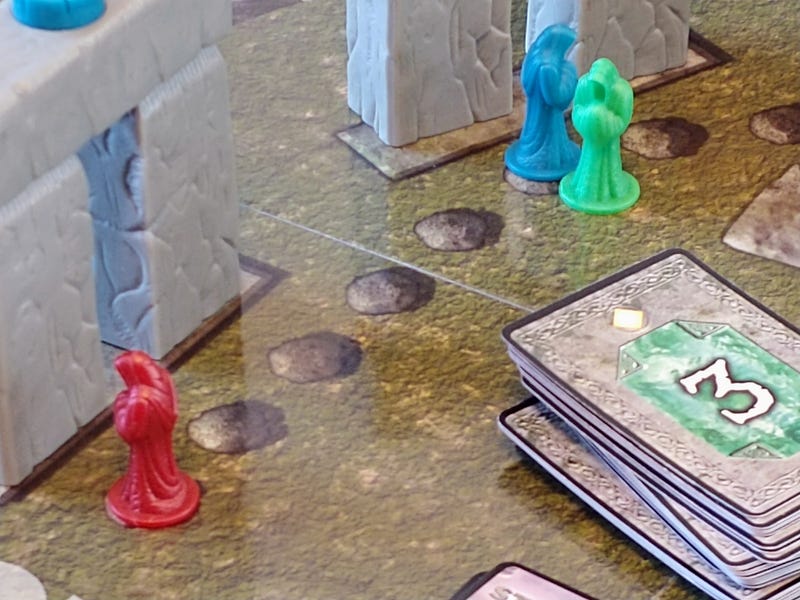
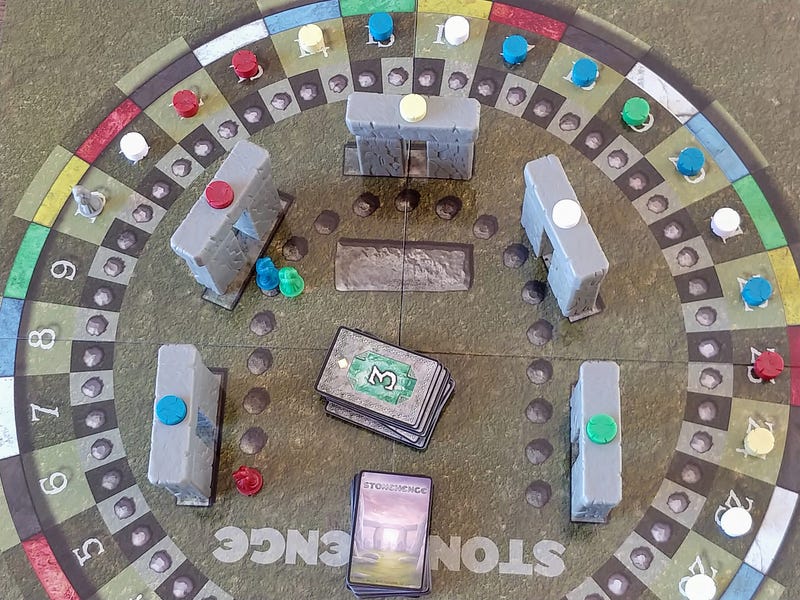
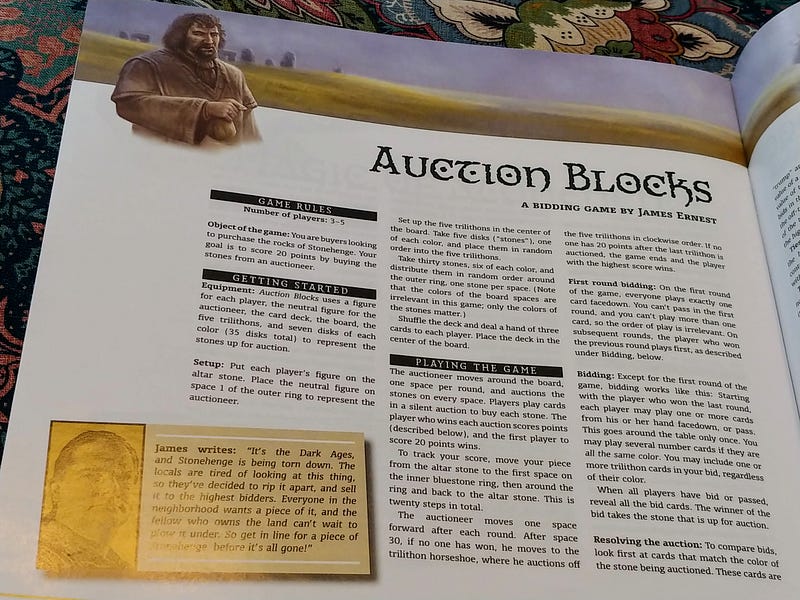
Another Stonehenge game, Auction Blocks, is basically Monopoly stripped down to its essentials. Bits of Stonehenge are auctioned off one at a time. Cards that match the stone being auctioned trump those that don’t. So a Blue 3 card will beat a 30 of any other color. There’s a trick-taking element too. You score 1 point for winning the stone itself, plus 1 point for every stone of that color you already have.
The conceit is that the locals are tired of looking at the pile of rocks, and the land owner wants to redevelop, so they’re selling it off. I have no proof that the designer was making a statement about the privatization of rail and water services. But I’m going to assume he was.
“Conservatism is having its extinction burst. Public opinion is against them: 92% of Americans support gun control. 18% believe abortion should be illegal in all cases. 75% support gay rights. 57% believe the govt should be responsible for health care.
They win bc they cheat.”
— @ithayla
A few days ago @ithayla posted a Twitter thread comparing clone suffrage in Android: Netrunner to the GOP’s war on abortion rights.
If this was about a video game, someone would have shot back with, “Leave politics out of it! It’s science fiction! It has nothing to do with the real world”! Maybe a more reasonable tweeter would argue that the clone scenario is only a thought experiment, like all good sci-fi. Or that shoehorning in parallels cheapens both the real abortion fight AND the sci-fi conjecture.
It’s true that people can read meaning that isn’t there into any piece of fiction. So what? Shoehorning political or cultural commentary into game analyses is a noble endeavor! That’s why I make a point of cramming “Fuck The Man” into almost every article. Some would say this invalidates the analysis. Maybe, but “Fuck The Man” is too important a message not to promote.
These are strange times. Almost all media is potentially political. Way more people follow politics now than in 2016. Apolitical means indifferent, and no one is indifferent these days. Pure escapism isn’t an option for most people anymore. Few are privileged enough to comfortably ignore this shitshow for long.
As for Stonehenge, it’s WAY out of print but you can find unopened copies cheap. Mainly because no one was into the idea. The system has something for everyone, but since the games share the same components they all look bland. For sane people, it’s meh. For home-brewers and remixers, Stonehenge is a good toolbox of ideas and components. And if you try hard enough, you’ll see that it’s all about how Brexit will bring about Thatcherism 2.0.