
Hacks and Variants
Your Future Robot Boss Will Treat You Like a Machine
Power Grid + The Robots
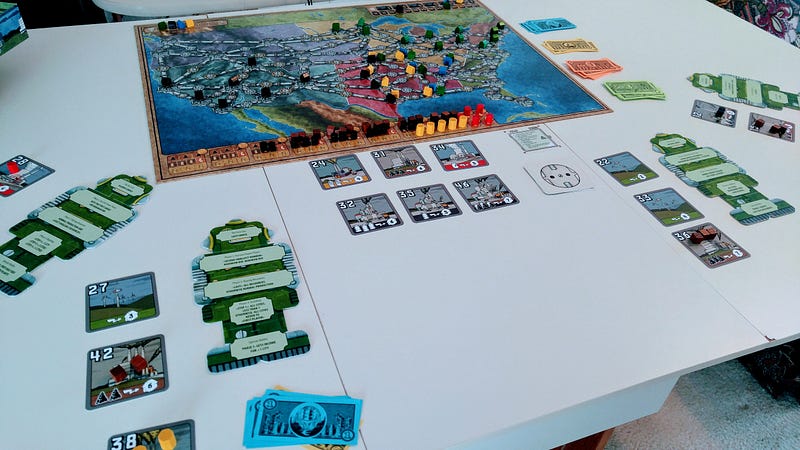
I really need to stop playing solitaire Power Grid. It’s making me paranoid and depressed. Power Grid is not a fun game in the slightest. But I am COMPELLED challenge the robot opponent over and over, if only to prove that I can beat a random collection of cardboard puzzle pieces. So far, I have failed every time.
Unfortunately it’s impossible to get anyone to play this monstrosity with me. It’s long, often boring, and there isn’t much interaction between the players. I gave up trying to recruit players long ago. Besides, you don’t really need people to play it. Except for the actual moving of components, Power Grid can play itself.
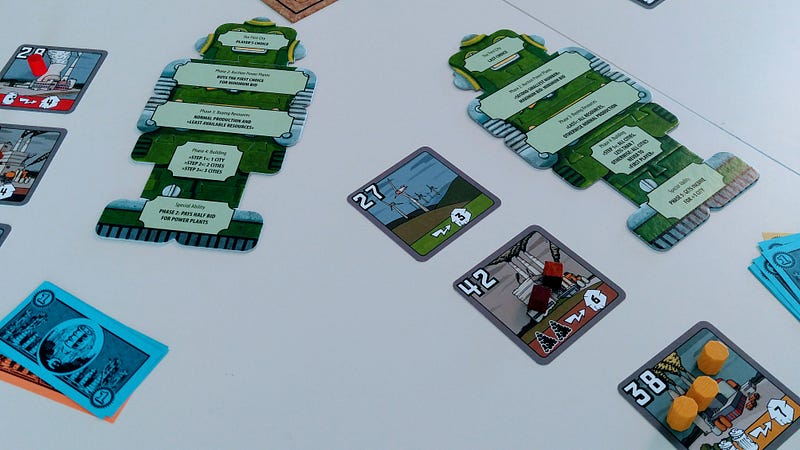
The instructions for The Robots expansion say that it’s not made for solo games. This is a lie. They say that to avoid scaring players into realizing that robots are coming for their jobs. It is, however, a pretty stale game. The robot is hard to beat, but only because it’s allowed to cheat the rules in one way or another. It’s supposed to supplement an otherwise two player game, but that’s unlikely to happen. Instead of holding out for a human, I went all-in with the robots.
The most sane alternative to my typical Power Grid situation was to run a game with four robots and no human players. After eliminating instruction tiles that rely too much on humans, I built four robot players and started it all up. I did what my new robot overlords told me to do. Kept score. Moved Power Plant cards. Transferred Resources. Etc. On the rare occasion a robot called on me to actually decide something, I did. I was a good human minion.
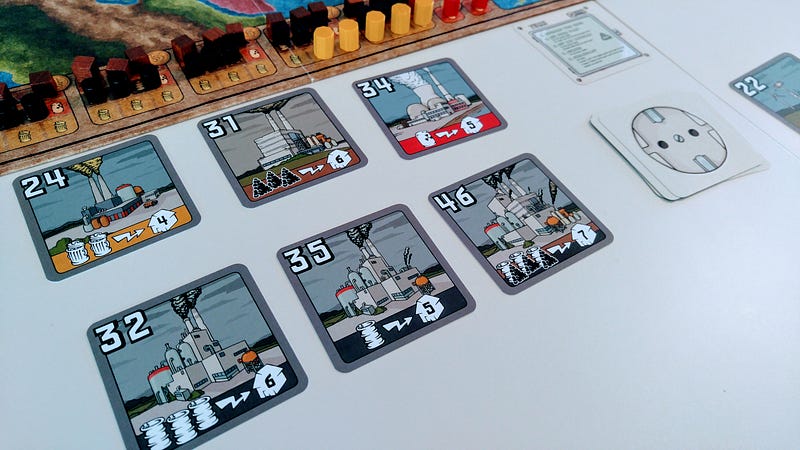
Like most euro games, Power Grid eliminates almost all traces of randomness. No dice. No hidden hands of cards. No fluctuating costs. Supply and demand for Coal, Oil, and other fuels are variable, but not random. There’s a limited amount of each Resource. The less there is, the more expensive it gets. The players have perfect knowledge of the supply, but the robots don’t “know” anything. When your opponent is a set of if-this-than-that orders, buying the Resources it needs and jacking up the price is a common human tactic. But, if ALL the players are driven by if-this-than-that orders, each robot is either lucky enough to need a different Resource or it’s not.
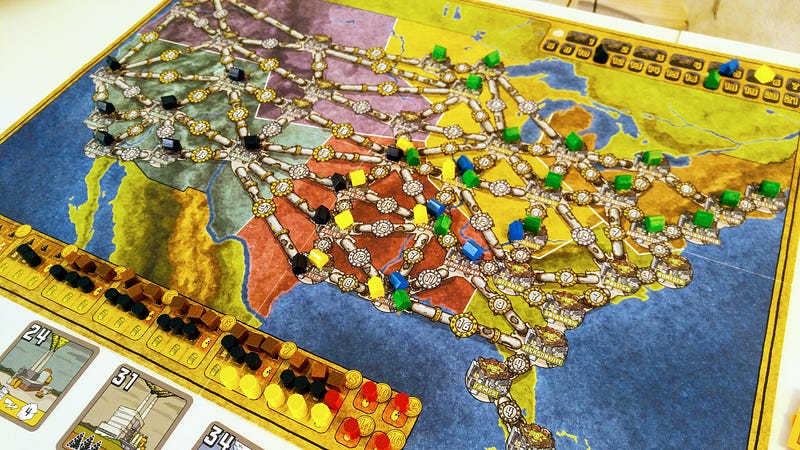
These robots don’t adapt. Each of them is a nothing more than a hardwired set of instructions, on top of an ability that allows them to cheat. For example, one of my robo-bosses could Build at a cost of 10 Electros regardless of what Step we were in. The others had to pay the market rate, which grows to 15 and 20 Electros in Steps 2 and 3. I interpreted these powers as the sort of efficiencies a real AI would find and exploit.
This went on for about three hours. I wasn’t making any calculations. I was just following orders. While taking a break about halfway through, I came to the conclusion that big companies ARE robots. They’re dumb and use meat parts called Humans, but they are autonomous. Their operations are inscrutable. No single person knows everything that’s going on. No one is “driving” ExxonMobil or Shell or BP. This is why executives don’t feel bad when their company dumps oil into the ocean or poisons an entire city. The company did it. The humans are innocent.
The robots do have one big advantage: they don’t worry. They don’t feel the need to save anything for a rainy day (unless their instructions say so). They buy whatever power plants and city connections they can afford, providing the rules say they can. They don’t worry about not having the cash for that perfect power plant next turn. If they can’t afford something, they don’t buy it and they don’t regret it. If a human’s plans go sideways, their confidence gets dinged. This often leads to more boneheaded moves later on. The robots are never rattled.
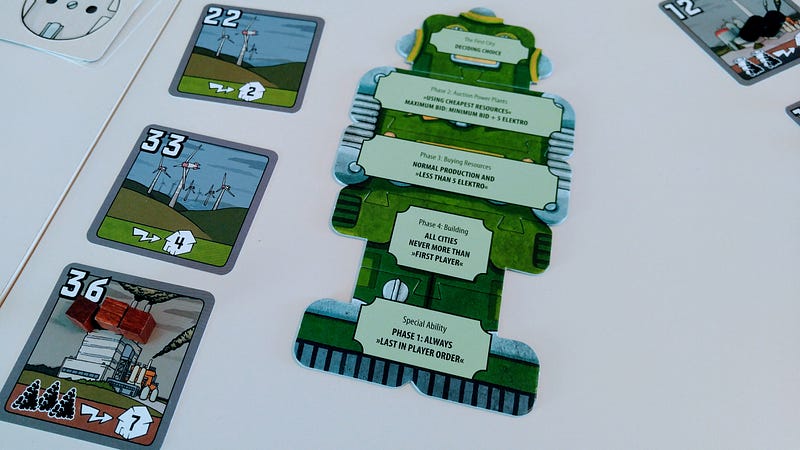
So which robot won? The Green one (the one with the Green houses. The robots themselves are all green). It was the obvious winner from the start. It had the special ability to be placed last. This meant it went first when during the Resource phase, making all Resources cheaper for it. Turn after turn, it ended up with more and more cash on hand, which led to more and more Building. The game was far from a nail-biter. The robots did what they were programmed to do. Nothing more. This is how the real robot apocalypse will happen. The robots will just slowly and surely grind down any competitors, robot or otherwise.
If I ever try this again, I’ll add the Fabled Expansion and see if the events screw some robots more than others. Or, if I can actually find players, I could run a robot-only game while human players play The Stock Companies. Because that’s what the real business landscape is becoming. Human investors betting on automated businesses, like gambling fiends at a horse race.


