
Mapping Your Inner Universe: Meet The 3 Types of Parts Inside You
Clarify your inner world through the lens of Internal Family Systems.

It’s near common-knowledge now that your inner world (or your pysche) is actually a whole ecosystem of different parts of you that are all playing different roles that help you navigate your day-to-day life.
If you could peer into your mind, you’d see different parts of you hustling and bustling around, doing their best to help you get your needs met.
Parts Work is the work of actually talking to your parts and helping them work together instead of fight against each other. The reason Parts Work is so powerful is because once your parts finally start working together, all their energy gets amplified and you have the feeling like you are unstoppable and free.
I’ve seen Parts Work completely transform the way people experience their life — from sobbing in bed all day to nailing two promotions in 9 months. Not to mention what it’s done in my own life.
Parts Work is a big deal.
(If you haven’t heard of Parts Work yet, ya really got to get on that train because it will change your life in all the ways you’re needing. This article is a great place to start.)
Not all of your parts are playing the same roles.
According to the Internal Family Systems (IFS) modality, there are two main types of parts inside of you: protector parts and vulnerable parts.
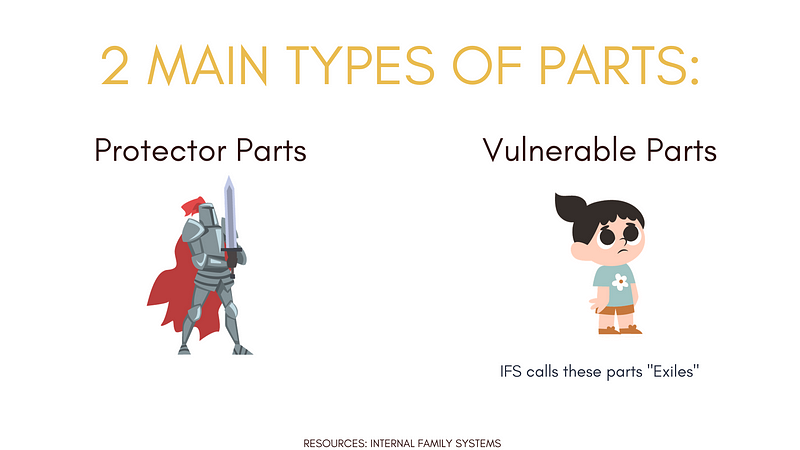
Your protector parts are working really hard to keep you safe from physical and emotional danger.
Your vulnerable parts are the parts of you that hold painful emotions or memories, such as shame, fear, trauma, or any extreme beliefs. (Note: IFS refers to these vulnerable parts as exiles.)
Within the umbrella of “protector parts” there are actually two types of protector parts: managers and firefighters.
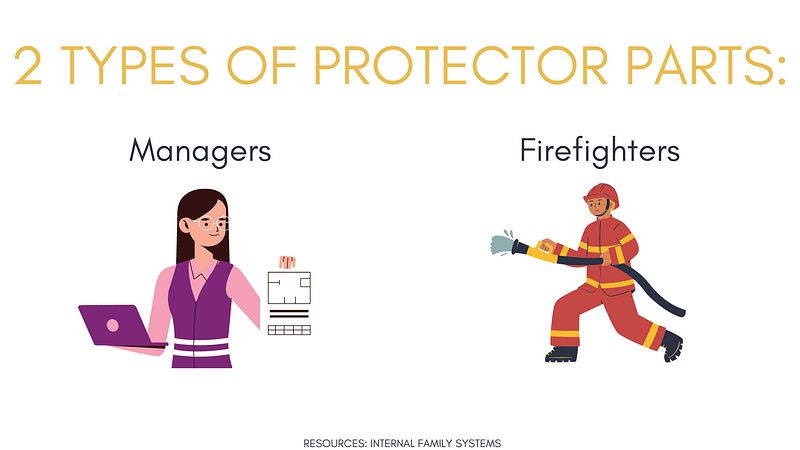
Managers are the parts of you that ensure we don’t experience more circumstances that cause you to feel the pain of your vulnerable parts. They are future-oriented and are focused on future pain prevention.
Their motto is “Never again.” As in, “Never again will I get hurt like that. If I do all the right things, I’ll be able to protect us from experiencing that pain.”
Examples of manager parts are perfectionist parts, planning parts, and inner critics.
Firefighters are the parts of you that are the last line of defense before you are completely flooded by the pain your vulnerable parts are carrying.
IFS calls this type of protector “firefighters” because like actual firefighters, they come out in times of emergency and they will do anything to put out the “fire” of the pain of our vulnerable parts out.
Examples of firefighter parts are substance-using parts, dissociation parts, and aggressive parts.
Oversimplified Map Of Your Inner Universe
Before we wrap up, I want to give you a very oversimplified map of how the different kinds of parts are laid out in relation to one another inside your inner world.
That way you can start bringing more clarity about what is currently happening inside of you, as well as how to better lead your parts into more feelings of freedom as you continue to heal.
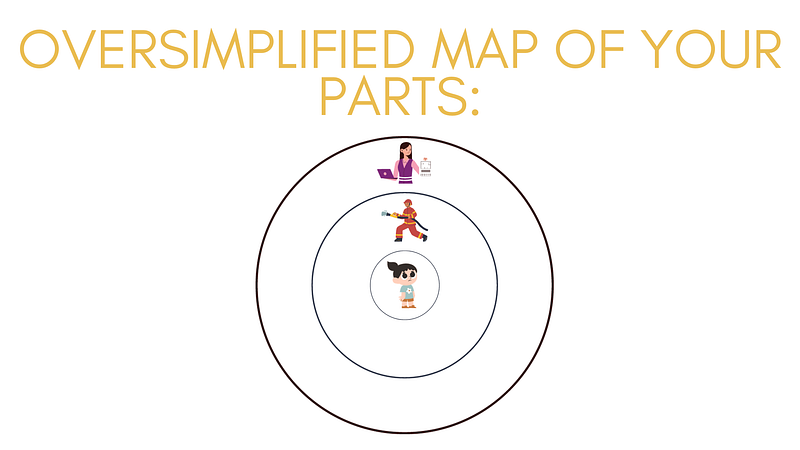
You can think of your vulnerable parts as being in the center. They’re holding your core beliefs and wounds.
Your firefighter parts are the last line of defense in protecting those painful beliefs and wounds from overwhelming you.
Then you’ve got your manager parts out on the periphery trying to do their very best to keep both your exiles and your firefighters at bay while making sure nothing bad happens in the future. (Manager parts are usually the first to admit how exhausted they are).
Releasing Your Trauma in a Safe Way
When we talk about “releasing your trauma” what I mean is helping your vulnerable parts release their pain and return to wholeness. That then allows your protector parts to not have to play such exhausting roles (and actually frees them up to play a role they actually want to play!).
The way to work through this process safely is by getting permission from the parts of you on the outside to go the next layer in. Until you get permission from the last line of defense to go to the vulnerable part and help them release those core wounds and that pain.
This means you build trust with yourself and with your parts from the outside in — from the periphery to the center. It degrades trust when you try to bully your way past any part that isn’t ready for you to go a layer deeper.
Meet Your First Part
You can get started with meeting your first part by downloading my free Meet A Part Of You Worksheet. It will walk you through the process of identifying a part and having your first conversation with it step-by-simple-step.
You can download it right here.
(Some folks have said this worksheet has completely transformed the way they experience themselves so…be prepared).
More Parts Work, Please!
You got it! Here are more helpful Parts Work articles: