avatarAvi Kotzer

Free AI web copilot to create summaries, insights and extended knowledge, download it at here

3552

Abstract

“Not in word list” phrase.</p><p id="89b9"><i>Malefic</i> is an adjective, so it’s reasonable to suppose someone who is playing the game would look for the related noun. The second definition of malefice (a piece of mischief;<b> </b>an evil deed) corresponds to the definitions of malefic given by the dictionary:</p><figure id="46ff"><img src="https://cdn-images-1.readmedium.com/v2/resize:fit:800/1*hX1c7LmCO_FsEUVzoGAAxQ.png"><figcaption></figcaption></figure><p id="2b3c">Like I said before… what were the editors of the Spelling Bee thinking?!?</p><h2 id="422c">Bad word!</h2><blockquote id="9794"><p>Who knows what evil lurks in the hearts of men?</p></blockquote><p id="e64f">You get my applause of admiration if you knew that quote was from The Shadow, a famous pulp hero of the 1930s and 40s who later starred in comic books, television, movies, and video games. Fun fact: Orson Welles voiced the character on radio for just over a year in the 1930s.</p><p id="7731">But the definition of “evil deed” for malefice is not our focus today, although I suppose it related to the main definition of “evil sorcery” or “evil spell”. The reason the word “evil” keeps popping up has to do with the word’s etymology. <i>Malefice</i> comes from the Latin <i>maleficium</i>, from <i>maleficus</i>, meaning… evil.</p><p id="fd02">There are various terms used to describe people who practice occult arts: witch/wizard and sorceress/sorcerer are two of the most common. One of the interesting things about both these pairs of words is the connotation related to their gender. <b>Witch</b> traditionally evoked the image of an ugly, wart-covered, cackling old woman who was casting hateful spells left and right; while <b>wizard</b> made people think of wise men like Merlin or Gandalf. <b>Sorceress</b> is used as a synonym of “malevolent temptress”, a negative sexual depiction of women, while <b>sorcerer</b> makes one think of Mickey Mouse as an apprentice in <i>Fantasia</i>.</p><figure id="589e"><img src="https://cdn-images-1.readmedium.com/v2/resize:fit:800/1*NzipFyVQVFWxysFm8JTVxw.png"><figcaption>Credit: Disney</figcaption></figure><p id="4920">These differences in connotation are great examples of how words <i>per se </i>are not sexist, racist, etc., but the associations and nuance we ascribe them can turn them into “evil spells” of sorts. Take the word “colored”, for example. It was the predominant and preferred designation by African Americans in the late 19th and early 20th centuries, but is now considered offensive. After several other terms replaced it (Negro, Black, African American), “colored” was adapted into “people of color”, which has a wider use and is currently accepted.</p><p id="b6c4">Hebe, an ethnic slur commonly used in the 20th century, was given a positive connotation by Columbia graduate Jennifer Bleyer when she founded the satirical Jewish lifestyle magazine <i>Heeb</i> in 2001.</p><p id="12e4">In Venezuela, where I grew up, the expression “coño de tu madre”, which had been really really really offensive for most of Spanish-speaking history (because it referenced the genital area of one’s mother) became a friendly verbal nudge and even a quasi-compliment — as in, “you devil you” — in the 1990s. Its cousin, “coño de madre” (in reality, <i>coño’e’madre</i>), is now used as the equivalent of “bro”.</p><h2 id="4aa3">Role reversal</h2><p id="038a">Perhaps the words <i>malefic</i> and <i>malefice</i> had you thinking about yet another Disney movie:</p><figure id="2080"><img src="https://cdn-images-1.readm

Options

edium.com/v2/resize:fit:800/03KFZMBzLEdiJnEIj.jpg"><figcaption>Credit: wikipedia.com</figcaption></figure><p id="d390">For those of you who never saw the original, the above character is <b>Maleficent</b>, the self-proclaimed “Mistress of All Evil” in Walt Disney’s 1959 animated film <i>Sleeping Beauty</i>. Much like the Hulk, you didn’t want to make her angry:</p><figure id="3ce8"><img src="https://cdn-images-1.readmedium.com/v2/resize:fit:800/0*0DMzYspqDxTaiS7v.jpg"><figcaption></figcaption></figure><p id="7c92">That’s Maleficent after turning into a dragon at the end of the movie. Spoiler: she gets killed by the valiant prince, who then fulfills his necrophiliac fantasy by marrying Sleeping Beauty and living happily ever after with her.</p><p id="59fa">As you surely remember, Maleficent is not invited to the christening of baby Aurora, shows up anyway, and curses the infant to “prick her finger on the spindle of a spinning wheel and die” by the end of her sixteenth birthday. Fortunately, one of Aurora’s three fairy godmothers, Merryweather, had not made her wish yet. Although she cannot annul Maleficent’s curse, she softens it so Aurora doesn’t die but falls into a deep sleep from which she can be rescued only by the kiss of a true necrophiliac… um, sorry, I mean prince.</p><p id="4f17">In <i>Sleeping Beauty</i>, Maleficent is portrayed as the typical mean fairy tale witch / sorceress. More than 50 years after the movie came out, Disney felt bad and decided to do some justice to the much-maligned character. In the 2014 film, <i>Maleficent</i>, the back story helps us sympathize with her as a good-hearted but tragic protector of supernatural beings who is betrayed by the love of her life, Aurora’s dad. So who did Disney choose to portray the woman they had once cruelly depicted as a gaunt, pale, languid woman? Well, none other than the gaunt, pale, languid Angelina Jolie, of course!</p><p id="2016">Hmmm… subtle!</p><p id="f3ac">Just as subtle as the editors of the Spelling Bee, who today decided that the word <i>malefice</i> is a <a href="https://www.merriam-webster.com/words-at-play/dord-a-ghost-word"><b>dord</b></a>.</p><p id="37fe">You can check out my previous entry on another <b>dord* </b>here:</p><div id="f736" class="link-block"> <a href="https://readmedium.com/ichthyic-9e457114a1fa"> <div> <div> <h2>Ichthyic</h2> <div><h3>If it looks like a fish and sounds like a fish, then… it’s a dinosaur?</h3></div> <div><p>medium.com</p></div> </div> <div> <div style="background-image: url(https://miro.readmedium.com/v2/resize:fit:320/0*eTjxIanWniZcPNHd.jpg)"></div> </div> </div> </a> </div><p id="676f">*What the heck is a <b>dord, </b>you ask? Here’s the answer:</p><div id="89f8" class="link-block"> <a href="https://www.merriam-webster.com/words-at-play/dord-a-ghost-word"> <div> <div> <h2>'Dord': A Ghost Word</h2> <div><h3>One of the questions people like to ask lexicographers is this: Can you sneak something into the dictionary? Can you…</h3></div> <div><p>www.merriam-webster.com</p></div> </div> <div> <div style="background-image: url(https://miro.readmedium.com/v2/resize:fit:320/0*hEvI6COSCs6nBG7i)"></div> </div> </div> </a> </div></article></body>

Malefice

An “e” at the end was enough to turn a word into a dord*

Photo by Soyoung Han on Unsplash

Today’s New York Times Spelling Bee letters:
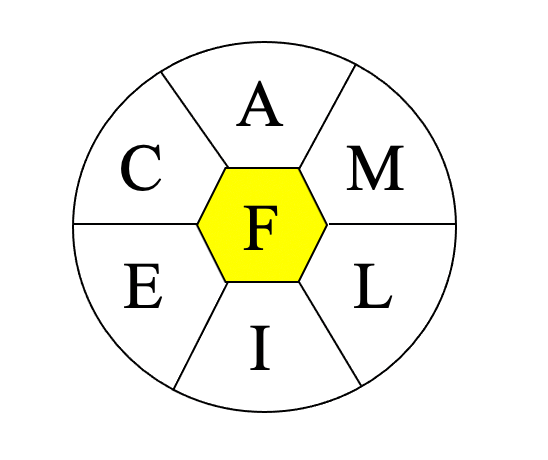
Art: Iva Reztok

A, C, E, I, L, M, and center F (all words must include F)

Merriam-Webster says…
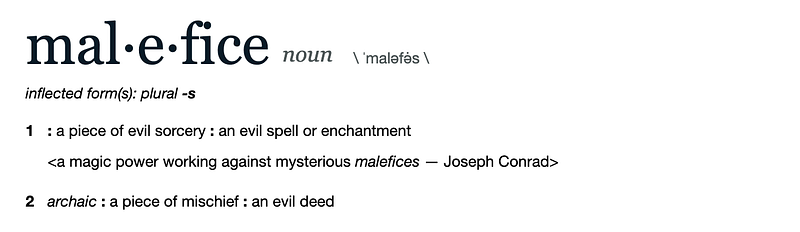
Credit: merriam-webster.com

Silly little dictionary! Don’t you know malefice can’t possibly be a word if the New York Times says it ain’t?

For further fascinating facts, check out the Spelling Bee Master.

What’s your favorite dord* from today’s puzzle?

My Two Cents

One letter. That made all the difference. I must admit to, once again, being completely befuddled by the lexicographic decisions of the Spelling Bee. Who in heck can figure out what’s going in the editor’s minds.

Spoiler alert: there is a spoiler coming up if you haven’t finished playing today’s game.

Every Spelling Bee puzzle has at least one pangram. Now, the classic definition of a pangram is “a short sentence containing all 26 letters of the English alphabet”. Calvin Li has an interesting article about perfect pangrams, those (rare) sentences that contain only 26 letters, each one different. When you think about the fact that there are only 6 vowel sounds (a, e, i, o, u, y) and 20 consonants, you realize what a challenge this is. And yet… those perfect sentence pangrams exist!

Spelling Bee pangrams do not involve sentences, as the object of the game is to find words. In this context, then, a pangram is any word that contains all seven letters of the puzzle at least once. The rules of the game do allow letters to be used more than once per word. So, in today’s puzzle, malefic is a pangram because it contains each of today’s letters (a, c, e, f, i, l, m) at least once. Additionally, since each letter appears once and only once, malefic is also a perfect pangram.

In the scoring system the Spelling Bee uses, pangrams are worth at least 14 points: 1 point per letter plus a bonus 7 for finding the pangram.

All this raises (not begs) the question: why was malefic accepted, but not malefice? I’m sure many other players added an “e” after finding malefic, as I did. And I’m sure many of them groaned when the Spelling Bee replied with its frustration-inducing “Not in word list” phrase.

Malefic is an adjective, so it’s reasonable to suppose someone who is playing the game would look for the related noun. The second definition of malefice (a piece of mischief; an evil deed) corresponds to the definitions of malefic given by the dictionary:
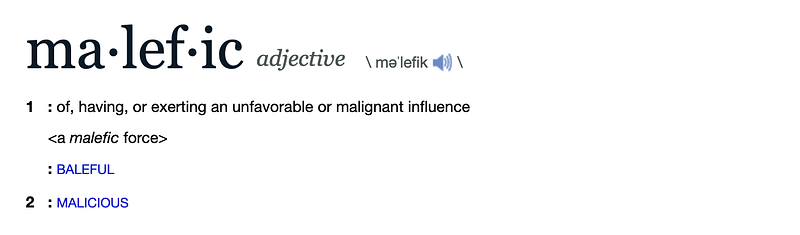
Like I said before… what were the editors of the Spelling Bee thinking?!?

Bad word!

Who knows what evil lurks in the hearts of men?

You get my applause of admiration if you knew that quote was from The Shadow, a famous pulp hero of the 1930s and 40s who later starred in comic books, television, movies, and video games. Fun fact: Orson Welles voiced the character on radio for just over a year in the 1930s.

But the definition of “evil deed” for malefice is not our focus today, although I suppose it related to the main definition of “evil sorcery” or “evil spell”. The reason the word “evil” keeps popping up has to do with the word’s etymology. Malefice comes from the Latin maleficium, from maleficus, meaning… evil.

There are various terms used to describe people who practice occult arts: witch/wizard and sorceress/sorcerer are two of the most common. One of the interesting things about both these pairs of words is the connotation related to their gender. Witch traditionally evoked the image of an ugly, wart-covered, cackling old woman who was casting hateful spells left and right; while wizard made people think of wise men like Merlin or Gandalf. Sorceress is used as a synonym of “malevolent temptress”, a negative sexual depiction of women, while sorcerer makes one think of Mickey Mouse as an apprentice in Fantasia.

Credit: Disney

These differences in connotation are great examples of how words per se are not sexist, racist, etc., but the associations and nuance we ascribe them can turn them into “evil spells” of sorts. Take the word “colored”, for example. It was the predominant and preferred designation by African Americans in the late 19th and early 20th centuries, but is now considered offensive. After several other terms replaced it (Negro, Black, African American), “colored” was adapted into “people of color”, which has a wider use and is currently accepted.

Hebe, an ethnic slur commonly used in the 20th century, was given a positive connotation by Columbia graduate Jennifer Bleyer when she founded the satirical Jewish lifestyle magazine Heeb in 2001.

In Venezuela, where I grew up, the expression “coño de tu madre”, which had been really really really offensive for most of Spanish-speaking history (because it referenced the genital area of one’s mother) became a friendly verbal nudge and even a quasi-compliment — as in, “you devil you” — in the 1990s. Its cousin, “coño de madre” (in reality, coño’e’madre), is now used as the equivalent of “bro”.

Role reversal

Perhaps the words malefic and malefice had you thinking about yet another Disney movie:
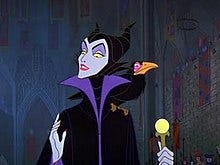
Credit: wikipedia.com

For those of you who never saw the original, the above character is Maleficent, the self-proclaimed “Mistress of All Evil” in Walt Disney’s 1959 animated film Sleeping Beauty. Much like the Hulk, you didn’t want to make her angry:
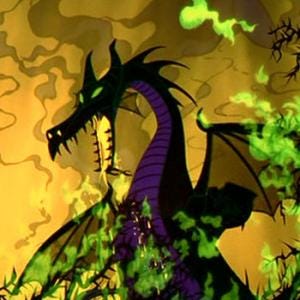
That’s Maleficent after turning into a dragon at the end of the movie. Spoiler: she gets killed by the valiant prince, who then fulfills his necrophiliac fantasy by marrying Sleeping Beauty and living happily ever after with her.

As you surely remember, Maleficent is not invited to the christening of baby Aurora, shows up anyway, and curses the infant to “prick her finger on the spindle of a spinning wheel and die” by the end of her sixteenth birthday. Fortunately, one of Aurora’s three fairy godmothers, Merryweather, had not made her wish yet. Although she cannot annul Maleficent’s curse, she softens it so Aurora doesn’t die but falls into a deep sleep from which she can be rescued only by the kiss of a true necrophiliac… um, sorry, I mean prince.

In Sleeping Beauty, Maleficent is portrayed as the typical mean fairy tale witch / sorceress. More than 50 years after the movie came out, Disney felt bad and decided to do some justice to the much-maligned character. In the 2014 film, Maleficent, the back story helps us sympathize with her as a good-hearted but tragic protector of supernatural beings who is betrayed by the love of her life, Aurora’s dad. So who did Disney choose to portray the woman they had once cruelly depicted as a gaunt, pale, languid woman? Well, none other than the gaunt, pale, languid Angelina Jolie, of course!

Hmmm… subtle!

Just as subtle as the editors of the Spelling Bee, who today decided that the word malefice is a dord*.

You can check out my previous entry on another dord* here:

*What the heck is a dord, you ask? Here’s the answer:

Spelling Bee
Language
History
Film
Maleficent
Recommended from ReadMedium