
Ichthyic
If it looks like a fish and sounds like a fish, then… it’s a dinosaur?
Today’s New York Times Spelling Bee letters:
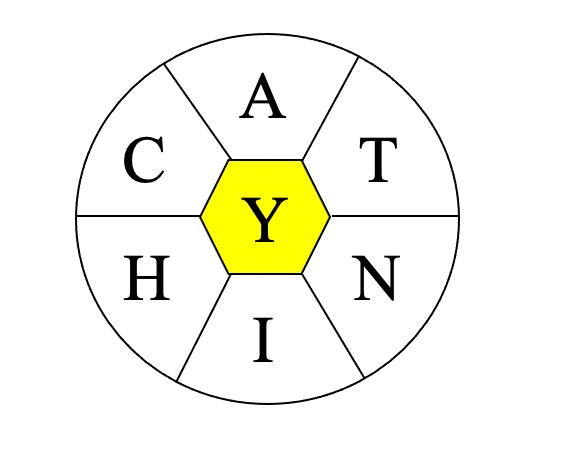
A, C, H, I, N, T, and center Y (all words must include Y)
Merriam-Webster says…

Silly little dictionary! Don’t you know ichthyic can’t possibly be a word if the New York Times says it ain’t?
For further fascinating facts, check out the Spelling Bee Master.
What’s your favorite dord* from today’s puzzle?
My Two Cents
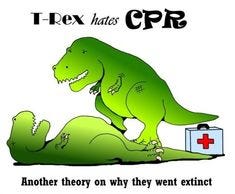
When I was a kid, I was obsessed with dinosaurs. Yeah, I know: how original! Back then (the primitive 1970s) the Tyrannosaurus Rex was the biggest, baddest, giant-est lizard of them all and was taken very seriously. This was probably due to the fact that the T-Rex memes making fun of its short arms hadn’t come out yet.
My personal favorite was the Triceratops, because in most of the books I read he was the only dinosaur who stood up to Mr. Rex. (You’ll notice I’m describing both as “he”, because that’s how I saw them when I was 9 years old.) Stories would depict all the other sauruses fleeing in panic when the Tyrannosaurus came strolling through, but Triceratops would calmly continue to chew its cud. Then this face-off would happen:
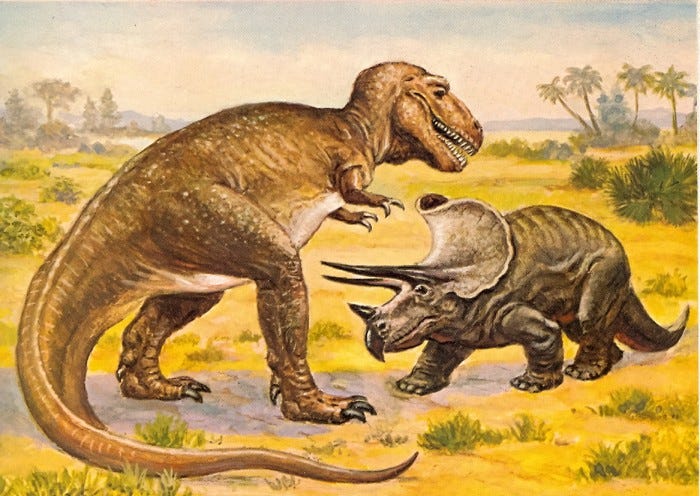
Somehow Mr. Tops would always come out, uh, on top. Sometimes he’d kill T-Rex, other times he’d wound him so badly that the short-armed terror would limp away to lick his wounds and find another dinosaur to munch on.
The above photo, and especially its gorier version, with Triceratops actually goring Tyrannosaurus, was one of the iconic dinosaur images of my childhood.
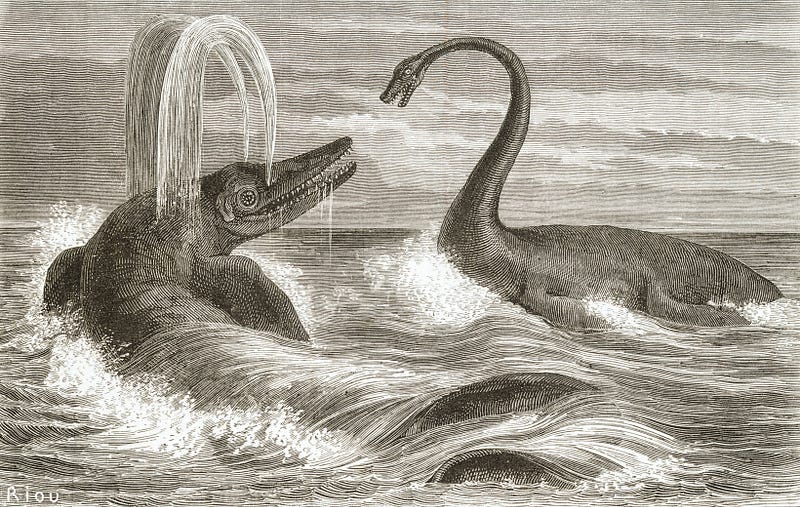
The other one is the sea battle between the Plesiosaurus and the Ichthyosaurus, as shown in the illustration at the top of today’s column. They were also the protagonists of a scuffle in Jules Verne’s Journey to the Center of the Earth, first published in 1864. A few decades earlier that ichthyic dinosaur had been discovered in England. By the middle of the 19th-century dinosaurs were really trending, despite the absence of Twitter and TikTok.
The 1867 revised and expanded version of the novel featured illustrations by Édouard Riou, who had worked previously on some Verne novels. One of the images was this one, depicting the Ichthyosaurus biting the neck of the Plesiosaurus.
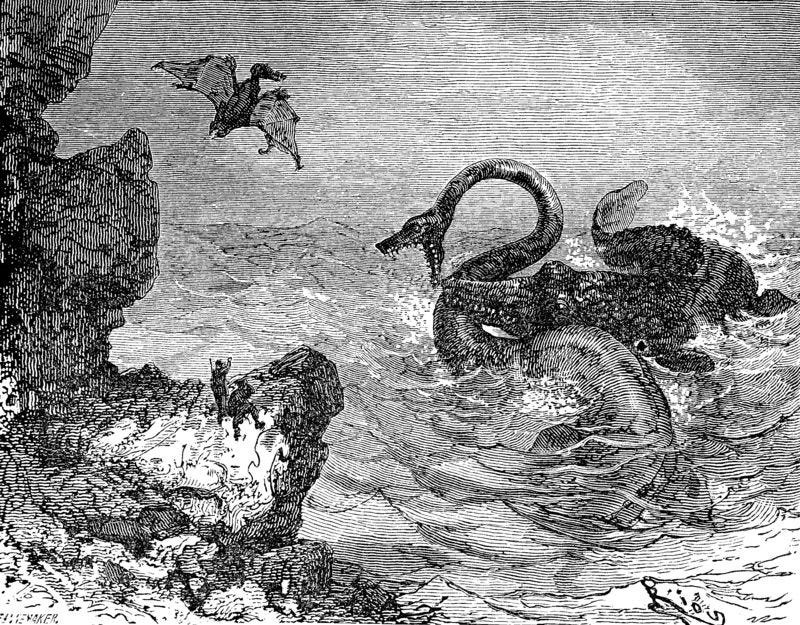
When I perused the dinosaur books of my childhood, my curious young mind always wondered who would win in a battle between Tyrannosaurus and Ichthyosaurus. Forty years later, I’m still waiting for the answer.
Terrible reptile
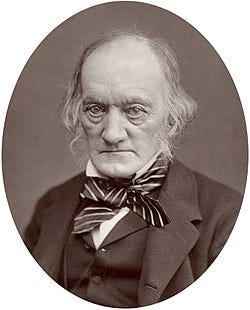
The term dinosaur was coined in 1841 by Richard Owen, English biologist, comparative anatomist, paleontologist, and intense starer:

His contributions to zoology, taxonomy, and dinosaur-ology were tremendous. Almost as tremendous as the hatred a lot of people had for him. “a most deceitful and odious man”; “malicious, dishonest and hateful individual”; “social experimenter with a penchant for sadism… addicted to controversy and driven by arrogance and jealousy”; “o one fact tells so strongly against Owen…as that he has never reared one pupil or follower.”
If you think those are terrible things to say about a person… imagine what Owen’s enemies said. Ha, ha! Kidding! I think…
Thirty years before that term, dinosaur, was in use, a boy and his sister discovered the skull and torso of a very large and very ichthyic animal.
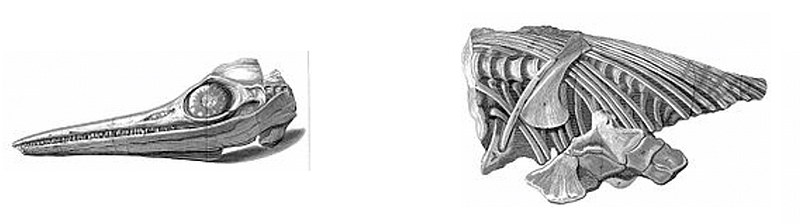
Their mother sold both to a man named Henry Henley for £23, which back then was the equivalent of $5 billion… I think. Henley lent the fossil to the London Museum of Natural History of William Bullock. When that museum closed, the British Museum bought the fossil for a price of £47 (or $10 billion). Today you can still find that piece in the Natural History Museum; the inventory number is BMNH R.1158 in case you want to look it up.
In 1814, the specimen was described by Professor Everard Home, in the first scientific publication dedicated to an Ichthyosaur. Home had procured additional fossils, but wasn’t sure how to classify this new and strange animal. The individual bones of the skeleton looked very much like they had belonged to a reptile, but the anatomy as a whole resembled that of a fish. Home considered the Ichthyosaur a transitional form between fishes and crocodiles, but in an evolutionary sense… since Charles Darwin was about 5 years old.
The Ichthyosaurus captured the imagination of the public. Thomas Hawkins, an eccentric collector and pre-Adamite theorist, believed the Ichthyosaurs to be a monstrous creation of the Devil himself. His published, illustrated works on the animal contained scientific descriptions and were the first real textbooks on this marine dinosaur.
Ichthyosauruses became really popular in 1854 when life-sized, painted, concrete statues of extinct animals were placed in a park in London. Among them were three models of an Ichthyosaurus.
Fossil girl
Remember the brother and sister I mentioned earlier, the ones who first discovered fossils of an ichthyic prehistoric animal?
Well, that sister was none other than Mary Anning, who in her short life (she died at 47) became world-renowned for her discovery of dinosaur fossils in the county of Dorset, England. The area where she did most of her searching is now called the Jurassic Coast.
Her discoveries included the first Ichthyosaur skeleton; the first two nearly complete Plesiosaurus skeletons; and the first Pterosaurus skeleton outside Germany. Her observations played a key role in the discovery that some pretty stones known as bezoars back then were actually fossilized feces.
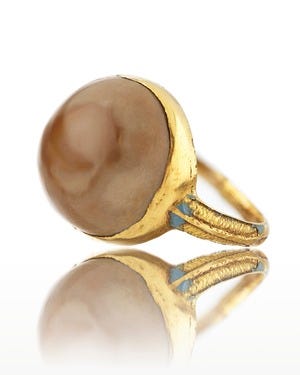
Yeah, that’s right. People in the 17th and 18th centuries were wearing dinosaur poop as jewelry!
Unfortunately, Anning was not able to fully participate in the scientific community of 19th-century Britain, was not allowed to join the Geological Society of London, and did not always receive full credit for her contributions. This was due to the fact that she was a Dissenter (a Protestant who had separated from the Church of England) and a woman.
Or maybe it was because she had pointed out people were using dinosaur poop as jewelry.

(The dog in the above painting is very much not a fossil, in case you were wondering.)
In 1830, Anning discovered a nearly complete Plesiosaurus fossil. It was described in an 1840 paper by Richard Owen. Remember Owen, coiner of the word “dinosaur”? This is the face he made when Mary Anning asked to be given credit for discovering the skeleton.
Not all men treated Anning with contempt, however. Henry De la Beche, geologist and paleontologist — and a good friend — made a watercolor painting of prehistoric Dorset based on the fossils Mary had found.
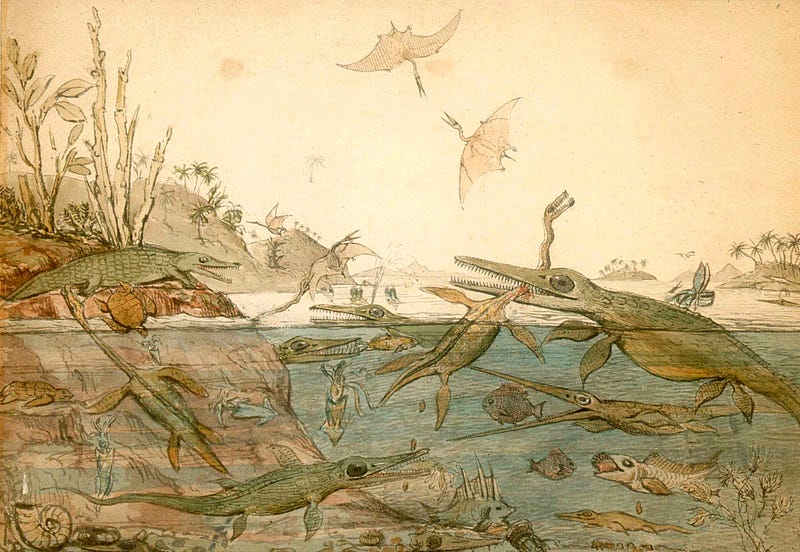
Again we can see the ichthyic dinosaur, Ichthyosaurus, chomping down on the neck of the Plesiosaurus, as usual. The poor Plesiosaurus is so scared it’s literally crapping himself. And that crap will eventually be made into jewelry. There seems to be a theme here…
In 1830, De la Beche commissioned Georg Scharf to make a lithographic print based on the above artwork; proceeds sales of the print’s copies were donated to Anning so she could continue her work. Then in 1835 Anning was swindled out of her life savings, about £300, the equivalent of Jeff Bezos’ fortune in twenty years. Another friend William Buckland convinced the British government to give her an annuity of £25 (or $1 million in today’s money) as a way of thanking her for her many contributions to the science of geology.
Although this pension gave Anning financial security, it didn’t prevent her from dying of breast cancer twelve years later.
Members of the Geological Society contributed to a stained-glass window that was made in Anning’s memory at St. Michael’s Church in Lyme Regis. It was unveiled in 1850 with this inscription: “This window is sacred to the memory of Mary Anning of this parish, who died 9 March AD 1847 and is erected by the vicar and some members of the Geological Society of London in commemoration of her usefulness in furthering the science of geology, as also of her benevolence of heart and integrity of life.”
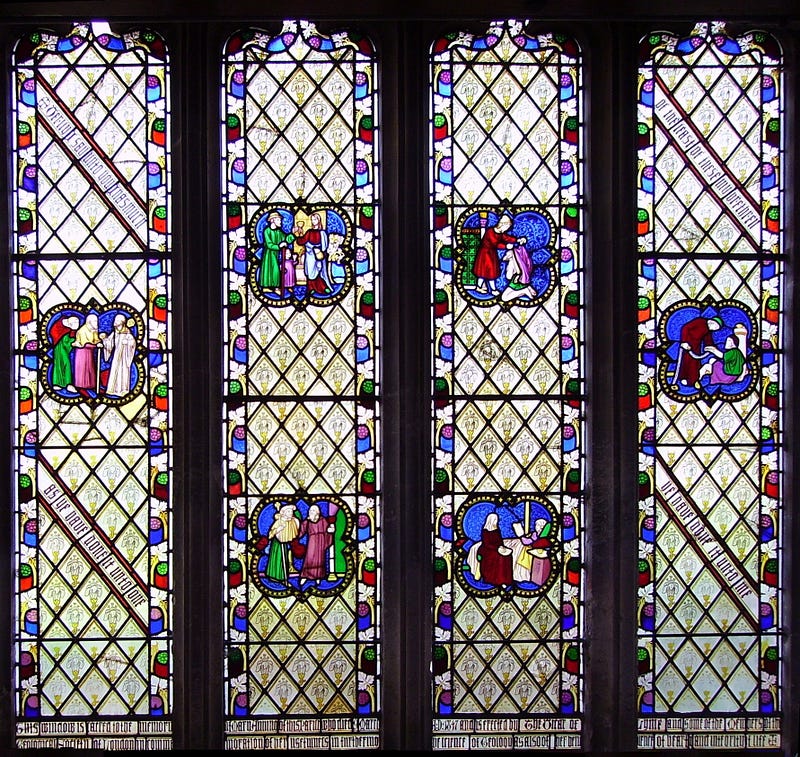
And yet… despite Mary Anning’s awesomeness and her awesome discovery of a fish-like dinosaur, the editors of the Spelling Bee decided that the word ichthyc is a dord*.
You can check out my previous entry on another dord* here:
*What the heck is a dord, you ask? Here’s the answer: