
Dele
What’s the… uh, deal, with this proofreading mark?
Today’s New York Times Spelling Bee letters:
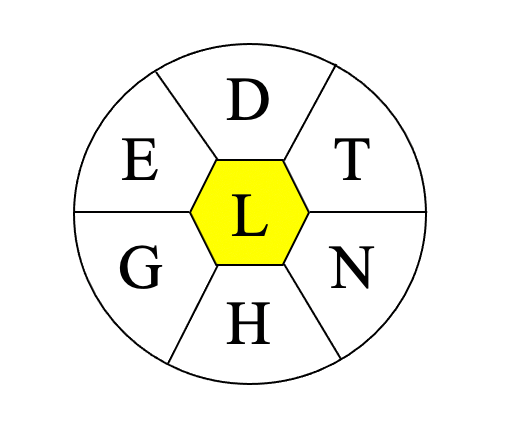
D, E, G, H, N, T, and center L (all words must include L)
Merriam-Webster says…
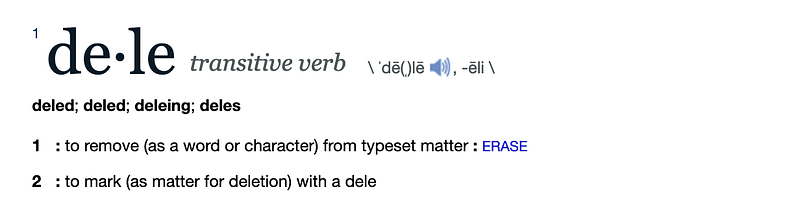
Silly little dictionary! Don’t you know dele can’t possibly be a word if the New York Times says it ain’t?
For further fascinating facts, check out the Spelling Bee Master.
What’s your favorite dord* from today’s puzzle?
My Two Cents
It’s well known that memories can be triggered by certain things, especially our five senses. One of the famous literary instances involves the narrator of the seven-volume novel (!) In Search of Lost Time (also known as Remembrance of Things Past), by French author Marcel Proust. In one notable part, the narrator drinks some warm tea and eats a madeleine, upon which his mind is flooded with memories he thought long lost.
No sooner had the warm liquid mixed with the crumbs touched my palate than a shudder ran through me and I stopped, intent upon the extraordinary thing that was happening to me. An exquisite pleasure had invaded my senses, something isolated, detached, with no suggestion of its origin. And at once the vicissitudes of life had become indifferent to me, its disasters innocuous, its brevity illusory — this new sensation having had on me the effect which love has of filling me with a precious essence; or rather this essence was not in me it was me. … The taste was that of the little piece of madeleine which on Sunday mornings at Combray (because on those mornings I did not go out before mass), when I went to say good morning to her in her bedroom, my aunt Léonie used to give me, dipping it first in her own cup of tea or tisane. The sight of the little madeleine had recalled nothing to my mind before I tasted it. And all from my cup of tea.
Today we know that the limbic system in our brains is related to the sense of smell, emotions, and long-term memory.
So right there is the explanation of the effect of Proust’s madeleines. Of course, he and others before him had no way of knowing the exact science behind their empirical evidence.
Dele that graf!
Merriam-Webster tells us that the verb dele comes from the imperative singular form of the Latin verb delēre, meaning “to wipe out” or “destroy”.
And destroy is certainly one thing some editors do very well. The better editors out there, however, will find a way to build you up as a writer or translator. So fear not the “red pen”, my dear reader. It can help improve your craft.
(As an aside, the Oxford English Dictionary claims that the word deleatur (“let it be deleted” in Latin) existed in English a long time ago, which could mean that dele may be just an abbreviation of that longer word.)
This is the symbol associated with the verb dele.
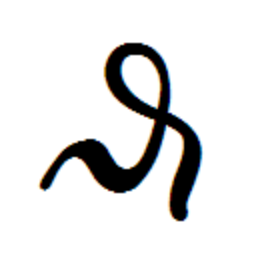
Its name, shockingly, is… dele.
I was pleasantly surprised to learn today that it actually may have come from a fancily-scripted “D” in the old German handwriting script known as Kurrent. Some proofreader must have thought it would be an effective way to indicate that text should be deleted. And the symbol above does resemble that capital “D” below.
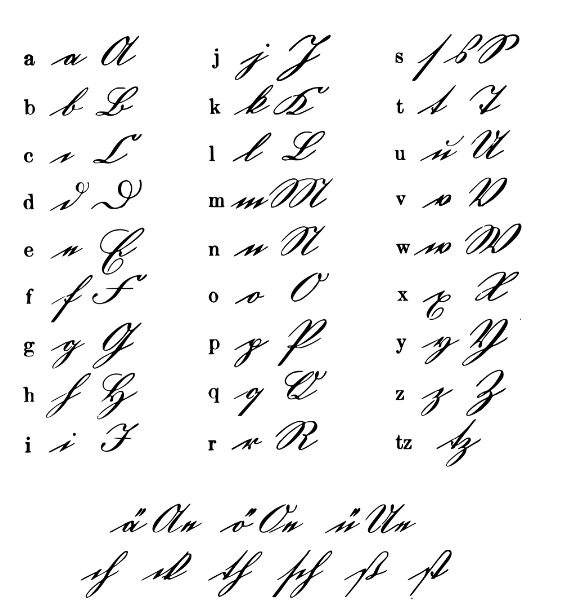
When I started out as an editor, I thought the dele was just a fancy way to do a “cross-out” without lifting pen from paper. And I’ve thought that for more than twenty years… up until a couple of hours ago!
Deles are used in two ways: (1) directly over the text you want to cross out, and (2) placed in the margin next to the text you want to cross out, which needs to be, um, crossed out. Like this:

The advantage of the system shown above is that it’s cleaner, causes less confusion, and is more precise when dealing with long portions of text. Of course, for entire paragraphs you can always go old school and use a thick red marker to swipe two crisscrossing diagonal lines in a power-tripping X. Yeah, that’s right: someone was once traumatized by a power-tripping X-marking teacher… and that someone was me.
Stat! Wait, I mean stet!
Why did I mention the story about Proust and his madeleine-sensitive limbic system?
Well, dele is one of my (many) madeleines. It takes me back to the beginnings of my proofreader days, way back in that ancient and primitive time known as the 20th century. Yes, we did have computers and even internet, although back then the world wide web made a weird buzzing and grating noise whenever you connected to it.
Most copyediting and proofing were done by hand, on paper (gasp!). Lots of paper was wasted by this system. So was lots of fuel, as FedEx and other companies went back and forth shipping tons of wasted paper between the printer and the publisher. In my case, working for a small company in the bilingual editorial world, we were shipping it back and forth to important clients like Harcourt, Pearson, McGraw-Hill, and others.
When I first started I was handed this crib sheet and told to memorize it:
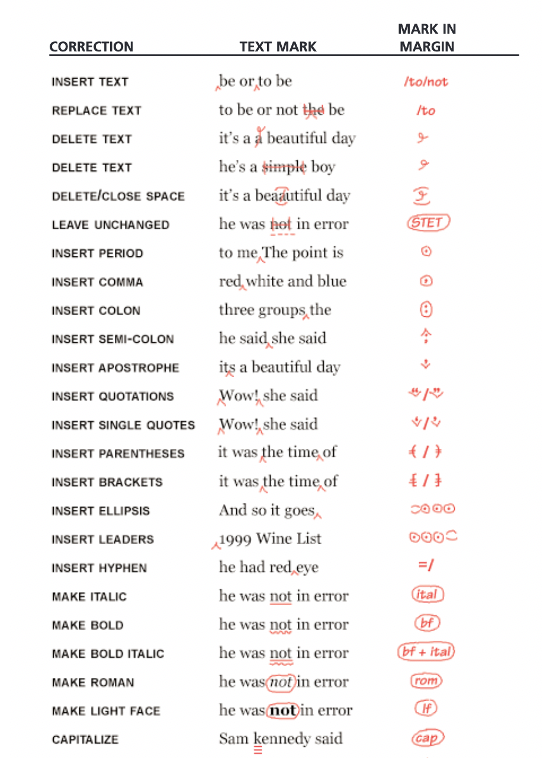
Actually, it was much longer… and I didn’t really need to memorize it. After all, I was no longer in school, and although my boss was the boss of me, I just kept the crib sheet handy. Eventually I learned by heart (and use) most, if not all, the marks.
Then along came the 21st century, and with it, a famous, important. earth-shattering invention.
No, not Facebook. Adobe Acrobat. Cue the boo-birds, who have every right to boo. I’m on your side! Although I’m also the first to admit that Acrobat and InDesign / InCopy are much better options than the old Quark software.
I know Adobe products came out before the year 2001, but they were basic, not-very-useful versions of what has now become the industry standard.
No longer did we have to write and write and write for hours by hand when copyediting an entire Teacher Guide, and risk cramping up and getting carpal tunnel syndrome. Now we could simply cramp up and develop carpal tunnel syndrome by typing and typing and typing on the computer.
Much more effective and technologically advanced!
In any case, Adobe Acrobat has developed myriad tools to allow you to edit and proofread documents digitally.

And allows one to showcase the Liar Paradox in a very elegant way:
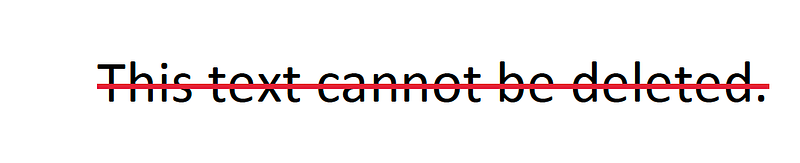
This not only saves time, but also paper, and fuel… much to the chagrin of FedEx and other companies. Unfortunately, it also makes publishers more impatient. Deadlines dwindled from years to months. Sometimes weeks, for small projects.
I have a theory, and I call it Kotzer’s Law of Publishing. Books are being turned around, from scratch, quicker and quicker every year and decade that goes by. Which means one day an entire book — from conception to published edition — will be created in a single day.
Here’s an odd thing to consider. Being that the New York Times is a newspaper, and for centuries newspapers used to correct things by hand and use proofreader symbols in the process of doing so… how is it possible that the editors of the Spelling Bee decided that the word dele is a dord*?
You can check out my previous entry on another dord* here:
*What the heck is a dord, you ask? Here’s the answer: