
Ilmenite
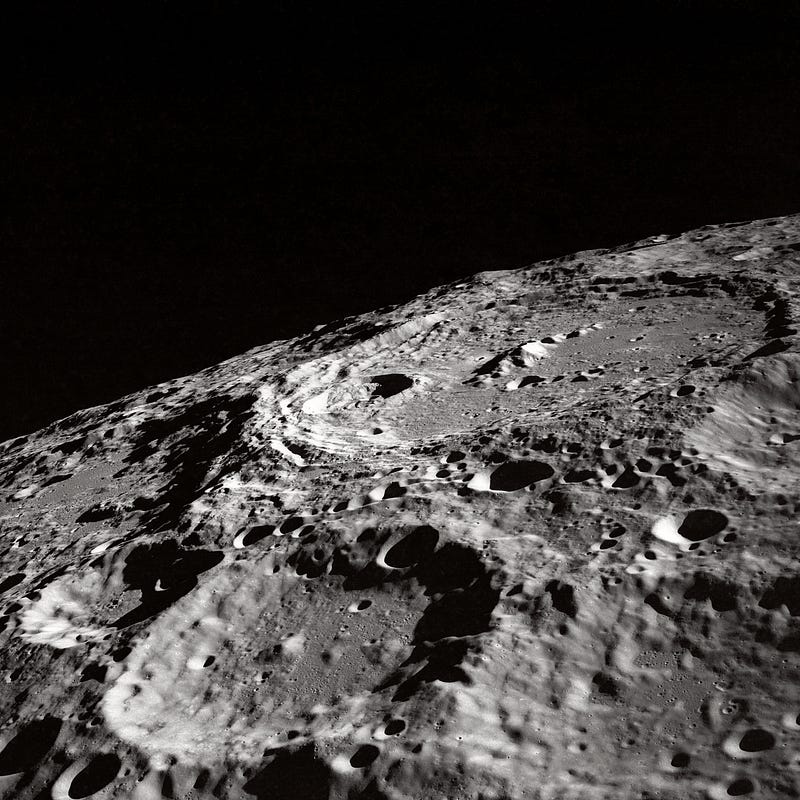
This mineral could help us live on the Moon
Today’s New York Times Spelling Bee letters:
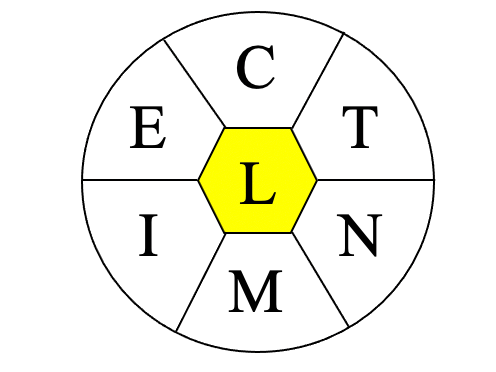
C, E, I, M, N, T, and center L (all words must include L)
Merriam-Webster says…
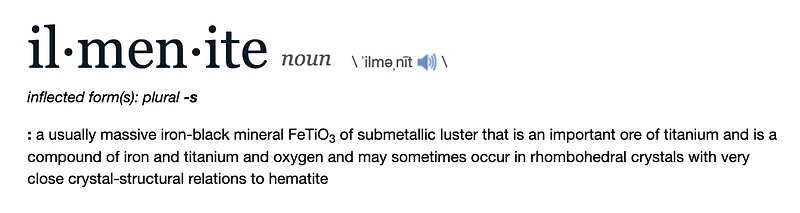
Silly little dictionary! Don’t you know ilmenite can’t possibly be a word if the New York Times says it ain’t?
For further fascinating facts, check out the Spelling Bee Master.
What’s your favorite dord* from today’s puzzle?
My Two Cents
It’s human nature to take things for granted. Especially things we experience on a daily basis and have come to assume that are “just there”. Titanium dioxide is one of them. Bet you weren’t expecting me to use that as an example!
Perhaps you thought I was going to talk about indoor plumbing, electricity, the internet, Tom Brady winning a Super Bowl…
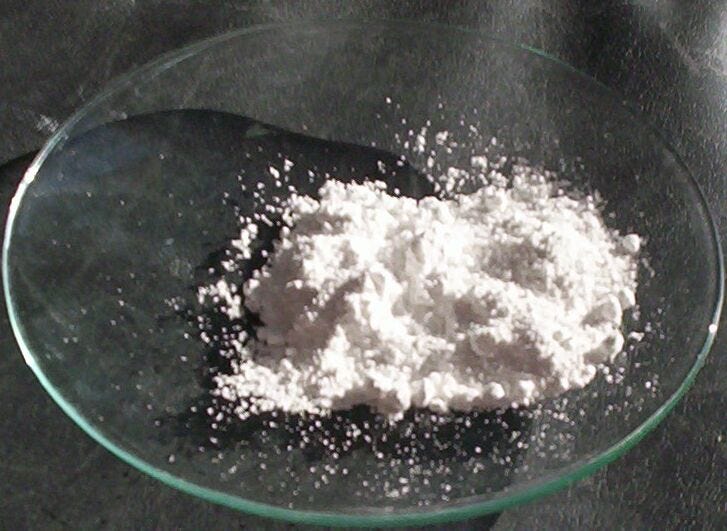
No, it’s not cocaine — although that is also taken for granted, especially when discussing anything that happened in the 1980s. The photo is showing some titanium dioxide in dust form. I have no idea what would happen if you snorted it, so I’ll refrain from suggesting you become the next Tik Tok sensation by doing just that.
Here, there, everywhere
Ate any food with coloring in it lately? Went to the beach and applied sunscreen? Painted your home or your office? You probably used titanium dioxide.
According to a 2018 article by Bloomberg, titanium dioxide “accounts for almost two-thirds of the pigments produced globally”. This chemical compound makes your toothpaste bright white, helps powder the doughnuts Chief Clancy Wiggum munches on, and makes the zebra crossing contrast sharply with the asphalt on which it’s painted.
In fact, titanium dioxide has been the most widely used white pigment for decades because of its brightness and high refractive index. It’s also used in ceramic glazes, tattoo pigment, cosmetics and other skin products, sunscreen (where it’s considered to be less harmful to coral reefs than other alternative ingredients), special optical mirrors, and even to coat certain medicinal tablets and pills.
Titanium dioxide comes mostly from three different minerals: rutile, anatase, and ilmenite, our daily dord*.
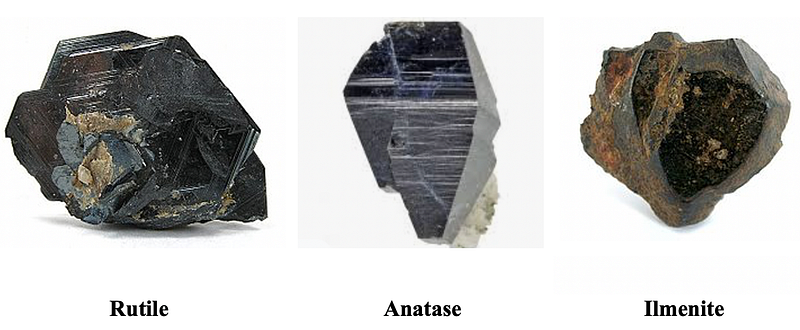
Ilmenite is the main source of titanium dioxide.
Wikipedia explains that “ilmenite crystallizes in the trigonal system. The ilmenite crystal structure consists of an ordered derivative of the corundum structure; in corundum all cations are identical but in ilmenite Fe2+ and Ti4+ ions occupy alternating layers perpendicular to the trigonal c axis. Containing high spin ferrous centers, ilmenite is paramagnetic.”
Now, I have no clue what that means, but it is interesting to look at.
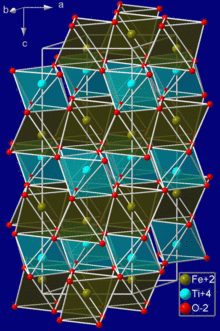
It’s reminiscent of an Escher drawing:

The mineral was discovered by William Gregor in 1791 in a stream close to the English village of Manaccan in Cornwall. For that reason ilmenite is sometimes also referred to as manaccanite. The name ilmenite, according to the dictionary, comes from German Ilmenit, from the Ilmen range in the Ural Mountains of Russia.
Ilmenite most often contains appreciable quantities of magnesium and manganese and the full chemical formula can be expressed as (Fe,Mg,Mn,Ti)O3. Ilmenite forms a solid solution with geikielite (MgTiO3) and pyrophanite (MnTiO3) which are magnesian and manganiferous end-members of the solid solution series.
Did you understand that? Well, I didn’t either. But look how pretty ilmenite is under natural light!
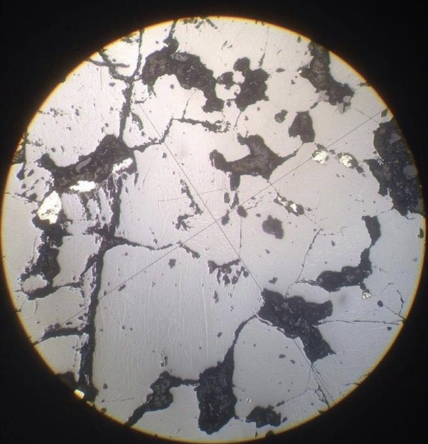
Furthermore, I found this about ilmenite: “Ilmenite is a common accessory mineral found in metamorphic and igneous rocks. It is found in large concentrations in layered intrusions where it forms as part of a cumulate layer within the silicate stratigraphy of the intrusion. Ilmenite generally occurs within the pyroxenitic portion of such intrusions (the ‘pyroxene-in’ level).”
That sounds complicated. Let’s take another look at ilmenite, this time under polarized light:
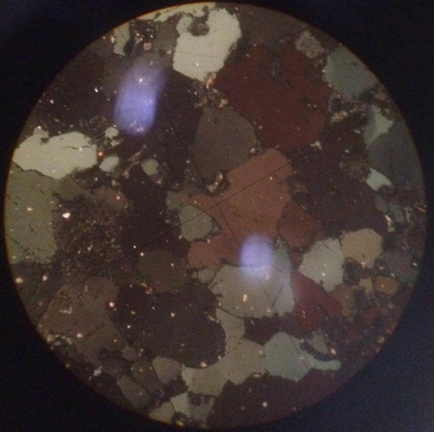
In conclusion, this mineral is hard on the brain but easy on the eyes.
Fly me to the moon…
When the Apollo mission astronauts came back to Earth in the late 1960s and early 1970s, they brought with them a treasure trove of conspiracy theories… and some moon rocks. Now, I’m sure you thought I was going to say that those moon rocks had ilmenite in them.
Gotcha!
It was actually in the soil samples.
Some forty years later the New York Times reported that a new type of rock was discovered on our one and lonely natural satellite. It was done by the Chinese in 2013 when their Chang’e-3 spacecraft landed on the moon in the first unmanned mission since the days of Apollo. Now, the confirmation of ilmenite was done through spectrometers, but a few years later, the Chang’e-5 mission brought actual samples to be analyzed.
In any case, scientists seem certain there is ilmenite on the Moon. And why is this good? (Well, aside from being pretty, of course, as we saw earlier.)
Ilmenite on the Moon could be mined to extract oxygen, hydrogen, and helium. Those gases could be used to produce air and water, and their combustibility would provide electricity. In an interview with BBC News in 2005, Professor Colin Pillinger had this to say: “You’d also want to use lunar rocks as building supplies — it is so costly to lift even an extra kilo of steel into space, running to many hundreds of thousands of dollars.”
But I would take Professor Pillinger’s words with a grain of salt. After all, he was the head of the ill-fated Beagle 2 mission to Mars.
Here’s yet another pretty picture to gaze at:
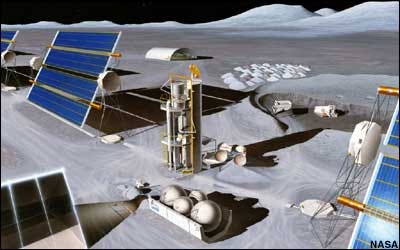
The above image of an oxygen-production plant on the Moon looks really cool, doesn’t it? The main reason it looks really cool is because it’s a really cool artist’s impression of what a really cool oxygen-production plant on the Moon would look like.
But we’ll never end up having a moon base, will we? I mean, I’ve been waiting most of my life for it, and the best I got was a 1970s TV show about one and two billionaires now competing to see which of them can spend more money to see the curvature of the Earth and spend a few seconds weightless.
Wait a second. The curvature of the Earth? Isn’t our home planet flat, according to conspiracy theorists? If so, maybe the reason we can’t have a moon base is that the Moon itself is an optical illusion.
Right…?
I guess finding ilmenite on the Moon wasn’t enough for the New York Times. Or perhaps it was the complicated, technical explanations about it that they found off-putting. In any case, the editors of the Spelling Bee clearly think that ilmenite is a dord*.
You can check out my previous entry on another dord* here:
*What the heck is a dord, you ask? Here’s the answer: