
Littleneck
Yet another pangram canceled by the Spelling Bee
Today’s New York Times Spelling Bee letters:
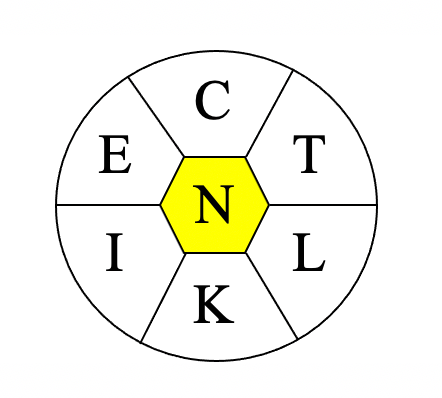
C, E, I, K, L, T, and center N (all words must include N)
Merriam-Webster says…
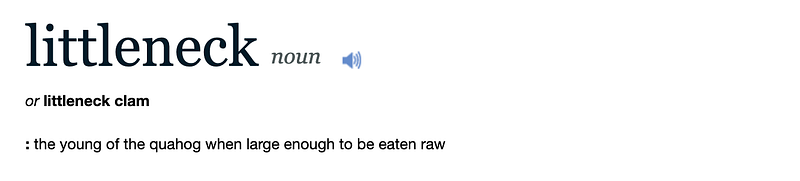
Silly little dictionary! Don’t you know that littleneck can’t possibly be a word if the New York Times says it ain’t?
For further fascinating facts, check out the Spelling Bee Master.
What’s your favorite dord* from today’s puzzle?
My Two Cents
I was surprised that incel was rejected as a word in today’s puzzle. Even though this word had spent most of its lexicographic days since 1999 in obscurity, it had become more known and widespread for unfortunate reasons.
I hope the editors of the Spelling Bee continue to reject incel — at least once more, please — so that next time it shows up I can write about it. It’s just that today I also encountered littleneck, which, as a pangram, trumps incel. (And when I say trump, I am not making a veiled reference… although by writing about not making a veiled reference, I have just made a pretty unveiled reference.)
What is a pangram? It has a few definitions, but in Spelling Bee lingo, a pangram refers to any word that contains all seven letters of the puzzle at least once. The rules of the game allow letters to be used more than once in words. So, in today’s puzzle, littleneck is a pangram because it contains each of today’s letters (c, e, i, k, l, t, n) at least once, with the letters “e”, “l”, and “t” appearing twice. (You’re allowed to repeat letters as many times as you want in order to create words.)
In case you’re still working on today’s puzzle, I won’t spoil it by listing the other pangram(s).
Why are pangrams a big deal? Because they are worth a lot of points. You get one point per letter for every word that has five or more letters, plus a bonus of 7 points for a pangram. And since a pangram has at least seven letters, you will get at least 14 points if you find one. Littleneck is worth: 10 points (ten letters) + 7 bonus points = 17 points.
I think I speak for most of us Spelling Bee enthusiasts when I say one of our greatest frustrations is finding a pangram and seeing the “Not in word list” sign pop up.
Clam up
Our friends at Merriam-Webster tell us that littlneck has been in use since 1883 and that the term originated from Littleneck Bay on Long Island, New York.
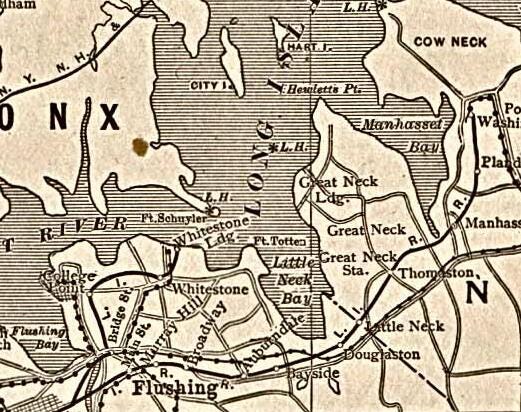
Although as you can see, Little Neck was spelled as two words. So why was that place chosen as the name for this type of quahog? I’m not sure. Maybe that bay had a lot of littlenecks, as opposed to the other type of quahogs. Which brings us to…
Quahog.
To many fans of pop culture (myself included), that word immediately brings to mind this:

That is the Griffin family, stars of the animated TV show Family Guy, which since 1999 has been making many people laugh — and others complain — at their very edgy and politically incorrect jokes.
The show takes place in the fictional town of… wait for it… Quahog, in the New England state of Rhode Island. Peter and his three best friends spend a lot of time drinking at the local bar called The Drunken Clam. Which is what a Quahog is. Well, except for the “drunken” part.
The quahog is also known as the hard clam, is a modification of the Narragansett word poquaûhock. The official scientific name is Mercenaria mercenaria, or “double mercenary”. I think that’s because way back when clams used to work as the hitmen for hire of the seacoasts. But don’t take my word for it. I like to be creative sometimes and make up stories.
What I’m not making up is the variety of names for quahog sizes: the smallest that you can legally harvest (or dig for) are the countnecks or peanuts; then, in increasing size, come the littlenecks, the topnecks, the cherrystones, and finally the largest, which are simply called quahogs or chowder clams.
The terms littleneck and topneck bring back fond memories of my time living in Queens, New York. There is a fantastic seafood restaurant on Woodhaven Boulevard called London Lennie’s. Here is their story, as told on their website:
Our tradition of… selecting our fish and seafood began in 1959 when my father, Leonard “Lennie” Barnes, first opened the door to our family restaurant here in Rego Park, Queens. He first discovered his love of fresh fish and seafood during a seafaring stint in the Merchant marine, which brought him to local fish markets across the globe… For over 50 years, we are honored to have become a tradition among your dining alternatives.
So if you’re ever in Queens wondering what to have for dinner, try London Lennie’s. They have an excellent raw bar, if you’re into that. And, of course, their raw bar includes littleneck and topneck clams, although they also spell them as two words. Hmmm…
Happy as a clam
I find idiomatic expressions very interesting, especially across languages. It’s usually when you learn another language — or find out about an idiom from that language— that you realize what it literally means. Many expressions in English and Spanish that I grew up with never seemed silly or absurd to me because I had always heard them, understood their figurative meaning, and never gave much thought to what the actual words meant when strung together.
When I took French lessons many years ago, I was fascinated by the numbers between 70 and 99. Up to 60, French follows a pattern recognizable to most speakers of English and Romance languages (and possibly other languages that I don’t know how to count in). So, 23 is vingt-trois, literally “twenty-three”. And 61 is soixante et un, which means “sixty and one”.
Fast forward to 75… soixante quinze. That is not “seventy-three” or even “seventy and three”. It’s “sixty-fifteen”. Basically what happens after 69 is you start adding and multiplying numbers. The number 80 is quatre-vingts, or “four-twenties”. Why? That’s a matter for another article. I’ve strayed far enough today. But before we get back to clams, I’ll leave you with my favorite French number, 99: quatre-vingt-dix-neuf. “Four-twenties (plus) ten and nine”.
Back to idioms. In Spanish we say “más aburrido que una ostra”. More boring/bored than an oyster. Why is this saltwater bivalve mollusk boring (or bored), while clams tend to be on the happier side? Perhaps clams are more social? Or, if you believe my earlier theory about quahogs being the hitmen of the sea, maybe that job has a high satisfaction rate for them.
So why the expression “happy as a clam”? Well, the original one had an added element.
Clams usually hang out in shallow ocean waters. During low tide, when the ocean recedes from the shore, clams are exposed to predators. On the other hand, high tides protect clams, which probably makes them “happy”. They don’t get eaten raw or thrown into a chowder for at least another day. Apparently sailors and shellfish gatherers started using the expression “happy as a clam in the mud at high tide”.
That original idiom was cut in half around the 19th century. As a result, foreign-language learners probably think American clams have smiley faces or something like that.
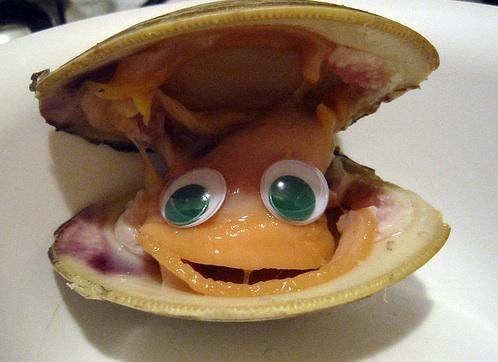
Don’t worry, London Lennie’s removes the eyes before they serve you the clam. I guarantee it.
So that’s that. But before I end with my usual rant, I wanted to briefly discuss the Venerupis philippinarum, or Japanese littleneck clam. Why? For two reasons.
(1) It’s also called a “littleneck”.
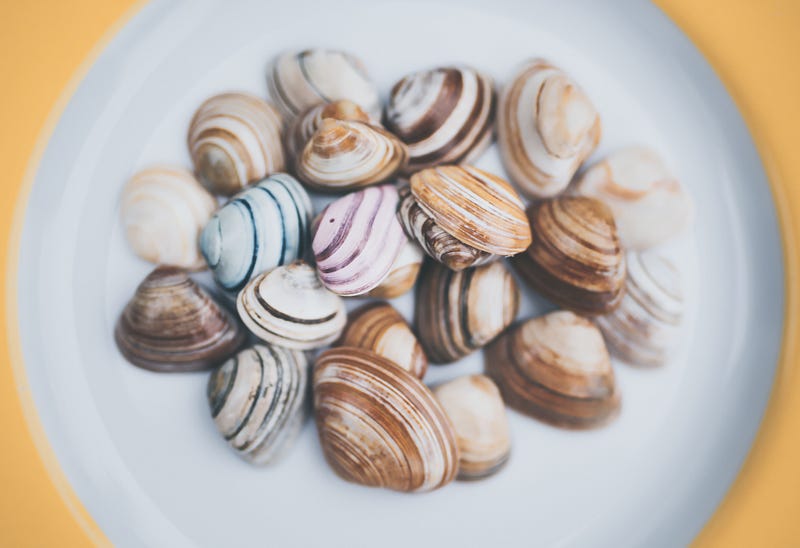
(2) I get to post this pretty picture of the variety of shell colors and patterns this clam is known for.
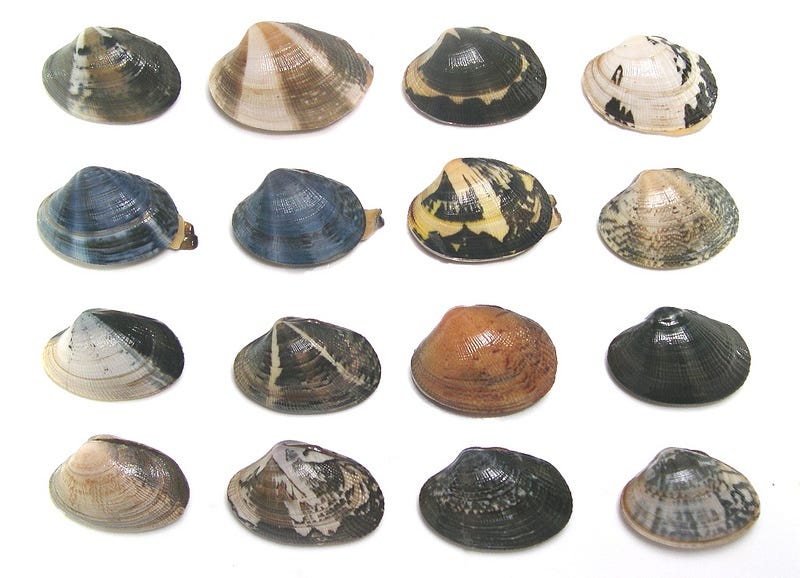
So here’s my rant to end the column. Despite the fact that the dictionary tells us that littleneck is one word, and despite the fact that it is a valuable pangram worth 17 points… the editors of the Spelling Bee decided that littleneck is a dord.*
You can check out my previous entry on another dord* here:
*What the heck is a dord, you ask? Here’s the answer: