
Gobo
Not quite the opposite of a BOGO sale

Today’s New York Times Spelling Bee letters:
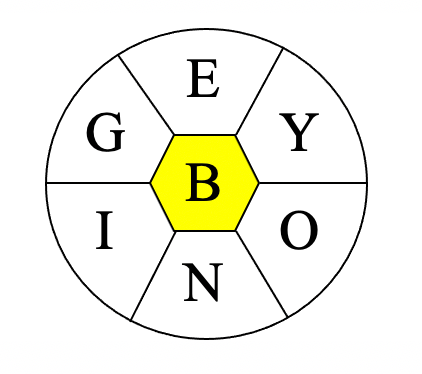
E, G, I, N, O, Y, and center B (all words must include B)
Merriam-Webster says…
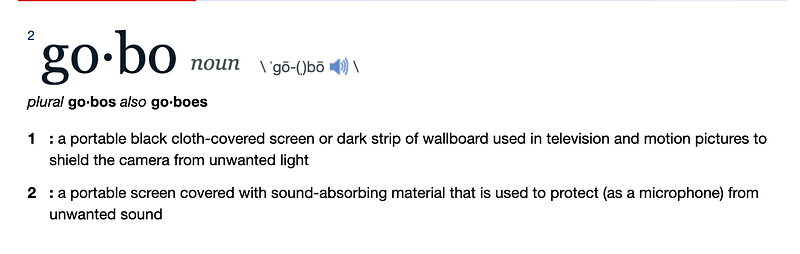
Silly little dictionary! Don’t you know that gobo can’t possibly be a word if the New York Times says it ain’t?
For further fascinating facts, check out the Spelling Bee Master.
What’s your favorite dord* from today’s puzzle?
My Two Cents
Don’t you love it when one word has many different meanings? One of the best examples is, of course, run, whose entry in some printed dictionaries could run — bad pun intended — a few pages long.
Gobo gets nowhere near run as far as number of definitions is concerned, but it’s not a lightweight word, either.
As a keen reader of my column, I’m sure you noticed the superscript 2 in front of gobo in the screenshot above. When words have meanings that are not at all related (or even with different parts of speech), most dictionaries number them in separate semi-quasi-entries. So here is entry 1 for gobo:
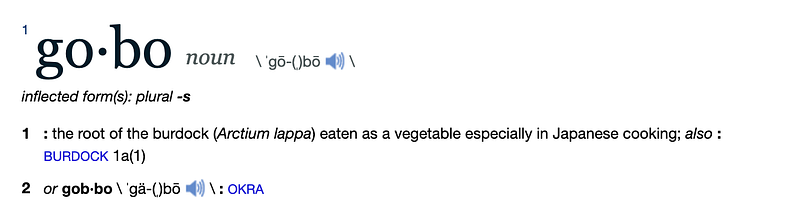
There are a few other things named gobo that do not appear in the dictionary:
▹ A commune, or third-level unit of administration, in Cameroon
▹ A city in Japan, known for manufacturing mahjong tiles and dice, as well as the city’s eponymous rail station
▹ One of the characters in the Fraggle Rock television show
▹ A Linux distribution
▹ One of Bambi’s twin cousins, from the original Austrian novel, Bambi, a Life in the Woods, which inspired the Disney movie.
Now, I understand that the Spelling Bee can’t accept any of the above because they are proper nouns, or names, so let’s move on the gobos with a lowercase “g”.
Audiovisual gobo
Although the function of gobos in the movie/theater/photography industry is not exactly the opposite of their use in the radio business, they are not as similar as one would have thought based on the fact the objects share a name.
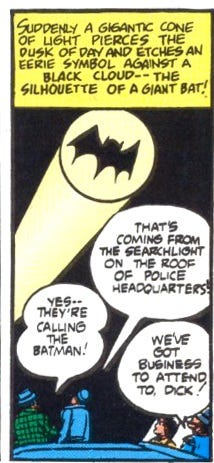
A gobo is placed inside or in front of a light source to control the shape of the emitted light and its shadow. In photography, especially studio photography, gobo usually refers to one of two things. Any object that casts a shadow when placed in front of a light source, or equipment that goes in front of a light (such as a gobo arm or gobo head), presumably to hold the gobo in place, if it’s a flat sheet.
I say “if” because, technically speaking, you can use three-dimensional objects as gobos. A plant, your cat, your roommate… but ask permission first. Especially from the cat.
Photography Skool explains this:
In photography, a GoBo or a “Go-Between Object” can be introduced to add contrast and interest to a flat scene by way of a shadow pattern. It is a subtractive device that cuts out light from the light source with opaque elements that create shadows on the background, floor or the subject itself… A gobo is any object that goes between a light source and the subject to project a shadow pattern. It creates mood, drama or story in a scene. Cut out a pattern in an opaque material. Place the gobo between the light and the subject. Focus the pattern by using a lens or moving the light source.
In the movie industry, gobos are (or were) typically used in film noir and horror.

In theatrical lighting, the term gets a bit more specific and technical. Gobos are sheets — made of glass, steel, cloth, etc. — inserted at one of two points between the lamp and the lens(es).
Gobos are used in nightclubs, weddings, and even corporate events, typically to display the company’s logo. It’s likely you’ve come across one when attending any of the above, but didn’t give it a second thought. Now you know and can show off by pedantically explaining how that light effect is produced. Just please mention Silly Little Dictionary! so I can add a few cents to the couple of bucks this column generates monthly.
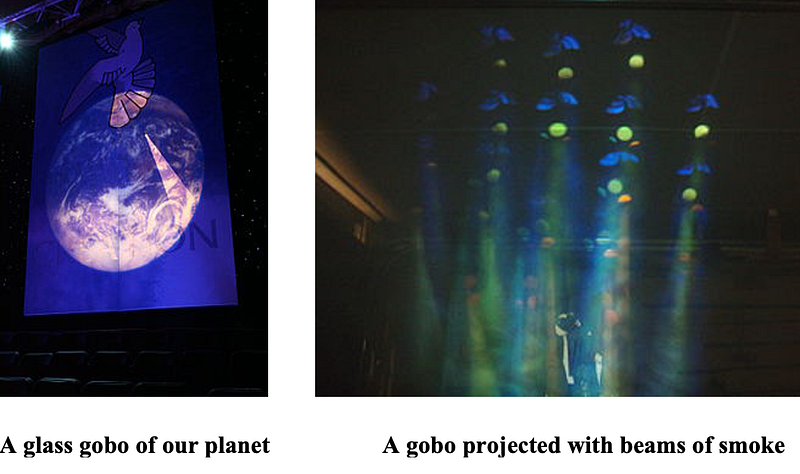
And then there’s this, one of the most famous gobos in pop culture:
In the radio industry, gobos are used in an entirely different way. They are panels placed strategically for sound isolation. For example, a recording engineer might put a gobo between two musicians to so that their microphones don’t interfere with each other, allowing them to play near each other.
Gobo panels absorb and diffuse sound waves and they can reduce unwanted reverberation. They are typically built to be transported, moved, and stored in a convenient manner. For example:
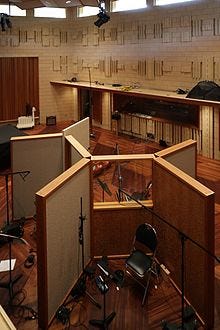
A typical gobo is made of one or more wooden panels covered with foam, carpeting or other materials that can dampen sound.
As Photography Skool noted, gobo may have originated as a shortening of the phrase “go-between”. Other theories claim the original term was ‘go-before’, or that it is an acronym for “goes before optics” or “goes between optics”. However, these are likely backronyms, or acronyms formed from existing words. A well-known case of a backronym is the Amber Alert, originally named after Amber Hagerman, the 9-year-old who was kidnapped and murdered in 1996. Amber was later turned into “America’s Missing: Broadcast Emergency Response”.
Edible gobo
Arctium lappa, commonly called gobō in Japanese (牛蒡/ゴボウ), edible burdock, beggar’s buttons, thorny burr, or happy major, is a Eurasian plant cultivated in gardens for its root used as a vegetable. However, in North America, Australia, and a few other countries it is considered an invasive species.
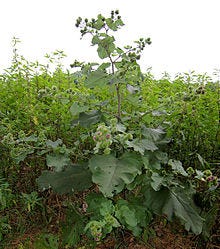
The leaves are much bigger than the above photo may lead you to believe. Look:
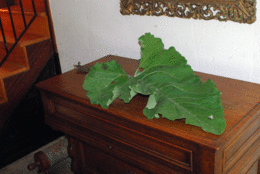
According to botanical.com, it be eaten and has medicinal properties.
The dried root from plants of the first year’s growth forms the official drug, but the leaves and fruits (commonly, though erroneously, called seeds) are also used. The roots are dug in July… they are 12 inches or more in length and about 1 inch thick, sometimes, however, they extend 2 to 3 feet... Burdock root has a sweetish and mucilaginous taste. Burdock leaves, which are less used than the root, are collected in July… They have a somewhat bitter taste. The seeds (or fruits) are collected when ripe. They are brownish-grey, wrinkled, about 1/4 inch long and 1/16 inch in diameter. They are shaken out of the head and dried by spreading them out on paper in the sun.
Gobo is used in Japanese cuisine to make a variety of dishes, including this salad:
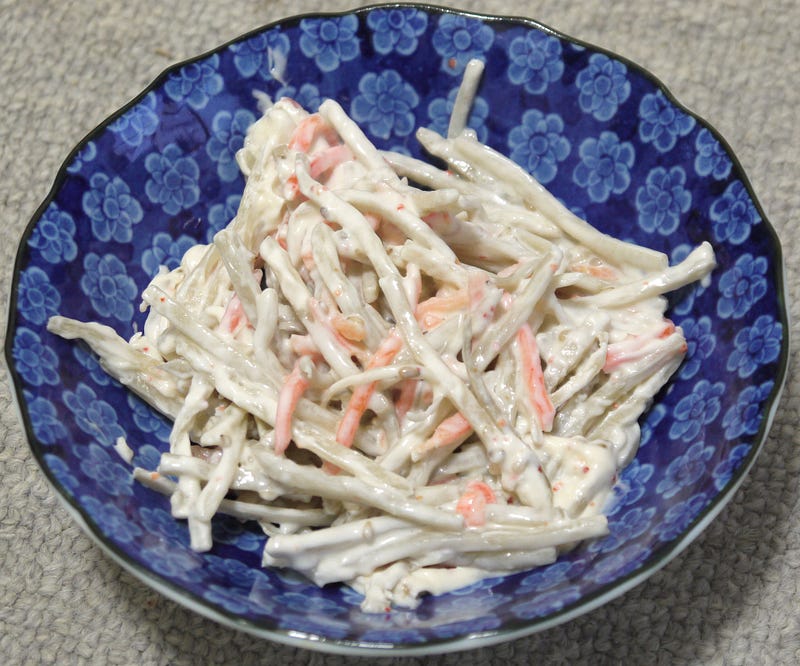
That actually looks interesting and yummy. And now, I’m hungry…
What’s left to say today? Not much, except that despite gobo’s incredible versatility as a word… the editors of the Spelling Bee, who have decided it’s a dord.*
You can check out my previous entry on another dord* here:
*What the heck is a dord, you ask? Here’s the answer: