ae on wooden frames was borrowed from famous Japanese paper-making industry.”</p></blockquote><p id="9a55">This is a sheet of <i>nori</i> — well, actually, a few of ‘em.</p><figure id="820f"><img src="https://cdn-images-1.readmedium.com/v2/resize:fit:800/0*2XkXgPlZKPIeq1yd.jpg"><figcaption></figcaption></figure><p id="552e">And this is what one of them sheets looks like under 200x magnification:</p><figure id="8524"><img src="https://cdn-images-1.readmedium.com/v2/resize:fit:800/0*-Ukwqu16KGjvyjzK.jpg"><figcaption>Photo by Photon 400 750, own work</figcaption></figure><p id="91e8">If you blow this up on a 12 x 12-foot canvas, you can probably sell it at a gallery a la <a href="https://en.wikipedia.org/wiki/Allan_McCollum">Allan McCollum</a>.</p><p id="923b">This beautiful painting shows someone toasting the <i>nori</i> sheet to dry it:</p><figure id="7013"><img src="https://cdn-images-1.readmedium.com/v2/resize:fit:800/0*XN5cRTAUTRh6HP35.jpg"><figcaption></figcaption></figure><p id="cc9d">Nowadays this is done industrially. In fact, <i>nori</i> production and processing are considered an advanced form of agriculture. However, if you prefer, you may imagine that the <i>nori</i> wrapping your food at the local sushi bar was made in a similar idyllic scene like the one depicted above.</p><p id="0769">And speaking of wrapping dishes, here are two typical ones involving <i>nori</i>.</p><figure id="c664"><img src="https://cdn-images-1.readmedium.com/v2/resize:fit:800/1*tzyGoBiruLw_NQfonunfWQ.png"><figcaption>Screenshot collage by Iva Reztok</figcaption></figure><p id="659b">The six rolls on the left are <b>norimaki</b>, which refers to any item wrapped in <i>nori</i>. In this case, <b>sushi</b>. The two items on the right are <b>onigiri</b>, filled balls of rice wrapped in <i>nori</i>. Although norimaki and onigiri are often confused, they are not interchangeable. Onigiri is made with plain white rice, while sushi is white rice <a href="https://www.wikihow.com/Make-Sushi-Rice">combined with</a> vinegar, sugar, and salt.</p><p id="f69a">That’s right. <i>Sushi</i> does not refer to the seafood, but to the staple grain. How old were you when you find out? I’m not afraid to admit I was way way into adulthood when someone explained that to me. Like… last week. Kidding. But I do think I was in my thirties.</p><p id="bca0">Now, to make my point clear about the word <i>nori</i>, I want you to know that, at least in the U.S., the product began to be widely imported from Japan in the 1960s. It was sold not only in Asian-American grocery stores, but also at natural food markets thanks to the growing macrobiotic movement.</p><p id="86f8">Then, in the 1970s, sushi bars themselves became popular in the States, a fact I can attest to despite not having grown up there and having been born in the 1970s. How? Well, there is a 1978 <i>Columbo</i> <a href="https://www.imdb.com/title/tt0075865/">episode</a> in which the unflappable detective visits the home of the murderer while he is having a sushi dinner. There are even geishas included!</p><p id="b01f">In conclusion, Americans have been exposed to the word <i>nori</i> for at least fifty or sixty years.</p><h2 id="8922">Pretty big in Wales</h2><p id="eb9f">Did you know <i>nori</i> is quite popular in Wales and Ireland? Turns out thousands of years ago the original inhabitants of Japan traveled by boat to what is now Great Britain and settled there, mixing in with the locals. That’s why Welsh and Irish languages resemble the Japanese spoken long ago, and why whisky is drunk in Ireland. Turns ou
Options
t it’s an invention from the land of the rising sun.</p><p id="5344">Except for the first sentence, the above paragraph is a load of crap. So why did I write it? To prove a point. And that point is… well, I’m not sure anymore, but I promise there was one when I started crafting this thing in my mind.</p><p id="e361">The <b>laver seaweed</b> is a red algae that belongs to the genus <i>Porphyra</i>. Interestingly, many <i>Porphyra</i> species were originally classified as <i>Pyropia</i>, the genus from which <i>nori</i> is made. So there is some connection between laverbread and sushi.</p><p id="949f">The British seaweed is found around the west coast of the island and the coasts of Ireland, where it is called <b>sleabhac</b>.</p><p id="a061">Despite its name, laverbread is not a bread, although it is typically served with toast.</p><figure id="44d1"><img src="https://cdn-images-1.readmedium.com/v2/resize:fit:800/0*dDZr1lRUtOA38xBm.JPG"><figcaption></figcaption></figure><p id="a8d8">In the above photo, the laverbread is the greenish glop in the middle. This traditional Welsh delicacy is made by mincing or pureeing the seaweed after boiling it. Sometimes that end product is coated in oatmeal. As part of a healthy Welsh breakfast, laverbread is eaten with bacon and cockles (the mollusks).</p><p id="d122">And when I said “healthy” I wasn’t being my usual sarcastic self. Because seaweed is its main ingredient, laverbread has tons of protein, iron, iodine, and vitamin B12.</p><p id="3f7b">Next time you visit Wales, don’t forget to try what actor <a href="https://www.imdb.com/name/nm0000009/">Richard Burton</a> called “the Welshman’s caviar”. But don’t hold that quote against him. I’m sure he meant to include Welshwomen and other Welshpeople, too.</p><p id="b127">What’s clear today is that you can eat as much sushi in as many different restaurants as you’d like, you can even prepare it at home, you can go to Wales and chomp on <i>bara lafwr</i> to your heart’s content… but it won’t make a difference to the editors of the Spelling Bee, who have declared that the word <i>nori</i> is a <a href="https://www.merriam-webster.com/words-at-play/dord-a-ghost-word"><b>dord</b></a><b>.</b></p><p id="d9c8">You can check out my previous entry on another <b>dord </b>here:</p><div id="2414" class="link-block">
<a href="https://readmedium.com/lethe-633cc7a8959">
<div>
<div>
<h2>Lethe</h2>
<div><h3>Can we forgive the Spelling Bee for forgetting about this word?</h3></div>
<div><p>medium.com</p></div>
</div>
<div>
<div style="background-image: url(https://miro.readmedium.com/v2/resize:fit:320/0*gk4HeCGQLl82NFOl)"></div>
</div>
</div>
</a>
</div><p id="f727">*What the heck is a <b>dord, </b>you ask? Here’s the answer:</p><div id="0038" class="link-block">
<a href="https://www.merriam-webster.com/words-at-play/dord-a-ghost-word">
<div>
<div>
<h2>'Dord': A Ghost Word</h2>
<div><h3>One of the questions people like to ask lexicographers is this: Can you sneak something into the dictionary? Can you…</h3></div>
<div><p>www.merriam-webster.com</p></div>
</div>
<div>
<div style="background-image: url(https://miro.readmedium.com/v2/resize:fit:320/0*-igozcJUkcCQ4SSM)"></div>
</div>
</div>
</a>
</div></article></body>
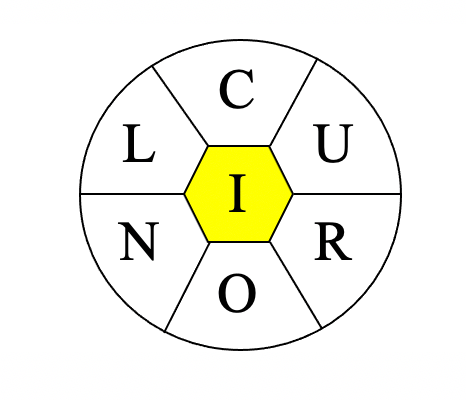
Do I really have to ask this rhetorical question, Spelling Bee editors? Nori? Really? Nori? You don’t think people who play the New York Times Spelling Bee game (and are probably crossword puzzle solvers, to boot) are familiar with the word nori?
The nori question has been thumping in my head since this morning; my mind sounds like Jim Mora in 2001 saying “playoffs”:
Big in Japan
The word nori is, of course, borrowed from Japanese. The dictionary records the year of its first use as 1892, but I assume they mean “first use in English”, as I’m sure the Japanese had been speaking the word for centuries if not millennia.
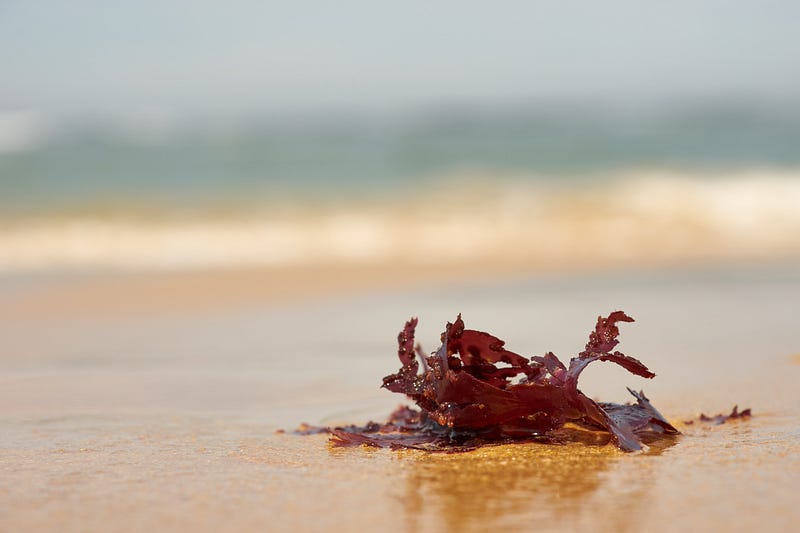
In simple terms, nori is an edible seaweed made into thin sheets using a process similar to traditional paper-making.
The seaweed is a species of red algae from the genus Pyropia, especially Pyropia yezoensis and Pyropia tenera. As Hiroko Shimbo explains in The Japanese Kitchen: 250 Recipes in a Traditional Spirit:
“Unlike wakame, kombu, and hijiki, which are sold in the form of individual leaves, nori is sold as a sheet made from small, soft, dark brown algae, which have been cultivated in bays and lagoons since the middle of the Edo Era (1600 to 1868). The technique of drying the collected algae on wooden frames was borrowed from famous Japanese paper-making industry.”
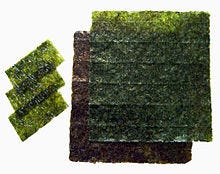
This is a sheet of nori — well, actually, a few of ‘em.
And this is what one of them sheets looks like under 200x magnification:
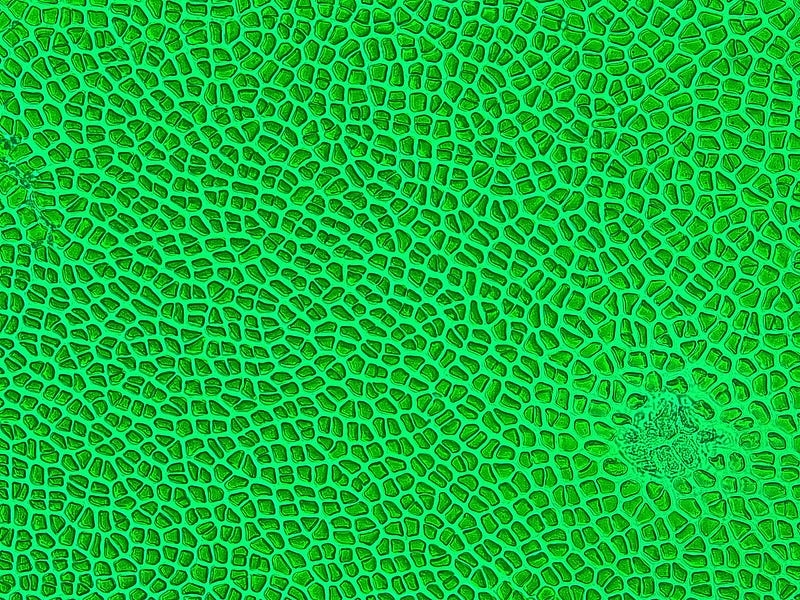
Photo by Photon 400 750, own work
If you blow this up on a 12 x 12-foot canvas, you can probably sell it at a gallery a la Allan McCollum.
This beautiful painting shows someone toasting the nori sheet to dry it:

Nowadays this is done industrially. In fact, nori production and processing are considered an advanced form of agriculture. However, if you prefer, you may imagine that the nori wrapping your food at the local sushi bar was made in a similar idyllic scene like the one depicted above.
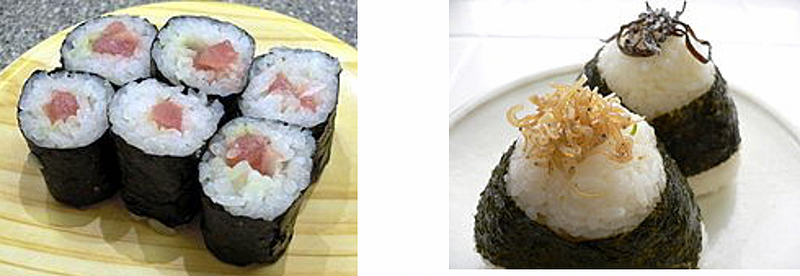
And speaking of wrapping dishes, here are two typical ones involving nori.
Screenshot collage by Iva Reztok
The six rolls on the left are norimaki, which refers to any item wrapped in nori. In this case, sushi. The two items on the right are onigiri, filled balls of rice wrapped in nori. Although norimaki and onigiri are often confused, they are not interchangeable. Onigiri is made with plain white rice, while sushi is white rice combined with vinegar, sugar, and salt.
That’s right. Sushi does not refer to the seafood, but to the staple grain. How old were you when you find out? I’m not afraid to admit I was way way into adulthood when someone explained that to me. Like… last week. Kidding. But I do think I was in my thirties.
Now, to make my point clear about the word nori, I want you to know that, at least in the U.S., the product began to be widely imported from Japan in the 1960s. It was sold not only in Asian-American grocery stores, but also at natural food markets thanks to the growing macrobiotic movement.
Then, in the 1970s, sushi bars themselves became popular in the States, a fact I can attest to despite not having grown up there and having been born in the 1970s. How? Well, there is a 1978 Columboepisode in which the unflappable detective visits the home of the murderer while he is having a sushi dinner. There are even geishas included!
In conclusion, Americans have been exposed to the word nori for at least fifty or sixty years.
Pretty big in Wales
Did you know nori is quite popular in Wales and Ireland? Turns out thousands of years ago the original inhabitants of Japan traveled by boat to what is now Great Britain and settled there, mixing in with the locals. That’s why Welsh and Irish languages resemble the Japanese spoken long ago, and why whisky is drunk in Ireland. Turns out it’s an invention from the land of the rising sun.
Except for the first sentence, the above paragraph is a load of crap. So why did I write it? To prove a point. And that point is… well, I’m not sure anymore, but I promise there was one when I started crafting this thing in my mind.
The laver seaweed is a red algae that belongs to the genus Porphyra. Interestingly, many Porphyra species were originally classified as Pyropia, the genus from which nori is made. So there is some connection between laverbread and sushi.
The British seaweed is found around the west coast of the island and the coasts of Ireland, where it is called sleabhac.
Despite its name, laverbread is not a bread, although it is typically served with toast.
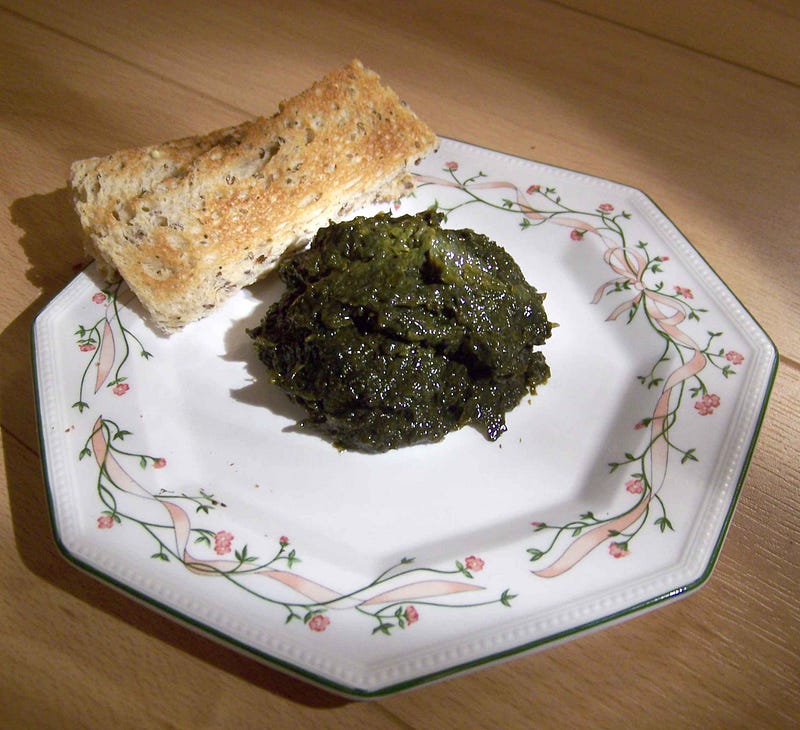
In the above photo, the laverbread is the greenish glop in the middle. This traditional Welsh delicacy is made by mincing or pureeing the seaweed after boiling it. Sometimes that end product is coated in oatmeal. As part of a healthy Welsh breakfast, laverbread is eaten with bacon and cockles (the mollusks).
And when I said “healthy” I wasn’t being my usual sarcastic self. Because seaweed is its main ingredient, laverbread has tons of protein, iron, iodine, and vitamin B12.
Next time you visit Wales, don’t forget to try what actor Richard Burton called “the Welshman’s caviar”. But don’t hold that quote against him. I’m sure he meant to include Welshwomen and other Welshpeople, too.
What’s clear today is that you can eat as much sushi in as many different restaurants as you’d like, you can even prepare it at home, you can go to Wales and chomp on bara lafwr to your heart’s content… but it won’t make a difference to the editors of the Spelling Bee, who have declared that the word nori is a dord.*
You can check out my previous entry on another dord* here: