
Author Skills | Writing Prompts | Creative Writing 101
Making Your Own Writing Prompts
Plus: how best to use them for your writing!
Lists of creative writing prompts can be so fun and helpful. I have provided some of them here, ready for you to use.
Each prompt can help provide something to kickstart your writing. It could be:
- a scenario or situation
- a phrase
- an idea or concept
- a picture or mental image
Each of these can, in turn, helps to boost the natural creative processes inside your mind. From a simple beginning, you can soon have a full idea for a story!
The image, idea or emotion in the writing prompt can be enough for you to begin your creative thinking.
The image, idea or emotion in the writing prompt can be enough for you to begin your creative thinking.
However, why rely on others, when you can develop a technique that will allow you to provide as many prompts for yourself as you need?
The technique
A few years ago, when I first got into creative writing, I got very interested in the use of writing prompts. I used them a lot to help me come up with poems, short stories, and flash fiction.
In the process, I came across some ideas for generating new writing prompts. And while I didn’t settle on any one idea in particular, I gradually combined several ideas into a system.
I have sworn by it ever since. And here it is:
Step 1
You will need a place to work, a desk or a table. You need something to write on — a notepad is helpful, though scrap paper will also do! Ideally, you will also have some individual note cards/index cards, too. A computer or laptop is optional.
Step 2
You also need a bunch of novels or other books easily to hand (it doesn’t matter if these are not in the same room as your desk). Ideally you will have an entire bookcase to choose from, and the more varied the better. It’s great if there are a few poetry books and technical manuals in there, not just novels. Non-fiction books are fine, too, as are magazines and brochures.
Now grab a few of these sources— around 5–7 would be ideal — picking them as randomly as you can.
Step 3
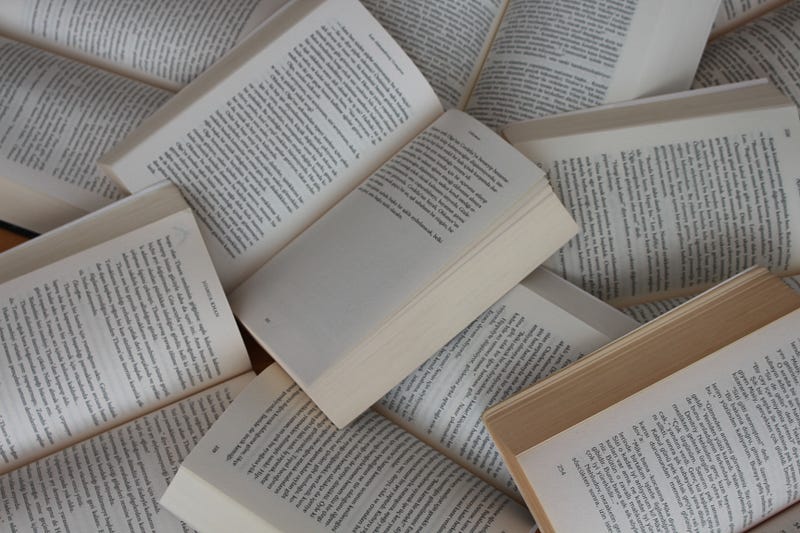
Set the books on your table or desk, open each one at a random page, and place them all open on the desk in front of you, so that you can see each one without having to hold them open.
Step 4
Now, take your notebook or scrap paper. On a single sheet, note down a phrase of 2 words+ from each book. It could be an entire sentence, but it doesn’t need to be complete — an unfinished phrase is perfectly fine (perhaps better!).
Step 5
You can close the books and put them aside, now, to make space. Copy the phrases you have collected onto a second piece of paper, and begin developing each one in a way that makes sense for you.
For example, if it is an unfinished sentence, try to complete it in any way that springs to mind. It doesn’t matter if the original sentence was about something completely different. Try to add interesting new elements to each one, too.
Take a few minutes to ‘workshop’ each of the original phrases into an idea or image. These are your prompts.
Step 6
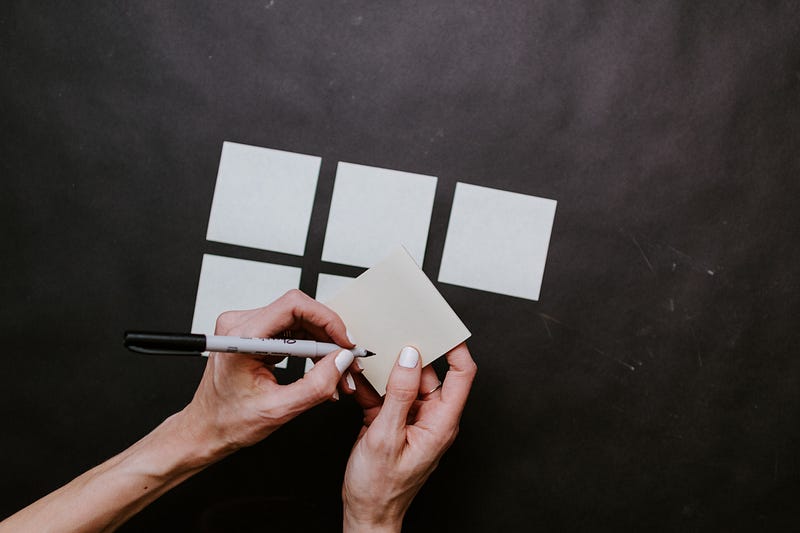
Finally, write each one of your new set of ideas down onto separate index cards or pieces of paper. By doing so, you are starting to build up a set of prompts that you can easily flick through and shuffle. It’s much more convenient than having them all in a static list.
An element of randomness can really kick-start the creative process!
Step 7
It can be good to take a break at this point. Put these aside, and set a time to come back to the ideas. Each one will incubate in your mind for a while. In order to make sure you don’t forget about them, why not set a reminder in your phone? A week or two from now would work great. In the meantime, you can create new prompts every day or two.
Step 8
When it’s time to actually get writing, take a stack of the prompts you have created, and start to flick through them. Read each one and think about it for half a minute or so, trying to look for something to spark off the beginning of a story, poem, or whatever.
Pick one prompt — something that grabs you.
When you’ve made your choice, put the rest of the prompts aside, set yourself 20 minutes to write in, and get brainstorming. Or, if you can, just start writing your story straight away.
Remember — there is no one right way to do creativity, and there is no single best kind of writing prompt, either. Many of the prompts I have seen have been quite detailed or elaborate, but often a single word, image or idea, or even a description or a smell can be enough to spark creativity.
If you do go down the route of establishing a large set of index cards with prompts, why not include some favorite quotes, song lyrics, and pictures, too? If you build up a big enough stock of ideas, you’ll never be stuck for the starting point for your next work!
In the story below, author Jann Christoph von der Pütten shows how effectively a picture can work as a writing prompt. And you probably have a few of those on your phone, right?
Good luck with your writing — and I hope you come up with some great prompts of your own. If you do, why not share your favorite ones here in the comments?
A shoutout to Lissa Lynne for her fascinating story, Confessions of A Writing Prompt Collector!.
Also, if you want to avoid missing any of my posts, you can get them direct to your inbox right here! Also, if you’re new to Medium yourself, consider supporting me by signing up for a membership with this link. Doing so supports me with a portion of your fee, and won’t cost a penny extra. If you do, thank you very much!


