
Making Poetry More Accessible
#1 — Starting with the Turn

Poetry has a reputation for being difficult. Difficult to read. Difficult to write. Difficult to talk about. And that reputation isn’t undeserved when you consider how at-odds with our day-to-day life poetry appears to be, with its structure unlike just about any other form of written expression. Ben Lerner addresses this disconnect in his “The Hatred of Poetry” and Matthew Zapruder touches on it in Why Poetry, so I’m not going to reinvent the wheel here.
What I aim to do here is make poetry more accessible, both for readers and writers at any level. I taught high school creative writing for several years and always started the curriculum off with poetry, especially to help students work on constructive feedback in workshops. In order to learn how to have productive workshop talks, we also had to be able to talk about poetry.
Not as some coded message or free-for-all that can “mean anything,” since those approaches don’t actually lead to any kind of useful conversation, but as thoughtful, creative expression.
And the key component I would always start out with was the turn.
Most people are pretty familiar with the basic structure of a story, but then claim they don’t know the first thing about how to read a poem.
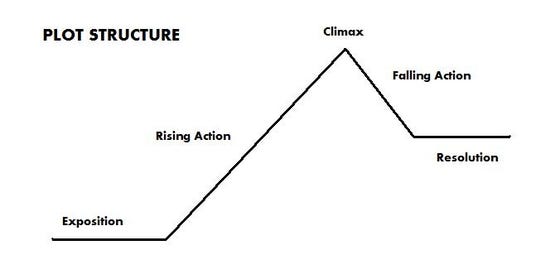
By and large, the structure looks the same. The title often serves as exposition or context, with the poem building toward its climax (or turn) and then pivoting to its resolution.
A poem without a turning point — that resides within a single feeling or idea — runs the risk of stagnation or sentimentality. When that happens, it’s not going to survive in circulation very long. We want poems to reflect the complexity of the world and of ourselves, neither of which can be reduced to a singularity. That’s a large part of why poets love inventing new comparisons through metaphor.
A good example of a turn comes from Billy Collins in “Introduction to Poetry.”
I ask them to take a poem and hold it up to the light like a color slide
or press an ear against its hive.
I say drop a mouse into a poem and watch him probe his way out,
or walk inside the poem’s room and feel the walls for a light switch.
I want them to waterski across the surface of a poem waving at the author’s name on the shore.
But all they want to do is tie the poem to a chair with rope and torture a confession out of it.
They begin beating it with a hose to find out what it really means.
Can you spot the poem’s turning point? Collins indicates the turn masterfully here with a shift in tone, perspective, and language. The poem opens with a list of requests and desires the speaker expresses to a group (most likely students) — “I ask,” “I say,” “I want.” The attitude is charming and playful…until the turn.
BUT
all they want is violence and hostility. The turn here is clearly telegraphed and emphasized with a shift from the perspective of the speaker to his students, a tone of whimsy to frustration, and a nice big “but” (one of the more common signal words to indicate a turn).
Once this turn is identified, it becomes much easier to talk about the poem. What’s going on before the turn? What changes after it? How does this shift affect or reflect the theme? This last one takes us down the road we ultimately want to be able to talk about and discuss with theme.
Rhyme and meter are fantastic elements of poetry, but they’re not nearly as accessible or conversation-driving to the average reader as theme. So those of you who are trying to break in to reading more poetry, here’s a good strategy to begin with. And those of you who are looking to improve your writing of poetry, this is a great element to include with fidelity.
It’s an element of poetry that the one poet everyone knows — William Shakespeare — used in his poems, as well. The sonnet structure (both Shakespearean and Petrarchan) pretty much hinged on the turning point as the focus of its form.
Some more wonderful poems that make beautiful use of a turning point (or points):
Robert Frost’s “Stopping by Woods on a Snowy Evening”
Tony Hoagland’s “History of Desire”
Langston Hughes’s “I, Too”
So get out there and check out some poems (and write some of your own!) and keep an eye out for how and when they turn from one idea to another.
Have some favorite poems/turns to share? What other elements of poetry do you find intimidating or confusing? Drop a comment down below so we can have a conversation!
More in this series:


