
Machines — 2
Emotional Intelligence, Consciousness, Soul, & Sentience
In this series of blogs, we will begin with a basic understanding of what machines are, and then move on to understand what the terms Emotional Intelligence, consciousness, soul, and sentience mean, when it comes to machines.
(Please read Machines — 1 on EI, before or after, you read this blog).
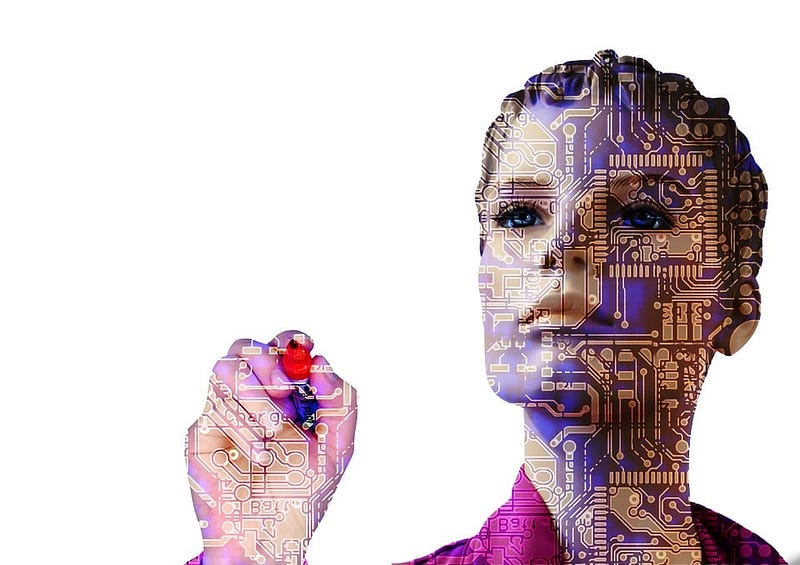
So, let us jump straight in, and try to tackle the second of these complex issues — Consciousness.
Consciousness refers to the state of being aware of one’s surroundings, one’s thoughts, and one’s feelings.
Consciousness can be approached from a philosophical, scientific, and spiritual angle. In this blog, we will approach it only from a scientific and philosophical angle.
When it comes to machines the question of whether a machine can be conscious or not has been raised many times, and still remains a topic of research. Most researchers agree that machines are unlikely to be conscious in the same way as humans. Consciousness is linked with subjective experiences which machines lack (at least till now). However, some researchers believe that since the subjective is just a complex case of objective, it all comes down to better inputs and faster computing power, which will enable machines to climb the ladder of consciousness very soon.
Talking of the ladder of consciousness, one name that can not skip my mind is that of Max Tegmark. Max Tegmark, a renowned cosmologist, holds a radical view on consciousness.
The ladder of consciousness in biological life-forms:
Level 1: Experience without consciousness: This level of consciousness is characterised by simple, sensorimeter experiences that do not involve awareness or introspections. For wxample, a thermostat detects changes in temperature and adjusts its setting to maintain a particular temperature range but does not have any sense of self or experience any subjective states.
Level 2: Experience and consciousness: This level of consciousness involves awareness and subjective experience. Animals, for instance, have this type of consciousness. They are aware of their environment and have subjective experiences such as pain, pleasure, and emotions.
Level 3: Conscious and self-aware: This levele of consciousness involves not only awareness and subjective experience but also ability to reflect on one’s own consciousness. This level of consciousness is unique to humans, and it allows us to introspect, be self-aware, and have complex thoughts and emotions.
Tegmark believes that consciousness is not a magical or mysterious phenomenon but rather an emergent property of complex information processing. He argues that consciousness arises from the complex arrangement of matter and energy and that all forms of matter and energy possess consciousness to some extent.
According to Tegmark, consciousness is similar to other emergent properties such as temperature or pressure, and can be described by mathematical equations. He believes that consciousness can exist in non-biological systems and it can be created artificially.
For example, a robot could be designed to detect stimuli such as temperature, pressure, and humidity, and use this data to adjust its behavior. Furthermore, a robot could be programmed to learn from past experiences, making predictions and adapting its behavior accordingly.
However, the question of whether such machines would truly be conscious is a matter of debate — more philosophical than scientific. Some philosophers argue that consciousness is irreducibly subjective and first-person, and therefore cannot be replicated in a machine. Others argue that consciousness is a matter of information processing and that machines could be developed to replicate the necessary neural activities. I am personally more inclined to agree with the latter.
The next big question after machine consciousness is of machine rights, the same as human rights.
If machines will someday be able to have the same level of consciousness as humans, then will they not demand and must have the same rights as us humans?
We talk of machines taking our jobs, but then will someday they also desire the products that we or their fellow machines create and be customers?
Because with complete human consciousness, they will have the same demands and desires, but then because they will be much more capable than us mentally and physically, will we not lose the race to them both as creators as well as consumers, ultimately become irrelevant, and wipe out of the surface of this planet?
In the next blog Machines — 3, we will discuss about Soul in machines.
Influences:
- ‘Klara and the Sun’ by Kazuo Ishiguro
- ‘Homo Deus’ by Yuval Noah Harari
- ‘Life 3.0’ by Max Tegmark