
Machine Learning & Metaphysics
The art space is a catalyst for change
Machine learning and metaphysics. Distant topics, but both worth your attention if you want to enrich and challenge your mind. The goal of this article is to describe a conceptual framework of machine learning. A framework that can enrich philosophical discussion and clarify its meaning with artistic examples.
Machine learning can help to understand some philosophical concepts in the context of empirical reality.
Metaphysics is the philosophical study of the nature of reality. It includes ontology, the study of being, and epistemology, the study of human knowledge.
Metaphysics is concerned with examining our most basic assumptions about what exists and how we can come to know it. Ontology deals with the nature of categories of existence, while epistemology deals with our knowledge of these categories.
The term metaphysics comes from two Greek words: meta, meaning “beyond” or “after” and physics, meaning “physics” or “nature.” Thus metaphysics is the branch of philosophy that seeks to understand what reality is in itself, beyond any possible physical experience.
Knowledge is a familiarity with someone or something acquired through experience or education. It can refer to the theoretical or practical understanding of a subject.

Machine Learning is a field of computer science that evolved in the late ’60s and early ’70s, drawing on earlier work in pattern recognition and computational learning theory. It is defined as a subfield of computer science that is dedicated to the study of problem-solving by computer programs in general. The objective is to enable computers to learn from data, without being explicitly programmed.
Machine Learning is the application of statistical methods to automatically learn from data. In Machine Learning you try to use mathematical optimization methods to automatically learn from data and make predictions, without being explicitly programmed to do so. Machine Learning is a part of artificial intelligence. It is a field that studies computer algorithms that can learn or improve their performance with experience.
It has recently become one of the most popular research areas in computer science, with an explosion of interest in commercial companies such as Google, Apple, Facebook, and Amazon.com.
Machine Learning has transformed many areas of life including retailing, transportation, finance, entertainment and media. Now it’s time for philosophy
Where machine learning meets metaphysics?
Machine learning can help to clarify the meaning of some philosophical concepts in the context of empirical reality.
Let’s see this more clearly.
A metaphysical, philosophical term refers to a theory about the nature of reality.
The concept “algorithm” can be considered as a type of process that can be applied to something, in this case, the data represented by the dataset fed into the machine learning algorithm.This approach is interesting for several reasons.
First, it shows that machine learning and metaphysics are complementary subjects. We have machine learning algorithms and the data we want to learn from.
Second, demonstrating this points to the fact that machine learning is like any other branch of science. You need the data to be able to perform scientific research.
Third, it illustrates how scientists need empirical evidence to say anything about reality. Data are base of knowledge and experiment is the only way to prove them.
Finally, it makes clear that machine learning and metaphysics are not mutually exclusive subjects; they can be used in many different ways.
Let’s see how this can be applied to the concept of consciousness.
The concept of consciousness is one of the most important challenges in metaphysics, and the most difficult to define using scientific terms.
What is Consciousness
Consciousness refers to an individual’s awareness and is a property that corresponds to having experience, self-awareness, sentience, sapience and/or awareness.
It is what makes us different from all other biological entities.
Consciousness has traditionally been delimited to human beings, but in the last years, new definitions have been advanced that make it a feature of biological systems and non-biological entities.
It is important to note that this is a highly contested concept in the philosophy of science since there are no agreed-upon definitions for this term. What can be said with certainty is that consciousness does not exist without a form of representation.
Can art be an interactive space for machine learning and metaphysics?
Art is a concept that is not usually associated with Machine Learning and Metaphysics.
It can be however interesting to view Machine Learning as an art that involves some advanced techniques for extracting information from data, as well as the use of a lot of computational resources.
Metaphysics in art is the exploration of reality by deconstructing the concept of appearance and the senses.
The artistic practice of the 20th century has been a major influence on many concepts in Metaphysics. In particular, the avant-garde movement which emerged in Europe at the beginning of the century questioned traditional definitions of art and its functions.
The term “avant-garde” comes from French and literally means “advance guard”.
The 21st century brings art created by artificial intelligence. The art of machine learning is an avant-garde field for exploring a new metaphysics
Modern philosophy has a depressing attitude towards metaphysics. Paradoxically, machine learning can help lay the foundations of new metaphysics. Again, the art space can be a catalyst for change. Artists who combine the latest achievements of science with philosophical inquiry expand the realm of knowledge of the unknown.
Conclusion
Metaphysics is a branch of philosophy dealing with the fundamental nature of reality. The most important concept used in metaphysics is that of reality.
Machine learning can help to understand the nature of reality by presenting a different way of defining this term.
Art and Machine Learning are two concepts with a lot of synergies, as they use data and computation to explore the meaning of human experience. Machine learning is part of modern art and gives rise to a new metaphysics that can help provide us with a better understanding of reality.
The application of computational methods in art has had a major impact in recent years on how we define artistic practice and who is an artist today. The same methodologies are being used for exploring metaphysical ideas about life, consciousness, time, space, evolution, and other fundamental questions about reality.
Metaphysics in ML- art can be defined as the attempt to clarify concepts that are not yet understood by science, such as consciousness, free will and ethics.
As noted by Peter Sjöstedt-H: “Metaphysics is about asking fundamental questions about existence and meaning: the nature of objects and objects’ relationships to each other.”
Metaphysics can be defined as the study of the nature of reality.
Artists are more creative when dealing with complex issues such as philosophy and metaphysics. The results they achieve can be profound.
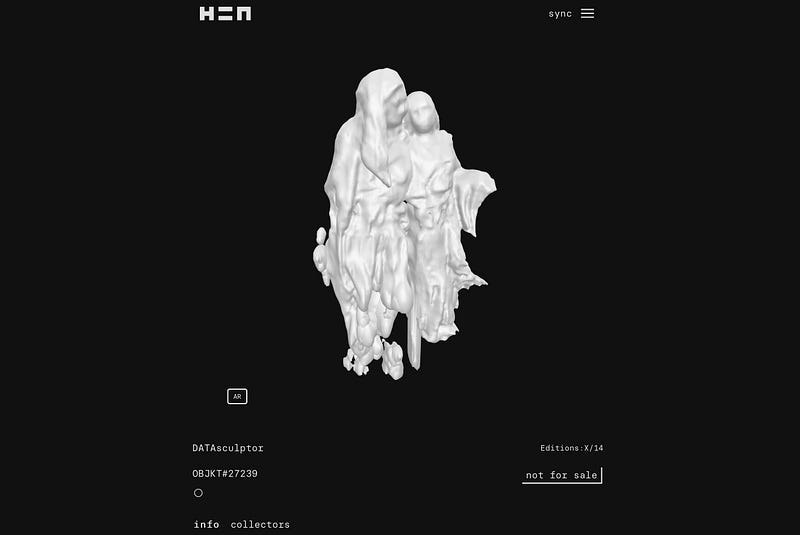
DATAsculpting
Machine Learning in Art on the example of myFATHERintheCloud.ai
towardsdatascience.com
- Check out my instagram with new material every week
- If you enjoyed this, follow me on Medium for more
- Want to collaborate? Let’s connect on LinkedIn
- https://linktr.ee/datasculptor
- 3D Machine Learning generated model on sketchfab


