
Headline Hacks
Long or Short: Which Headlines Are Better?
The research is divided, but you don’t have to choose

I spent over an hour today browsing reputable sites for the answer to the question: Are long or short headlines better? In between running to the couch to comfort my seven-year-old who was freaked out by the thunderstorm bellowing through our home, here’s what I discovered:
Some tell us the ideal blog post headline length is 60 characters. Others recommend 90–99 character headlines because they increase click-through rates by 0.43%.
Then it also depends on what platform you’re writing on. For instance, 40 to 49 characters are ideal for LinkedIn headlines as these were found to receive the highest number of post views overall.
In The Anatomy of a Perfect Blog Post, Hubspot informs us that headlines between eight and 12 words are shared most often on Twitter. And headlines between 12 and 14 words are liked most often on Facebook.
Backlinko analyzed 912 million blog posts and tells us that “very long” headlines outperform short headlines — 14 to 17 words are the way to go, generating 76.7% more social shares than short headlines.
Buffer tells us that according to science, the ideal length of a headline is six words since we absorb only the first three words and the last three words of a headline.
Then there’s Google search to consider:
How many characters will appear in search results before the headline gets cut off?
A Google forum product expert tells us it’s not about the number of characters — it’s a certain width in pixels that limits what is shown of a title. This width roughly translates into something between 60 and 70 characters.
And then I was thrilled to find this, which none of the others mentioned at all: a cross-sectional study of 22 scientific journals discovered that longer titles seem to be associated with higher citation rates.
The authors conclude that editors who insist on short and concise titles need to update the guidelines for authors so there’s more flexibility in title length.
So are long or short headlines better?
It makes sense that the more descriptive a title, the more a reader will know what to expect.
But there’s such conflict between research, I’m not convinced that headline length is really that important.
There’s More to Headlines Than Length
Let’s analyze a prospective headline for this article:
How long should a title be?
It’s got six words and 27 characters. It fits one research finding that six is the perfect number of words in a headline — although this isn’t agreed on by all the research.
All the research I dug into would agree: 27 characters are too few to make an impact.
So should I change the headline or keep it?
Part of my five-step process for creating alluring headlines includes running them through CoSchedule’s Headline Analyzer. This is a great way to begin filtering headlines quickly. It considers your headline length — yet recognizes that there are more to headlines than length. What’s more, it’s backed by data.
So, going back to my prospective title:
How long should a title be?
Here’s what CoSchedule Analyzer tells me:
It has 27 characters —a bit too short. It has six words — the right length.
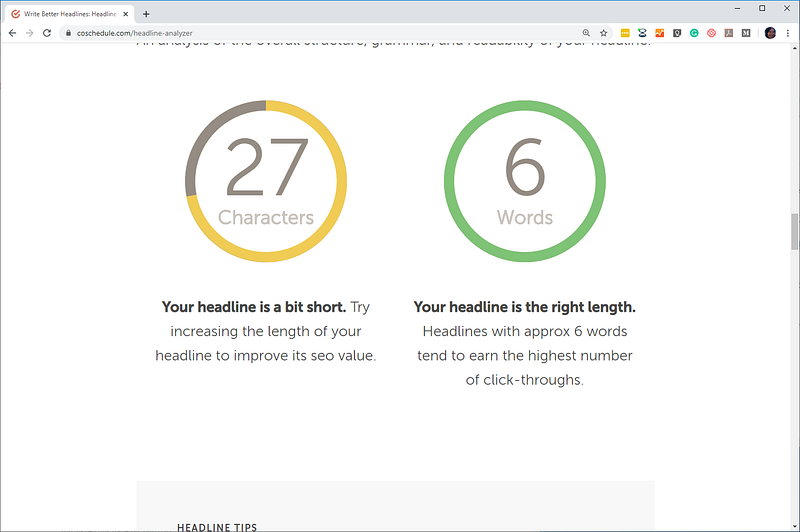
I got a headline score of 67. Not bad, but I prefer higher scores, usually above 70.
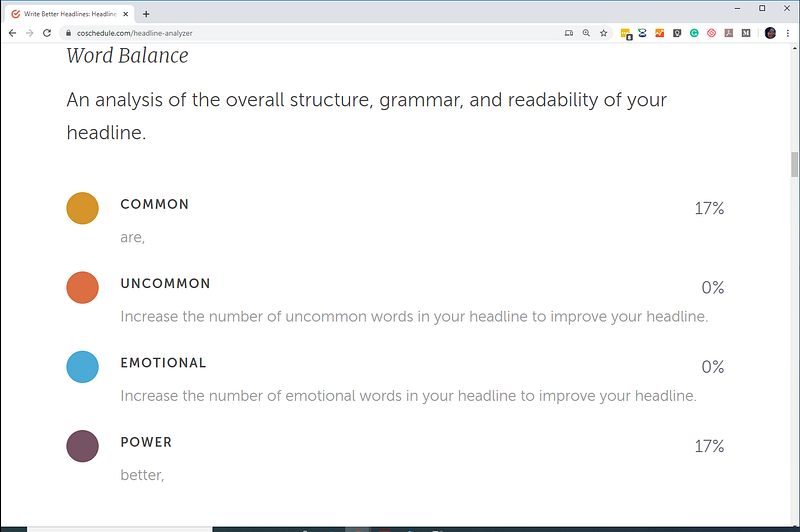
The analyzer tells me that I could improve the words in my title — I don’t have any uncommon words, emotional words, or power words in there. Including a better word mix will likely improve my headline.
I changed the headline to:
Are short or long headlines better?
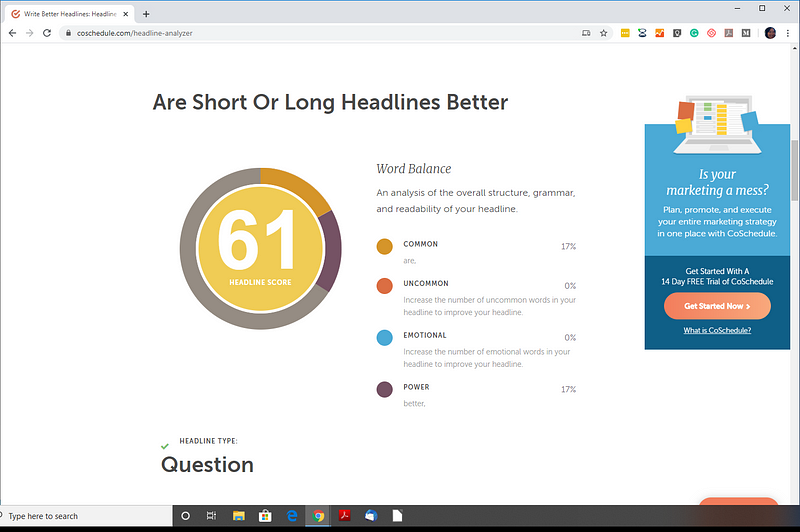
It gives me a score of 61.
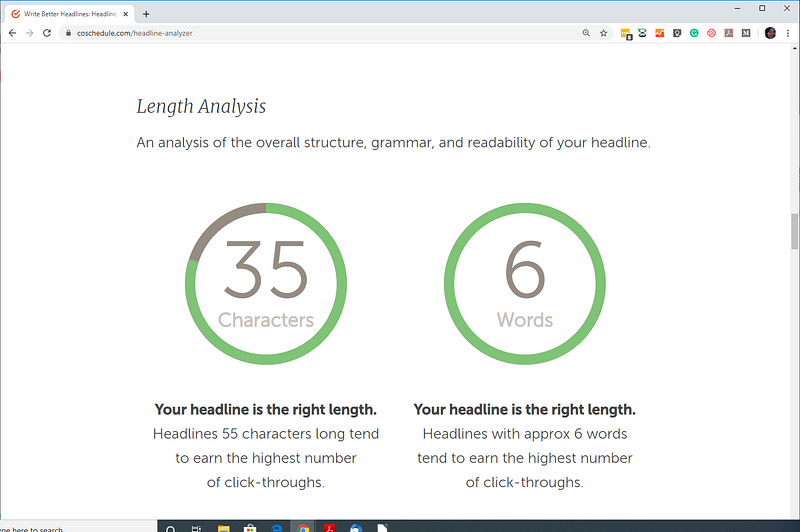
It has the right length according to CoSchedule: 55 characters and six words. (Note that 55 characters is considered too low in many of the other studies)
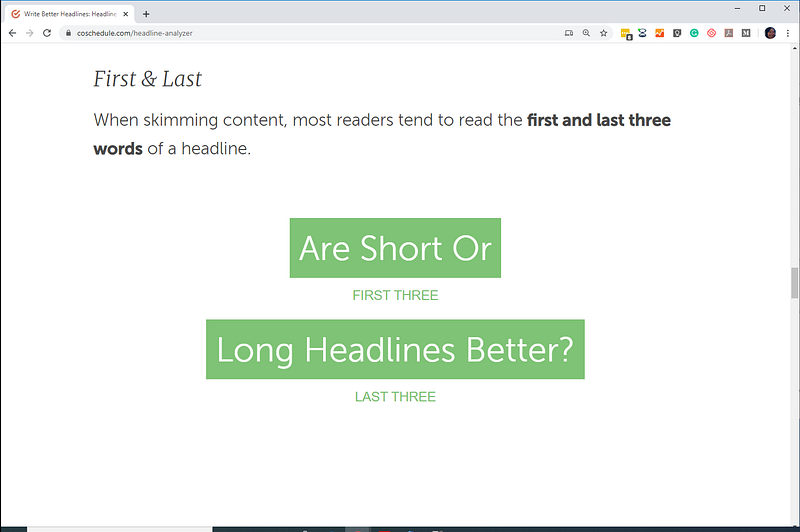
The first and last three words will most likely be read.
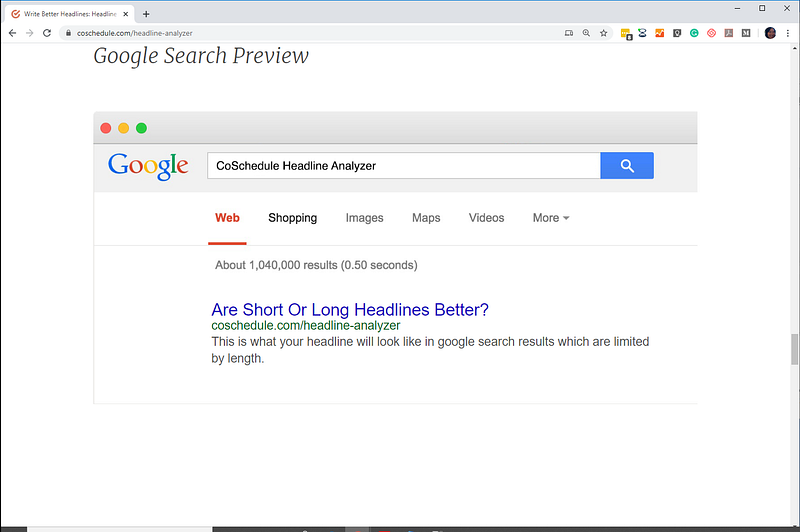
It looks decent in Google search results.
It includes a power word, “better.”
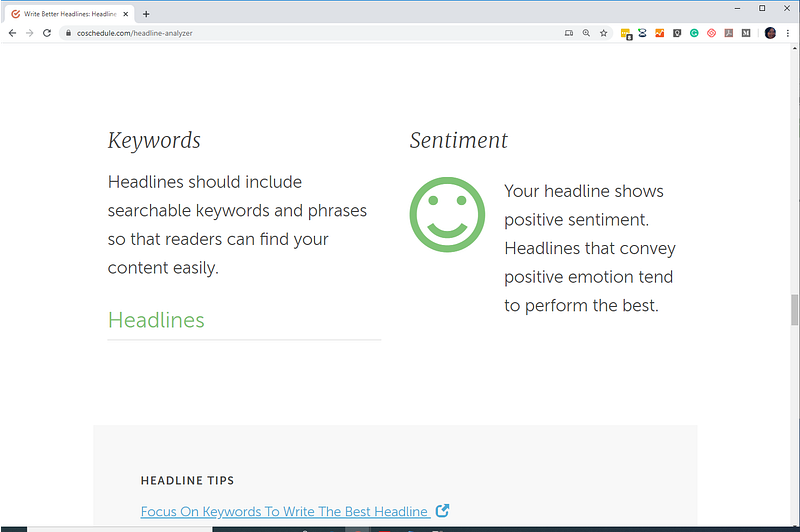
It has positive sentiment — headlines with positive emotion are shown to perform best.
Is This a Good Headline?
Although the score is lower, I like the headline. It’s simple. It’s clear. It’s a question many of us are curious about — or we are now, even if we hadn’t thought about it before. I like it better than How long should a headline be?
It is and isn't the right length, depending on which research you look at.
I considered the research. Used a tool that does a decent job. Then used my own judgment to make the call. I also got a second opinion from the publication editor, another human.
As much as we wish we had a surefire, quick, simple way to write great headlines, we don’t. We’ve got research and tools but they are only guides. We need to be OK with that and trust our intuition and growing experience.
We’ve got to be OK with getting feedback and asking for help from others who may have different insights and expertise. It doesn’t mean they’ll always get it right either.
So are short or long headlines better?
What to Do With the Conflicting, Often Contradictory, Confusing Research
Focus less on the length of the title and more on creating a useful title.
What’s a useful title?
One that tells you what you’re in for if you click. One that’s honest so your content follows through. Intriguing yet clear. One that gets a reader a little excited. Relieved. Hopeful. It’s a title that promises to update us, help us do something better, learn something new, challenge our thinking.
It’s a great question to think about: whether long or short headlines are better. It’s a question I’ve enjoyed delving into.
And now that I have, I don’t think it’s worth spending time tweaking until we come up with just the right amount of characters and words — according to whatever research you decide to follow.
Instead, spend more time learning and practicing how to come up with a meaningful headline.
How to Create Alluring Headlines
Grab a few tips from the most popular TED Talk headlines.
Find the right words from this ultimate list of 320 power words or the 194 highest-rated sensorial words for gorgeous headlines.
If you’re having trouble, go ahead and use proven headline formulas to entice readers. But whatever you do, whichever word, tool, or formula you use, always focus on writing genuine headlines — stay clear of clickbait.
Summary
The results are mixed on whether short or long headlines are better. There’s compelling research to argue either way.
But you don’t have to choose. Don’t choose. I’m not going to.
Instead, ditch thinking about the length of your headlines. Use a tool like CoSchedule’s Headline Analyzer that considers it for you. Trust in your own judgment and that of other people you trust.
Spend your time practicing how to write headlines that are clear yet intriguing. Simple and genuine. And whatever you do, avoid click-baiting in your headlines.
Happy headlining.


