Headline Hacks
17 Tips From Dissecting the Most Popular TED Talk Headlines
Ideas worth spreading deserve glorious headlines
In a conference room in California, a man in a wrinkly white T-shirt ummed his way through a speech. Pausing awkwardly halfway through sentences, to figure out the right word to go on. Speaking nervously with British humor that experience had shown wasn’t always appreciated (or understood).
Later he would cringe at his performance.
But Chris Anderson had prepared this speech. It was one of the most important speeches he had ever made. He wanted to save an event that meant the world to him: TED.
TED began as a local conference in California in 1984. Attendance reached 800 participants by 2001. Sadly, the conference was to be discontinued after 2001, as the charismatic owner of TED, Richard Saul Wurman planned to depart.
To avoid this, Chris rallied participants with a heartfelt and purposeful speech. He shared how much he wanted to continue the conference — and how could they let die an event that brought such intense inspiration and learning to them?
Chris shares that, to his amazement, Jeff Bezos, the founder of Amazon, was the first on his feet to applaud him. The rest of the room followed. And at this moment, Chris saved TED from extinction.
Since that day in 2001, Chris’ speech has paid off a million times over — by the lives that have been impacted by thousands of memorable “ideas worth spreading”. Shared by people across countries and across disciplines.
TED talks have gifted us with learning, inspiration, and wonder.
These 18-minute talks, both live and online, encourage conversations that matter. Help people connect. And include communities.
They give us the opportunity to learn how to improve ourselves. Understand how the world works. Marvel at the incredible feats performed. Be astonished and excited by the discoveries made by people all over the world.
The most popular TED talks have been watched up to 63 million times online.
There are many factors that affect the views of a TED talk. The speakers are carefully chosen — not for their speaking ability, but for their expertise. Their experience. Their insights. The content must be structured well with stories. The delivery of these talks must be genuine and deliver complicated topics simply. With eye contact. With plenty of rehearsal. The talks must capture hearts as well as minds.
But no matter how great the feat or research, no matter how astonishing the content of the talk — it won’t matter if the headline doesn’t stir people’s curiosity. We won’t know the idea is worth spreading if we’re not tempted to click Play to watch the videos — or click Pay to hear the talk live.
Make Your Headlines an Open Door
As writers, when no one knows us, our headline is the open door that invites people to step in.
As a writer, you have insight and experiences no one else has. You think, feel, and speak like no one else. And no one else forms exactly the same beliefs, assumptions, and conclusions as you do. Like TED speakers, you too have ideas worth spreading.
Yet without a magnetic headline, your ideas will go unnoticed.
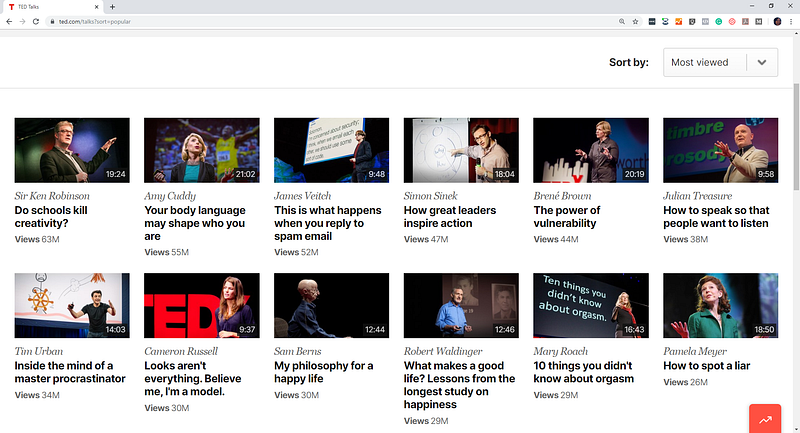
So let’s do something together — let’s look at the top 24 most viewed TED Talks (in November 2019). We’ll analyze why these headlines work so well. And then we’ll gather these insights as a list of useful tips.
Top 24 Most Viewed Ted Talks and Why They Work
Headline 1
Do schools kill creativity? — Sir Ken Robinson (Views 63M)
Why it works:
- Controversial
- Questions naturally arouse curiosity
- Speaks to our desire to be creative
Headline 2
Your body language may shape who you are — Amy Cuddy (Views 55M)
Why it works:
- Arouses curiosity
- Novel topic
- Helps us understand ourselves
Headline 3
This is what happens when you reply to spam email — James Veitch (Views 52M)
Why it works:
- Subject is a common frustration “spam email”
- Arouses curiosity
- Anticipation: suggests this could be entertaining or scientific, or both
Headline 4
How great leaders inspire action — Simon Sinek (Views 47M)
Why it works:
- Makes us want to click
- Powerful, short words
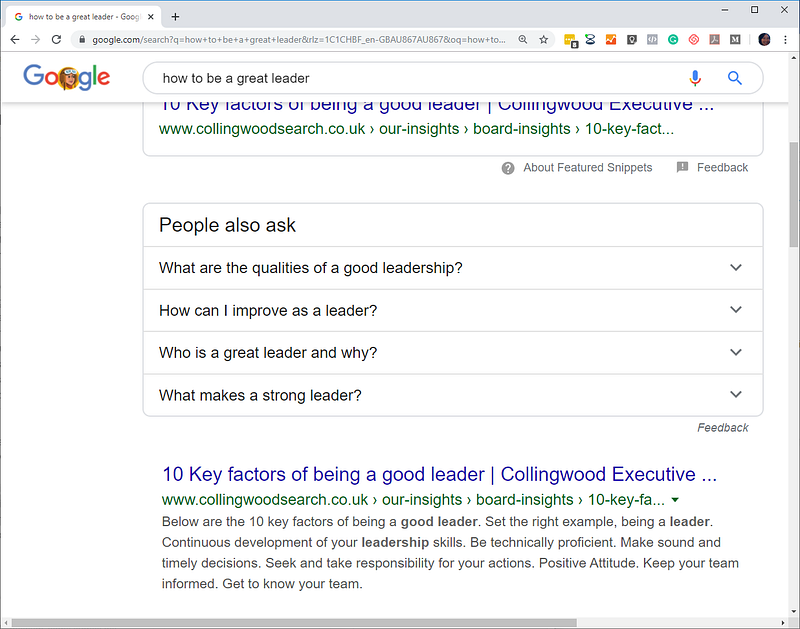
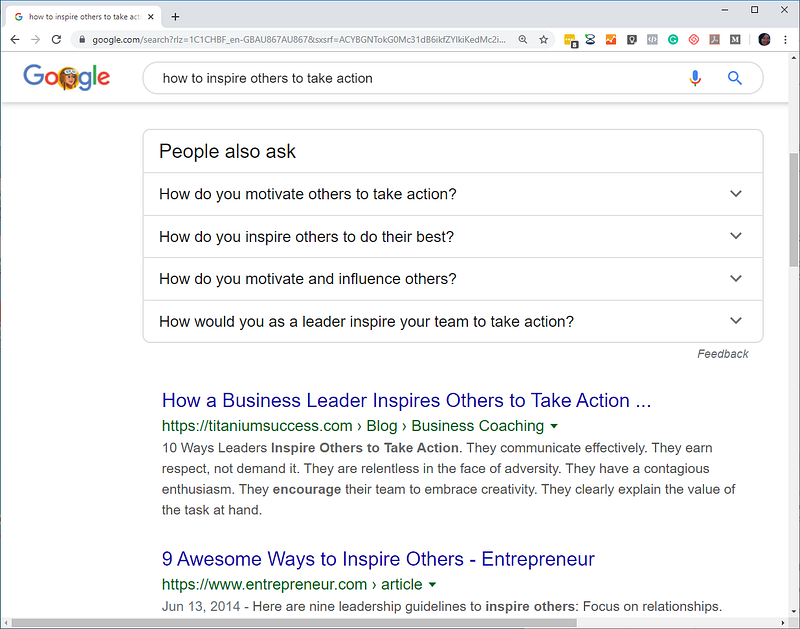
- Specific solution to common desires: we can imagine looking up “How to be a great leader” “How to inspire others to take action” (screenshots below). The headline is powerful because it combines the two questions.
Headline 5
The power of vulnerability — Brené Brown (Views 44M)
Why it works:
- Addresses a common fear
- Unexpected approach
- Arouses curiosity
Headline 6
How to speak so that people want to listen — Julian Treasure (Views 38M)
Why it works:
- “How to” headlines tune into our need to learn
- Appeals to our desires to be noticed and to connect
- Casual — we can imagine looking up this phrase on Google
Headline 7
Inside the mind of a master procrastinator — Tim Urban (Views 34M)
Why it works:
- Novel topic
- Unusual yet witty and entertaining combination of words “master procrastinator”
- Relatable
Headline 8
Looks aren’t everything. Believe me, I’m a model. — Cameron Russell (Views 30M)
Why it works:
- Challenges a common perception
- Arouses curiosity because of her profession
- Casual
Headline 9
My philosophy for a happy life — Sam Berns (Views 30M)
Why it works:
- Arouses curiosity
- Happiness is a common desire
- Anticipation of entertainment, humor, and insight
Headline 10
What makes a good life? Lessons from the longest study on happiness — Robert Waldinger (Views 29M)
Why it works:
- Credibility
- Arouses curiosity: uses the word “longest” which is a big claim
- The question addresses our desire to have good lives
Headline 11
10 things you didn’t know about orgasm — Mary Roach (Views 29M)
Why it works:
- Numbers stop wandering eyes
- Curiosity
- Topic is a common pleasure
Headline 12
How to spot a liar — Pamela Meyer (Views 26M)
Why it works:
- Short, simple, yet powerful words
- Anticipation of useful tips
- Understands many people aren’t skilled in this area
Headline 13
Why people believe they can’t draw — Graham Shaw (Views 26M)
Why it works:
- Addresses a common mental roadblock
- Relatable
- Presents a challenge
Headline 14
My stroke of insight — Jill Bolte Taylor (Views 26M)
Why it works:
- Uses an interesting word “stroke” that links to the presenter, who experienced a stroke
- Arouses curiosity
- Short, simple words
Headline 15
The orchestra in my mouth — Tom Thum (Views 26M)
Why it works:
- Unexpected, fascinating play on words
- Anticipation of humor and entertainment
- Witty yet simple
Headline 16
The puzzle of motivation — Dan Pink (Views 24M)
Why it works:
- Strong, descriptive verb “puzzle”
- Understands many of us struggle with this topic
- Anticipation of solutions
Headline 17
The art of misdirection — Apollo Robbins (Views 24M)
Why it works:
- A “How to”, we expect practical tips
- Strong word “art” implies we’ll learn from an expert
- Arouses curiosity — it’s an uncommon topic
Headline 18
The power of introverts — Susan Cain (Views 24M)
Why it works:
- “Power” is a strong word that catches our attention
- Addresses a common group
- Anticipation of a feel-good talk
Headline 19
The agony of trying to unsubscribe — James Veitch (Views 19M)
Why it works:
- “Agony” appeals strongly to our emotions
- Common problem
- Anticipation of a funny talk we can relate to
Headline 20
Your elusive creative genius — Elizabeth Gilbert (Views 18M)
Why it works:
- Understands the struggle people have with creativity
- Strong words “elusive” and “genius”
- Suggests a “How to” that will leave us with useful insights
Headline 21
Grit: The power of passion and perseverance — Angela Lee Duckworth (Views 18M)
Why it works:
- Uses strong words
- Specific
- Addresses our struggles and promises hope
Headline 22
The thrilling potential of SixthSense technology — Pranav Mistry (Views 18M)
Why it works:
- Promises a look into the future
- Strong verb “thrilling” creates excitement and anticipation
- It suggests credibility
Headline 23
The surprising science of happiness — Dan Gilbert (Views 18M)
Why it works:
- Credibility through the word “science”
- Addresses our common desire to be happy
- Suggests there will be tips
Headline 24
Brain magic — Keith Barry (Views 17M)
Why it works:
- Simple words
- Powerful word “magic” suggests we’ll be amazed
- Creates excitement and anticipation
17 Headline-Writing Tips From These 24 Popular Ted Talk Headlines
- Look up your topic on Google and see what words people use to search
- Choose short words over long ones
- Use wit when appropriate
- Use strong verbs
- Use interesting verbs
- Be specific
- Avoid generic adjectives
- Choose focussed, interesting adjectives (check out this list of 320 power words)
- Don’t use forms of “be” such as “is”, “am”, “were”
- Ask yourself, “What title would make me want to click?”
- Address mass desires: fears, need to impress, be liked, be successful, to connect
- Understands people’s level of awareness about a topic
- Questions or problems: When you repeat the reader’s question, it shows you understand them
- Numbers: Numbers typed out as numerals literally stop the wandering eye and boosts credibility too
- Curiosity: We’re informavores — we’re hard-wired for curiosity
- Credibility: Opinion on its own is weak — reliable sources give objectivity to an opinion
- How-to: Learning how to do something (or what not to do) is a natural human need
What you’ve now got is a practical list of 17 tips based on 24 of the most successful TED talks.
Still unsure where to begin? No worries. Check out my bulletproof, 5-step process to create alluring headlines. This may be a helpful complement to these 17 tips.
Summary
TED events and talks have gifted an abundance of mind-blowing ideas to people all over the world.
Yet without an equally impressive headline, even the most remarkable idea would sadly lay desolate, unable to gain the reach it deserves.
Same goes for your writing.
Well, you’re all set. You can refer to the list of 17 tips (based on 24 of the most popular TED talks of all time) anytime you need a headline that compels your reader to keep reading.
Ideas worth spreading need a glorious headline. That’s why you’ve got to pay special attention to headlines.
Create them. Caress them. Curate them.
And most of all, enjoy the gift of sharing your wonderful ideas with readers.