
Marriage Customs
Logically, Why Would a Woman Want to Change Her Last Name upon Marriage?
They’re brainwashed by a senseless, burdensome US marriage custom. Other countries don’t! Let’s explore some repercussions of stopping it.
Synopsis
- What would happen if women in the U.S. didn’t? Currently, it’s a huge burden to change her business cards, passport, driver’s license, credit cards, bank accounts, health record links, Facebook account, and who knows what else. Logically, it makes no sense except to show ownership by the man.
- Women in many other countries don’t change their last name. This article examines some of those customs and some strange ramifications here in the States.
They didn’t change their name on the Moon!
I started thinking about this when I read The Moon is a Harsh Mistress by Robert Heinlein while I was in college. The moon’s population started at 10:1 men to women.
They had every kind of marriage custom that one could imagine, and women wrote the rules. If a man complained, he got tossed out the airlock without a suit. Not one man complained. One custom that died:
A woman did not change her last name!
I wondered about that custom since I read that book in the 1960s. When I was growing up, a woman not changing her name was reserved for movie stars. The tradition was even embedded in songs in the United States, like I’d Love to Change Your Name by Kenny Chesney and many others.
Logically, it doesn’t make much sense, especially in later marriages when the woman still has her maiden name. She has to change her business cards, passport, driver’s license, credit cards, bank accounts, health record links, Facebook account, and who knows what else. It could run into hundreds of places. It also puts the woman into a subservient position in the relationship.
Still, she might want to change it - if she still had an ex-husband’s last name
Then she must go through the same gyrations if she wants to change it back after a divorce or death and remarriage.
Other societies
In some Spanish-based cultures, people have two hyphenated last names, like Smith-Jones. The first being the first half of the father’s last name and the second being the first half of the mother’s last name. It’s still a male-based chain, but nobody changes their last name.
So, in a family, the father has one last name, the mother something completely different, and all children a combination of the two, but still different than either parent.
According to Wikipedia, Portugal allows up to 12 last names of nearly any combination. Women may keep their original last name, but can add a few more.
Then, a Time Magazine article states some countries by law do not allow women to change their last names. France has had that law since 1789 and in the last 50 years, many other countries have enacted such laws.
According to the Time article, Japan requires the couple to take one last name, but doesn’t specify which one. The majority is male, 96+ percent of the time.
Yonghan Ching, Electrical Safety Engineer from Malaysia, explained in his answer to a Quora search question how it was an even more complex mix in Malaysia, Singapore and Hong Kong. And Tim Tran, a Vietnamese-born Chinese, explained in Quora how there was some impact from the West, but the concept of surname change is still foreign and unwanted.
What about children’s last name?
There is no problem keeping the last name if the woman is past child-bearing age. If not, then what last name would the child carry?
If it is the father’s, then the woman would be the outcast of the family with no visible connection to the children. Same if they carried the mother’s. It would get even more complicated if boys carried the father’s and girls carried the mother’s.
Maybe kids could start carrying hyphenated last names. However, that may foul up thousands of computer systems throughout the US.
Nothing is ever as simple as it seems on the surface.
What did I do?
I was 52 when we got married. My wife-to-be asked if I wanted her to change her name. When I asked if she wanted to, she said no. Well, I had been thinking about it for 35 years and had my answer ready.
No. It didn’t make any sense for her to change her name.
Of course, I had fun with it. People would say, “I would like to meet the new Mrs. Myers.”
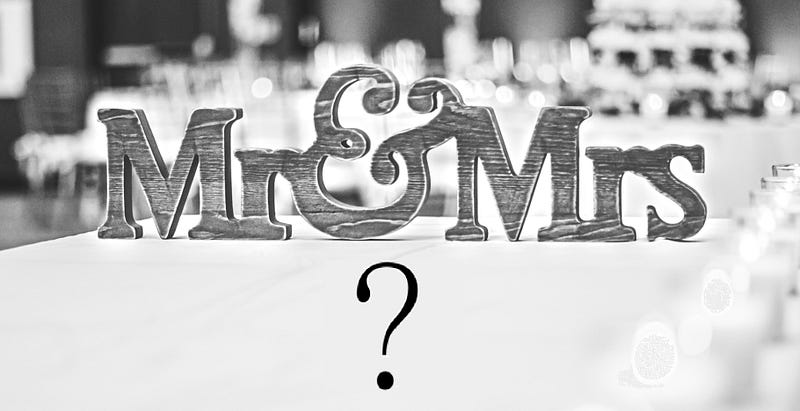
I would say, “There is no Mrs. Myers. Would you like to meet my new wife?” Even the term “Mr. & Mrs.” might change its meaning or become obsolete.
Love connects people, not the name
Conclusion
Nothing is simple when changing customs that have existed for hundreds of years. However, it is never too late to start discussing the possibilities.
As the latest crisis has shown, the world is getting more and more intertwined. Checking out other customs is a good idea. A combination of any two may improve lives in both.
Author’s note: I reread The Moon is a Harsh Mistress while writing this article. It still fits with current technology 60 years later. It is still just as relevant, except for one small scene that has been altered by the Loving v. Virginia Supreme Court decision.
Your responses
I’m very interested to see how other countries handle this, or if it is a question at all. If you choose to post a story, please leave a short comment, then edit it later and add your link. Thanks.
References
Portuguese name from Wikipedia, the free encyclopedia (Link)
Here Are Places Women Can’t Take Their Husband’s Name When They Get Married from Time by Jacob Koffler June 29, 2015 (Link)
Is it common for people in China, Korea, Vietnam or Japan to change names (other than by marriage) during their lives? If so, what are the reasons? a Quora question (Link)
- Malaysia, Singapore and Hong Kong. Answered Aug 28, 2019 by Yonghan Ching (Link)
- Vietnamese-born Chinese: Concept of surname change is still foreign and unwanted. Answered Aug 28, 2019 by Tim Tran (Link)


