
TRIBUTE
Living in Joan Didion’s Reality
She chronicled culture & chaos — we’re better off because of that
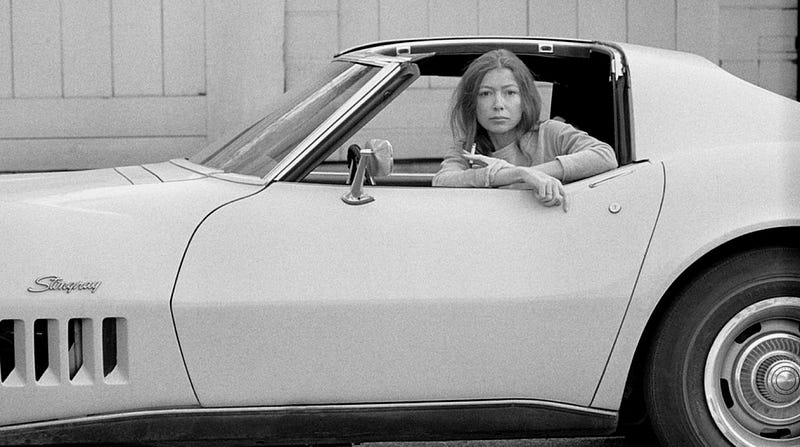
Joan Didion died Thursday. I’m wrecked. Simply destroyed. The woman who walked me through nascent years as a writer, then as a teacher of words; gone, two days before Christmas.
I was in the middle of making a grocery list when I got the news. Russet potatoes, 3.5 pounds; 16 ounces of half-and-half; parmesan cheese, and several cloves of garlic.
I’m responsible for the mashed potatoes Saturday. Oh, and the asparagus. I picked up the pies, apple, and cherry. One completely seasonal, the other off by a few beats, but sweet, nonetheless. I have the perfect Pie Person if you’re feeling the need.
Moker will wrap the presents — he does a better job than I — and has beverages covered. There will be four of us celebrating in my daughter’s mid-century ranch. It’s not Malibu or Brentwood, but I often imagine how Ms. Didion would decorate.
I always think of Joan Didion’s California, the Land of Plenty that at the same time wants for much, when I eat a cherry pie. Blueberries, apples, and strawberries are more common near Ms. Didion’s Sacramento — with which she had as many conflicts as comfortable thoughts — but there are a few sour cherry orchards near the homestead where she was a fifth-generation Californian. The tart nature of the fruit captures my imagination, as I’m sure it did the wordsmith who said goodbye to us this week.
Her observations, sometimes stark, frequently lean, also shouldered layers of meaning. My students often wrestled with her prose. But enough of them appreciated the twists and turns along the Pacific Coast Highway of Ms. Didion’s insights that we kept visiting, year after year.
She’s been called the “Patron Saint of Sentences.” I would go a step farther. The Queen of Credibility. Every year I delighted as my students tripped over, and then embraced, Didion’s lexicon — especially in essays such as “On Keeping a Notebook.”
“Verisimilitude” remains a personal favorite. What could be more apparent than “the appearance of being true or real”?
I learned that Ms. Didion chronicled American life in 19 published volumes — non-fiction about Cuban immigrants and El Salvador; semi-true tales masking themselves with a thin veneer of fiction in Run, River and Play It as It Lays; essay collections about the human condition in San Francisco’s Haight-Ashbury and Washington, D.C.
She also revealed the rawness of stinging grief in more personal accounts of her husband John Gregory Dunne’s untimely death in The Year of Magical Thinking, and in Blue Nights — another poignant work — that detailed her connection to her daughter, Quintana Roo, and her only child’s death at the age of 39. While I’ve pored over much of Ms. Didion’s reportage multiple times— Slouching Towards Bethlehem is a favorite — I’ve read each of these more deeply personal accounts only once.
I guess I haven’t yet returned to her homage to a family gone too soon because Ms. Didion treats even her twin tragedies the way she explains the vagaries and vicissitudes featured in the landscape of life — and in this case, death — as she sees it. Both narratives came close to ripping my heart right out of my chest. I have hoped, over the years, that chronicling these back-to-back losses helped Ms. Didion heal, instead.
Joan Didion has been called a “New Journalist,” and just like the authors Truman Capote and Tom Wolfe — whom I also introduced to my high school English class — she’s made an indelible mark.
“You converted so many cherubs into Didion readers,” one such former “cherub,” as I called my students, wrote me after the news. “Thank you from this one.”
Another’s note brought me around again to why I spent more than two decades in the classroom.
“Reading Slouching as a 17-year-old in [your] class irrevocably changed my life,” declared the young woman, now a professional writer herself. “What a stunning legend we were gifted with.”
I’ll soon be whipping potatoes and trying to figure out a balance in the ballet known as balsamic vinaigrette. And thinking about Joan Didion.
“We are imperfect mortal beings, aware of that mortality even as we push it away, failed by our very complication, so wired that when we mourn our losses we also mourn, for better or for worse, ourselves,” she wrote in The Years of Magical Thinking. “As we were. As we are no longer. As we will one day not be at all.”
Thank you for that, Ms. Didion, and for so much more. I just wish I’d been able to see your banana yellow Corvette — a gift from screenwriting earnings — up close. Maybe you and John and Quintana will take it for a spin, or a few, around the block now that you’re all together again.


