avatarMelinda Blau

Free AI web copilot to create summaries, insights and extended knowledge, download it at here

4913

Abstract

ed about sexual experience as well as what it meant to grow up as a “girl.” So many women resented that their brothers were treated better and had more freedom.</p><p id="e2ef">My greatest “find” was the bisexual community I didn’t know existed. <a href="https://www.womenshistory.org/education-resources/biographies/lani-kaahumanu">Lani Ka’ahumanu</a>,<i> co-</i>author with <a href="https://www.facebook.com/loraine.hutchins?__cft__[0]=AZWSi1VpkOwUoPPAEHQIr11EXug0jT0sY-s8WXKkoNcZMajKuI30IxIamzVsFBgCAakRtXNn6DhsWar8exaNzazVwRzm-gpKZSC4iS0qT7j6awLPTTvRpEXWkeAcOQvxQvCk1vGa2yCmao3FES3TOWNnsBOfDfK-fIAm9kM9CUFf4A&amp;__tn__=-]K-R">Loraine Hutchins</a>, of <a href="https://en.wikipedia.org/wiki/Bi_Any_Other_Name">Bi Any Other Name</a>. The two shared stories, similar to my own, of healthy relationships with men <i>and</i> women.</p><p id="abb5">Lani confirmed that bisexual prejudice was common, especially among lesbians. She introduced me to other activists and “sex positive” thinkers. But of all the eye-openers on that trip to San Francisco, attending Lani’s 50th birthday party showed me why bisexuality was so threatening to both straight <i>and</i> gay people:</p><p id="647e">You never know where you stand. At Lani’s party, lots of people — men <i>and</i> women — came on to me. Or…were they just being friendly? It was both pleasing and unsettling.</p><p id="a0b3">My interviews and research led me to the same conclusion (which sounds obvious 30 years later): Women are fluid in their appetites, depending on how they view themselves and how each new relationship affects them. Every woman’s journey is, as I titled the book, <i>Her Own Affair.</i></p><p id="d1d0">I never wrote the book. But a recent piece written by Marie A. Bailey, also in response to this prompt, beautifully illustrates women’s curiosity, their (dare I say) tendency to dabble — even if only to kiss — and their live-and-let-live ease about others’ sexuality.</p><div id="c6e9" class="link-block"> <a href="https://readmedium.com/why-im-glad-that-i-can-t-tell-gay-people-from-straight-people-ce0fa4846b75"> <div> <div> <h2>Why I’m Glad that I Can’t Tell Gay People from Straight People</h2> <div><h3>Crow’s Feet Writing Prompt #8: Pride Month</h3></div> <div><p>medium.com</p></div> </div> <div> <div style="background-image: url(https://miro.readmedium.com/v2/resize:fit:320/0*TapTo8VXVrUwWi2N)"></div> </div> </div> </a> </div><p id="fe8d">My day job as a journalist required me to stand at a distance in order to synthesize what I’d uncovered. Coming to a conclusion about myself was a lot more challenging.</p><h1 id="451d">Easing Out of the Closet</h1><p id="2109">In 1996, Freddi Greenberg, my editor at <i>Child</i> asked me to devote one of my bi-weekly columns to <a href="https://melindablau.com/wp-content/uploads/2018/07/20180616114057-2-GayParents.pdf">gay parents</a>. It was a natural choice for a column on “the new family,” but I also wondered if Freddi had guessed my situation. I never asked.</p><p id="c0ef">Around that time, Freddi drove up from New York to visit Northampton with with her daughter, who was looking at colleges in the area. She called to ask if I wanted to have dinner with them.</p><p id="9e3e">I vowed I’d never lie if a colleague asked about my home life. Everyone knew I was divorced; I wrote a book about co-parenting. But few asked about my current relationship.</p><p id="881e">At some point during the dinner with Freddi and her daughter — probably comparing life in Northampton to living in the City — I blurted out, “My partner is a woman!”</p><p id="97a7">I didn’t identify as a lesbian. But “I’m bisexual” didn’t roll off my tongue either. Saying that I had a female significant other at least started the conversation.</p><p id="b32a">I felt better — surprisingly good — afterward. I hadn’t been hiding <i>per se, </i>but the not-saying was getting to me — an elephant in the living room of my own mind. Even a lie of omission can weigh heavily.</p><p id="aed1">I’ve since moved from Northampton. When I relocated to Washington and, later, Paris, and strangers asks what brought me there, “My partner….she…” rolls off my tongue. No one is shocked or judges me. More importantly, <i>I find it easy. </i>Undoubtedly, it might be different if I lived in rural Utah, but I’ll never know.</p><h1 id="7f04">What I “am” in 2022 seems besides the point.</h1><p id="c706">The hiding and the uncertainties I once I struggled with seem quaint by comparison to the mind- and gender-bending sexual possibilities of today.</p><figure id="ad0c"><img src="https://cdn-images-1.readmedium.com/v2/resize:fit:800/1*aIFWsYy8SJM3E-pmQK8qtA.jpeg"><figcaption>Photo by <a href="https://unsplash.com/@sharonmccutcheon?utm_sour

Options

ce=unsplash&utm_medium=referral&utm_content=creditCopyText">Sharon McCutcheon</a> on <a href="https://unsplash.com/s/photos/gay-rights?utm_source=unsplash&amp;utm_medium=referral&amp;utm_content=creditCopyText">Unsplash</a></figcaption></figure><p id="c93c">Ironically, now that I’ve been rendered absolutely “vanilla” by the march of sexual consciousness and by the years, I feel <a href="https://www.lexico.com/definition/pride">pride</a> in myself <i>and</i> my community.</p><p id="9687" type="7">…a feeling of deep pleasure or satisfaction derived from one’s own achievements, the achievements of those with whom one is closely associated, or from qualities or possessions that are widely admired.</p><p id="2423">The personal pride comes from hard-won honesty. Not just about my sexuality, but to speak <i>my </i>truth about everything and anything that comes at me. To be authentic. I wasn’t always. Now at the very least, I keep trying.</p><p id="07b5">Authenticity, for those of us who work at it, is one of the greatest gifts of aging, regardless of your sexuality.</p><p id="01b5">I feel a collective pride, too but my “community” is not one populated only by queers. I like Kurt Vonnegut’s notion of a <a href="https://www.urbandictionary.com/define.php?term=karass"><i>karass</i></a><i>. </i>Mine is a collection of family members, friends, and countless <a href="https://readmedium.com/why-all-relationships-are-key-to-survival-a-timely-and-urgent-truth-b557a40f333e">consequential strangers</a> I’ve met throughout my life.</p><p id="e90d"><i>My</i> people are everywhere, on every spectrum. We come from different places, both real and metaphorical. Some of us, such as my fellow writers on Crow’s Feet, have never met in person. But we are bound together, nonetheless, by a cosmic connection. We share common values of decency and acceptance, of kindness and generosity. Who wouldn’t feel pride as part of such a community?</p><p id="1a1b">I understand the need for a marginalized group to assert an identity denied to its members, but I’m not sure that’s what the world needs <i>now</i>.</p><p id="e954">The truth is, we all carry many identities inside us. We don different hats as the occasion requires. We hope that our multiple selves will peacefully co-exist, but it depends, in part, on what life throws at us.</p><p id="b6f4">Nancy, a therapist I consulted in 1989 to discuss my early sexual confusion, was a divorced mother who’d come out as a lesbian a decade earlier. She seemed totally comfortable in her identity but, to her own surprise, backslid when her daughter got pregnant: “The first thing I thought was, ‘How will her children feel about having a gay grandmother?’”</p><p id="51e8">I remembered that story twenty years later when my daughter gave birth to the first of her three sons. By then, I knew myself, felt good about my work, and was in a stable long-term relationship. Just as important, times had changed.</p><p id="aab4">I never <i>had</i> to come out to my grandsons. Two women together was just one of the many possibilities in their world. At three, the youngest asked my daughter whether Tia (my partner’s grandma name) was my “husband.”</p><p id="286d">Change is always clearer in retrospect. Looking back, I didn’t forsee a world in which a child — my daughter’s youngest, now 13 — would text his grandmother in Paris to wish her, “Happy pride month.”</p><p id="14e8">But that’s okay. In <a href="https://readmedium.com/shock-and-awe-i-survived-long-enough-to-become-someone-elses-old-lady-60ec9e29b8cf">my dotage</a>, I find excitement and hope in the not-knowing. As <a href="https://www.brainyquote.com/topics/not-knowing-quotes">Agnes de Mille</a> put it</p><p id="85b8" type="7">Living is a form of not being sure, not knowing what next or how. The moment you know how, you begin to die a little.</p><h2 id="3973">If you like reading me…</h2><p id="87e2"><a href="https://melindablau.medium.com/subscribe">Subscribe</a> to my Medium articles — you’ll get an email when I publish. Join Medium with <a href="https://melindablau.medium.com/membership">my referral link</a></p><div id="4308" class="link-block"> <a href="https://melindablau.medium.com/membership"> <div> <div> <h2>Join Medium with my referral link — Melinda Blau</h2> <div><h3>As a Medium member, a portion of your membership fee goes to writers you read, and you get full access to every story…</h3></div> <div><p>melindablau.medium.com</p></div> </div> <div> <div style="background-image: url(https://miro.readmedium.com/v2/resize:fit:320/0*gF1EogMhAYDKf7jJ)"></div> </div> </div> </a> </div><p id="8e9b">Follow me on social media via <a href="https://linktr.ee/melindablau">LinkTree</a>.</p></article></body>

LGBTQ: You Talkin’ to Me?

An Exploration of Pride, Identity, and A Writer’s 40-Year Journey to Be Who She Is
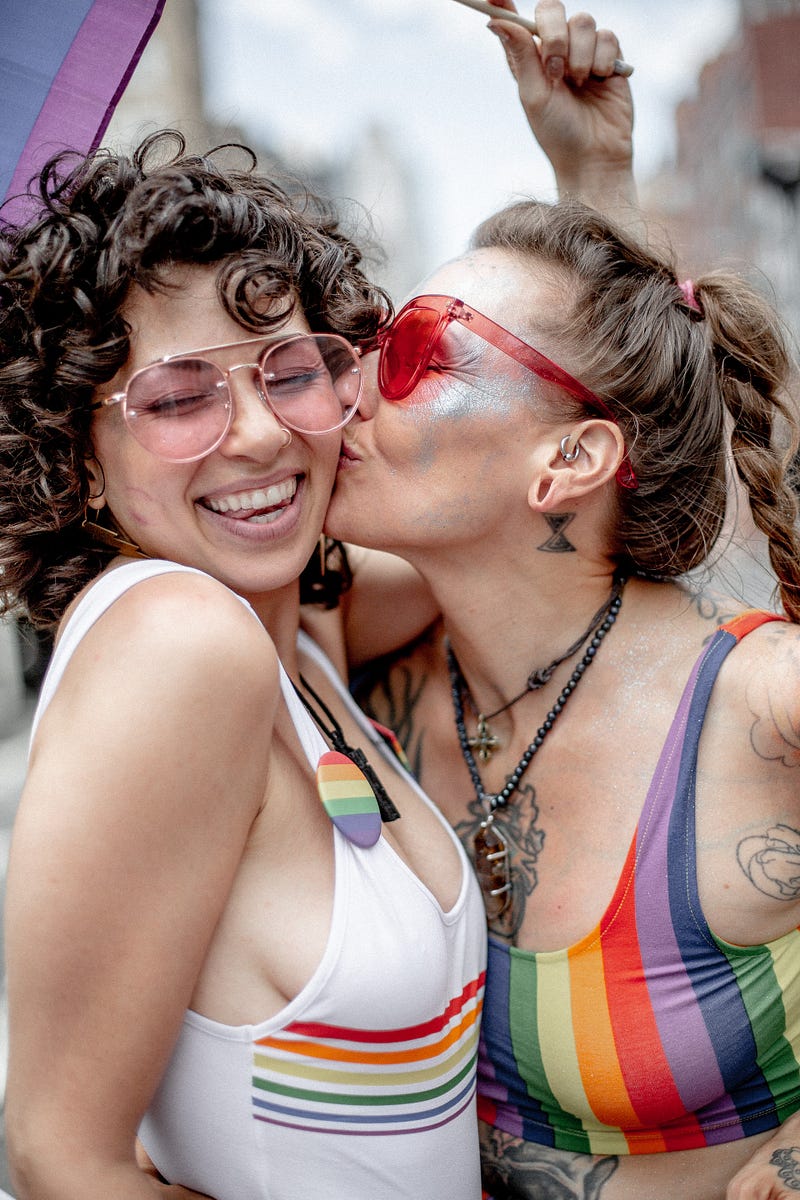
Photo by Brian Kyed on Unsplash

This piece is in response to Crow’s Feet Writing Prompt #8: Pride at any age.

Pride ’94, the Silver Jubilee

A few months after my 50th birthday, I spent a weekend with my good friends Reggie and Carla. I called them “my wives,” because they always took such good care of me. They talked my new girlfriend and me into joining them at the 1994 Pride march — a first for both of us. This particular year, was the silver jubilee, a celebration of the 25th anniversary of the Stonewall riots.

I was carried forth by the sheer joyousness of the event. It was a sign that society was coming to accept “alternative” lifestyles — at least in New York. Elsewhere, kids were still being beaten and killed for being gay.

I had had intimate relationships with women before — the first time during my marriage. However, I didn’t I feel pride. This wasn’t my community.
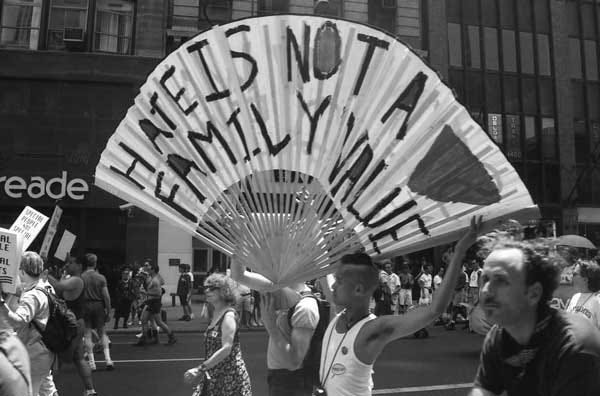
1994 Pride March, New York City, courtesy of Out History

I perceived my journey as different from most of the revelers that day. Growing up, I felt the sting of anti-Semitism, not homophobia. I am white, privileged, well-educated and lived almost forty years of my life as a straight woman. I could pass.

For a long time, I didn’t “call” myself anything. I played for both teams.

Who I slept with was no one’s business. Also, I was writing a column about family. Would readers devalue or discount advice from a bisexual? Would the Ladies Auxiliary of the American Legion strip “The New Family” column in Child of its Best in Media award if they found out the writer lived with a woman?

How odd that sounds now!

Today, I no longer want to pass — nor do I think I need to hide. But that didn’t happen overnight.

Unable — and Unwilling — to Be a Lesbian

Four years earlier, I had sold my apartment in Manhattan and moved to Northampton, better known as Lesbianville. There’s no better place in the U.S. to “out” oneself and to feel pride. And yet, when I first arrived, I felt like the lone bisexual among the militant and anti-male.

Once at my own dinner party, my new friends insisted I label myself, hoping I’d answer “lesbian” or at least “dyke.” Neither felt right.

“If I had to call myself something,” I finally said, “it would be bi.”

This prompted what felt like an interrogation:

“But who are you more attracted to, men or women?”

“Where do you get your emotional support?”

“Would you sleep with a man now?

“Don’t you understand how important it is to protect women’s space? How hard we fought to get it?”

I hadn’t expected that kind of pushback. For all the acceptance they craved, they refused to acknowledge another shade of difference. I was a denier, a fence-sitter, or, worst of all, someone who’d leave the woman I was with for a man.

Puleeze.

Oddly enough, it was sometimes no better with straight female friends. Whether they said it explicitly or not, college chums assumed I’d left my husband “for” a woman. Many thought I had become a lesbian (or maybe was one all along)…and that one day I’d be brave enough to admit it.

The journalist in me sensed that my situation was not unique. I read and researched and interviewed other women. We talked about sexual experience as well as what it meant to grow up as a “girl.” So many women resented that their brothers were treated better and had more freedom.

My greatest “find” was the bisexual community I didn’t know existed. Lani Ka’ahumanu, co-author with Loraine Hutchins, of Bi Any Other Name. The two shared stories, similar to my own, of healthy relationships with men and women.

Lani confirmed that bisexual prejudice was common, especially among lesbians. She introduced me to other activists and “sex positive” thinkers. But of all the eye-openers on that trip to San Francisco, attending Lani’s 50th birthday party showed me why bisexuality was so threatening to both straight and gay people:

You never know where you stand. At Lani’s party, lots of people — men and women — came on to me. Or…were they just being friendly? It was both pleasing and unsettling.

My interviews and research led me to the same conclusion (which sounds obvious 30 years later): Women are fluid in their appetites, depending on how they view themselves and how each new relationship affects them. Every woman’s journey is, as I titled the book, Her Own Affair.

I never wrote the book. But a recent piece written by Marie A. Bailey, also in response to this prompt, beautifully illustrates women’s curiosity, their (dare I say) tendency to dabble — even if only to kiss — and their live-and-let-live ease about others’ sexuality.

My day job as a journalist required me to stand at a distance in order to synthesize what I’d uncovered. Coming to a conclusion about myself was a lot more challenging.

Easing Out of the Closet

In 1996, Freddi Greenberg, my editor at Child asked me to devote one of my bi-weekly columns to gay parents. It was a natural choice for a column on “the new family,” but I also wondered if Freddi had guessed my situation. I never asked.

Around that time, Freddi drove up from New York to visit Northampton with with her daughter, who was looking at colleges in the area. She called to ask if I wanted to have dinner with them.

I vowed I’d never lie if a colleague asked about my home life. Everyone knew I was divorced; I wrote a book about co-parenting. But few asked about my current relationship.

At some point during the dinner with Freddi and her daughter — probably comparing life in Northampton to living in the City — I blurted out, “My partner is a woman!”

I didn’t identify as a lesbian. But “I’m bisexual” didn’t roll off my tongue either. Saying that I had a female significant other at least started the conversation.

I felt better — surprisingly good — afterward. I hadn’t been hiding per se, but the not-saying was getting to me — an elephant in the living room of my own mind. Even a lie of omission can weigh heavily.

I’ve since moved from Northampton. When I relocated to Washington and, later, Paris, and strangers asks what brought me there, “My partner….she…” rolls off my tongue. No one is shocked or judges me. More importantly, I find it easy. Undoubtedly, it might be different if I lived in rural Utah, but I’ll never know.

What I “am” in 2022 seems besides the point.

The hiding and the uncertainties I once I struggled with seem quaint by comparison to the mind- and gender-bending sexual possibilities of today.
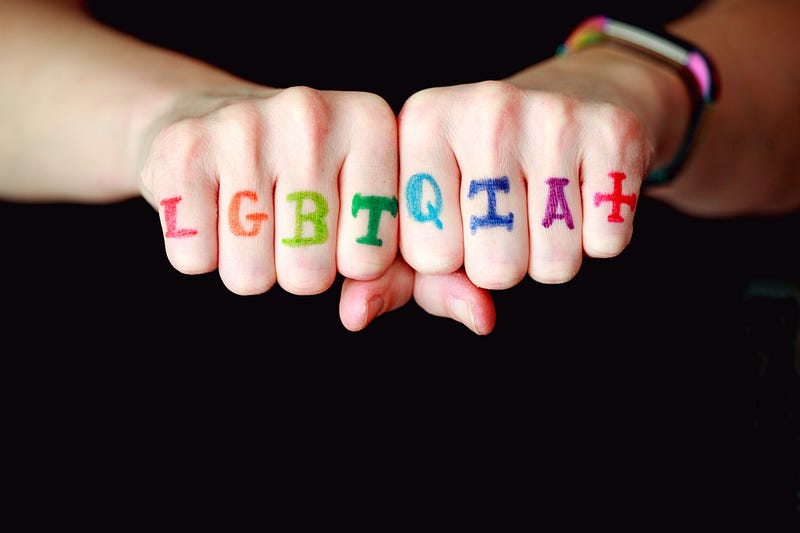
Photo by Sharon McCutcheon on Unsplash

Ironically, now that I’ve been rendered absolutely “vanilla” by the march of sexual consciousness and by the years, I feel pride in myself and my community.

…a feeling of deep pleasure or satisfaction derived from one’s own achievements, the achievements of those with whom one is closely associated, or from qualities or possessions that are widely admired.

The personal pride comes from hard-won honesty. Not just about my sexuality, but to speak my truth about everything and anything that comes at me. To be authentic. I wasn’t always. Now at the very least, I keep trying.

Authenticity, for those of us who work at it, is one of the greatest gifts of aging, regardless of your sexuality.

I feel a collective pride, too but my “community” is not one populated only by queers. I like Kurt Vonnegut’s notion of a karass. Mine is a collection of family members, friends, and countless consequential strangers I’ve met throughout my life.

My people are everywhere, on every spectrum. We come from different places, both real and metaphorical. Some of us, such as my fellow writers on Crow’s Feet, have never met in person. But we are bound together, nonetheless, by a cosmic connection. We share common values of decency and acceptance, of kindness and generosity. Who wouldn’t feel pride as part of such a community?

I understand the need for a marginalized group to assert an identity denied to its members, but I’m not sure that’s what the world needs now.

The truth is, we all carry many identities inside us. We don different hats as the occasion requires. We hope that our multiple selves will peacefully co-exist, but it depends, in part, on what life throws at us.

Nancy, a therapist I consulted in 1989 to discuss my early sexual confusion, was a divorced mother who’d come out as a lesbian a decade earlier. She seemed totally comfortable in her identity but, to her own surprise, backslid when her daughter got pregnant: “The first thing I thought was, ‘How will her children feel about having a gay grandmother?’”

I remembered that story twenty years later when my daughter gave birth to the first of her three sons. By then, I knew myself, felt good about my work, and was in a stable long-term relationship. Just as important, times had changed.

I never had to come out to my grandsons. Two women together was just one of the many possibilities in their world. At three, the youngest asked my daughter whether Tia (my partner’s grandma name) was my “husband.”

Change is always clearer in retrospect. Looking back, I didn’t forsee a world in which a child — my daughter’s youngest, now 13 — would text his grandmother in Paris to wish her, “Happy pride month.”

But that’s okay. In my dotage, I find excitement and hope in the not-knowing. As Agnes de Mille put it

Living is a form of not being sure, not knowing what next or how. The moment you know how, you begin to die a little.

If you like reading me…

Subscribe to my Medium articles — you’ll get an email when I publish. Join Medium with my referral link

Follow me on social media via LinkTree.

Gay Rights
Identity
Mental Health
Relationships
Family
Recommended from ReadMedium