
TEACH ONLY LOVE
Let’s Be Mindful Of Words Said In Anger
Holding your tongue in check is best when seething with indignation

THE power of words cannot be underestimated. I became conscious of this when someone I knew, outraged at her vice-ridden husband, wished him dead — in his face, during a loud, scandalous argument.
I was there. I heard it.
Some 10 years later, another one I knew wished her husband the same for being forever feckless in his family duties. She said this not in his face, but in a seemingly calm but seething in anger manner to other relatives.
I was there; I felt awkward.
At the time, I had the distinct impression that such words — “I hope you drop dead!” — were blurted not with malice, but out of sheer indignation.
These women didn’t mean it, wishing for their husbands’ demise. They were just tired of family problems and responsibilities resting solely on their shoulders.
But words, I gathered from the above incidents, have power.
Both women were widowed within a year or so of wishing their husbands dead. Both cried a river; their grief over the loss of their beloved was painful to witness.
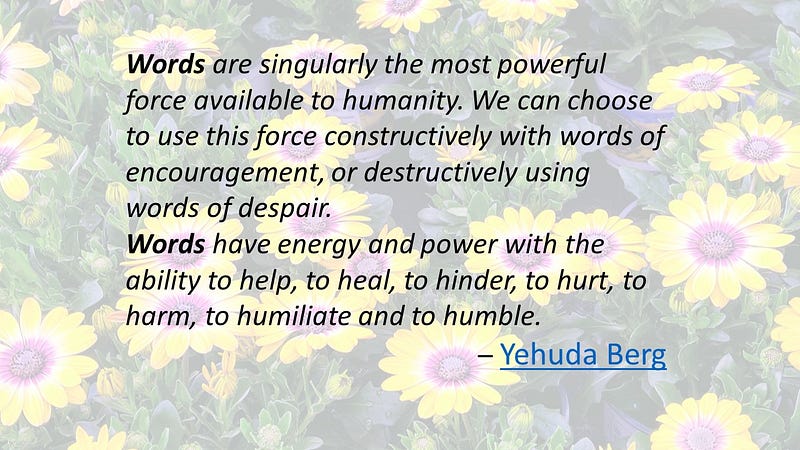
The power and energy of words
The illustration given above, no doubt is extreme. Its being extreme, however, was what made me sit up in earnest. It pushed me to ponder the fearful wonderment of how powerful words could be.
The saying, be careful what you wish for, came to mind. It may be clichéd but this admonition shouldn’t be overlooked.
I was also reminded of Proverb 18.21: Death and life are in the power of the tongue, and those who love it will eat its fruit. It is disquieting at first, but only when one focuses on the word “death” instead of the word “life”.
For as words can hurt and do damage (sometimes irreparably), the opposite is true.
Words can heal, uplift, inspire, provide strength even in the midst of despair, or light up a darkened heart which can be ours or another’s.
Words can even make possible what was earlier perceived as impossible.
Take the case of a young student who had an accident and suffered a severe brain injury; doctors diagnosed that he would be disabled, forever.
For two months, family, friends and schoolmates provided emotional support for the ICU patient. They talked to him, read and sang for him. He recovered, returned to his university studies, and graduated with high honors at Tufts.
Doctors provided lengthy medical analyses on how the patient recovered, all well and good.
But it could not be discounted that the cheery support and get-well wishes given to the brain-injury patient contributed to the student’s recovery.
Be always mindful of words uttered in sheer anger
It is not uncommon for words said in anger to be laden with abuse and ill wishes.
At times, however, the one who blurted out the invectives would later take it back. The reason? It was said only because the speaker was furious.
But should we, could we, deem the mindless utterance null or impotent after we invalidate the ill words we have hurled towards another?
I have no answer to this, although I tremble to imagine that those evil wishes could still be out there: somewhere in the universe, waiting and stewing for a particular moment to come into fruition.
To avoid the above quandary, let’s always hold our tongue and bite our lips when we’re on the verge of cursing or wishing someone ill.
No matter the depth of our frustration, disappointment, or fury towards someone (or something), it’s better to take a deep, deep breath than spit out words that could invite cheerless repercussions.
Instead of rashly negative words, it’s better to speak of or wish for a salve to the hurt or a solution to the issue.
Being mindful of the words that come out of our mouth (or our pen) can only be a boon.
So let’s be mindful and when angry, extra-mindful.
Let kindly words and charitable wishes wash away the resentment in our hearts.
Related readings:
Let’s Be Grateful Let’s Be Kind The Power Of Words To Transform
LinkedIn | WordPress | Twitter | Facebook | Instagram | Amazon Author’s Page | pinoypub.ph Please support me here, and thank you very much.