
TEACH ONLY LOVE
Let’s Be Grateful
Is shaming one’s parents necessary to elevate one’s self?
IMAGINE a big auditorium in an exclusive school. On a festive occasion, a batch of graduates would be recognized in that year’s commencement ceremony.
Jane Doe, summa cum laude, made the event more special. Not every batch of graduates in this expensive university produces a graduate with such high honors.
Add to that the fact that Jane Doe did not come from a rich family. She was on scholarship throughout her four years of pursuing her bachelor’s degree. It was a fantastic academic record, and the university was quite proud of her.
There were three rows of benches in the auditorium facing the stage. Each row has 10 long benches; each bench could sit 10 people.
The middle row was for the parents of the graduates.
On both rows flanking the parents were the graduating sons and daughters. Behind the graduates were their university mentors.
The valedictory address, as per protocol, was delivered by the graduate receiving the highest distinction, Jane Doe.
Her parents sat side by side, timidly, in the front row. They were also nervous.
Jane Doe’s parents looked older than their age, in clothes that showed their humble status in life. They looked joyful though; the pride for their daughter’s accomplishment shone in their eyes.
But the gleam of joy and pride in the parents’ eyes turned into bewilderment, then shock, and finally, tearful horror.
The horror of ungratefulness
In her valedictory address, Jane Doe said that she achieved, all by herself, the honors being bestowed on her. That her parents, she emphasized, had nothing to do with her achievements.
She explained that were it not for her own hard work in pursuing academic excellence, she would not have won a scholarship that made it possible for her to earn a university degree.
Her parents, slammed to the core because they were not rich, could only shed quiet tears.
A collective expression of utter discomposure could be gleaned from the faces of the university chancellor, the vice-chancellor, the deans, and the guest of honor who was seated behind the podium.
The audience, meanwhile, comprised of professors, lecturers, tutors, graduating students and their parents were as dismayed.
A pin dropping on the floor could be heard while Jane Doe delivered her speech thanking herself and dispraising her parents.
Jane Doe’s speech resulted in the chancellor requiring future valedictory speeches to be submitted first to the graduation committee for approval.
The spectacle of a well-respected tertiary institution rewarding, with very high honors, a graduate who publicly insulted her parents was disgraceful.
Why this case still bothers me after over 10 years
I knew Jane Doe, but not up close.
In her last year of studies, I and a few of my colleagues conducted a series of seminar workshops (on creative writing and print/broadcast media) at the university.
Jane Doe was brilliant in the workshops. She was singled out by us in the panel for her excellence. I remembered giving her a perfect rating, rare for me to give, but then she deserved it.
I believed then that she would go places given her exceptional talent.
My favorable thoughts, however, vanished when I learned about how she disrespected her parents.
For me personally, being grateful especially towards parents without whom we wouldn’t be born, is sacrosanct.
If we feel grateful for each new day that arrives, or towards the doctor or dentist for making our pain go away, or when our heart fills up with joy and gratitude when our baby gives us a toothy smile — why not feel joy and be grateful to our parents?
Imperfections
Just as grown-up children could not be perfect, the same with parents.
Parents could not be perfect in the eyes of mature children who seek faultless qualities. There would always be a flaw, no matter how trifling, that others would find in an individual - not only in parents.
But parents - and I will especially refer to mothers - deserve gratitude and thankfulness from their offspring.
Expressions of being grateful and thankful to our parents could take various forms. Inward, outward, silent, private, practical, or unashamedly public.
Exceptions
As in all other facets of life and living, there will be exceptions. Parents who knowingly caused the demise of their children, in my opinion, should not merit gratitude. For obvious reasons.
But again, in my sincere belief, parents who knowingly or unknowingly caused difficulty in the lives of their children should also be shown gratitude.
Perhaps, just perhaps, such children were born into knotty lives to prepare them for resilient and productive adult life.
Being grateful for every little blessing is an act that gives us quiet joy.
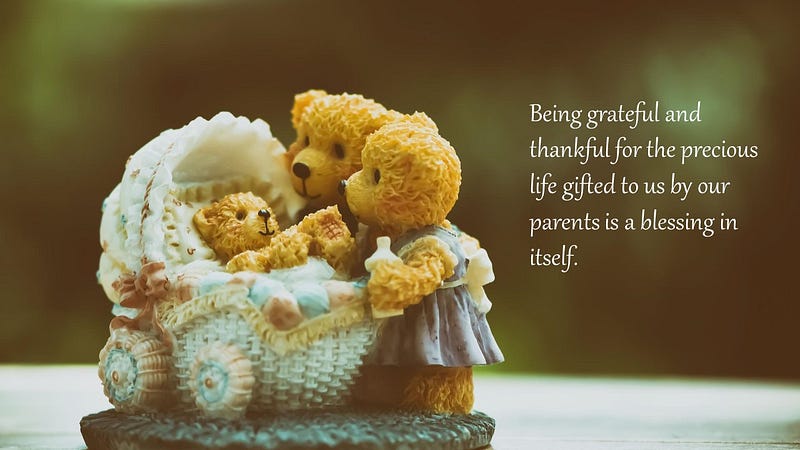
Being grateful and thankful for the precious life gifted to us by our parents is a blessing in itself.
So let’s be grateful.
It’s a boon for the spirit.
Full disclosure: I am familiar with Jane Doe’s case because my elder daughter was the former’s class adviser. Jane Doe, the last I heard, was working at a call center, writing scripts for cold callers. I wish her well, nevertheless, and I hope that she will find the light and the spiritual value in expressing gratitude towards her earthly giver of life.
Thank you for reading.
LinkedIn | WordPress | Twitter | Facebook | Instagram | Amazon Author’s Page | pinoypub.ph Please support me here, and thank you very much.