
Leaving Body Positivity Behind for Fat Acceptance
Cute fats, skin rolls, and why I’m not the right kind of fat to be body positive
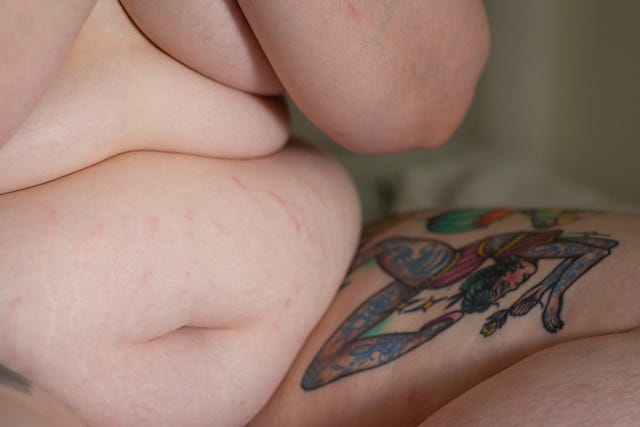
This summer, I posted photos of myself on Instagram in my first-ever two piece swimsuit. In some of the photos, a blindingly white triangle of belly is visible, and for the first time in my life I am okay with that. I used hashtags like #takingupspace, #fatbodiesmatter, #fatgirllife and #fatpositive, but I did not tag it as a body positive post.
As I’ve gotten more familiar with what it means to accept the body I live in, and to advocate for people who look and feel the way I do, I’ve realized that I’m not the right kind of fat to be body positive. I don’t see myself reflected in the bodies society labels as “plus sized,” “curvy,” or “a little extra.” Being tall with a 40D bust, a size 14 waist, and a little extra junk in the trunk is a far cry from being a size 26 or 28 from head to toe.
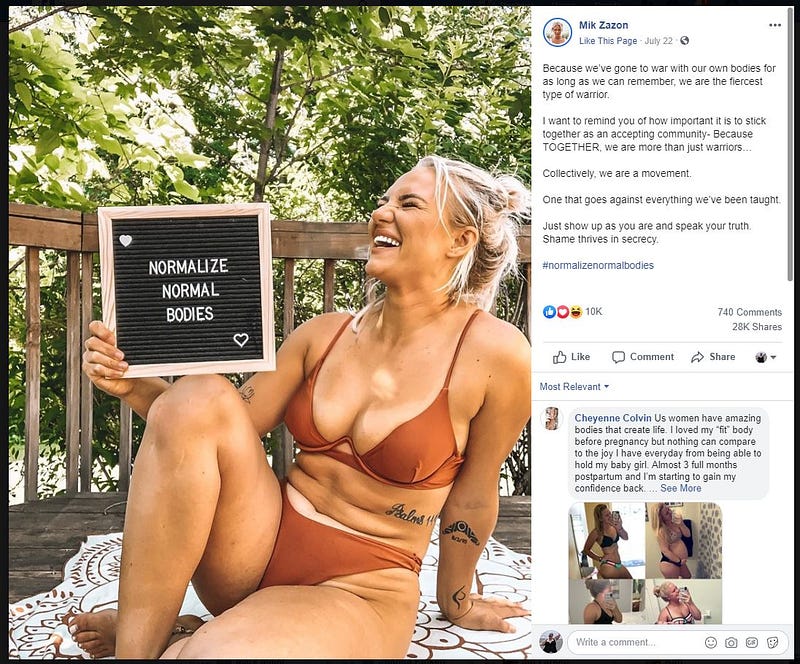
This post was shared in one of my Facebook groups this week, and at first I chose not to comment. I couldn’t stop thinking about it, though. When I see a hashtag that says #normalizenormalbodies and then the body in the picture is of someone who is smaller than the average sized US woman, and decidedly very much smaller than I am? It brings up all the feelings I’m trying to fight every day. My body is not normal. My body is not acceptable. My body is bad.
The concept of “sticking together as an accepting community” sounds good at face value. But it’s not that simple. There’s a difference between wrinkled skin and skin rolling with a layer of fat underneath. Almost every human can lean a certain way and create a crease in their flesh. There’s a difference between a body that can shop at any store its owner chooses, that when clothed is slim and smooth, and my body, with its drapes and lumps and curves.
Who is “body positivity” for?
When I watch bodyposipanda shaking her stuff, I feel simultaneously happy and unsettled. I consider what the reaction would be if I posted the same video and I don’t think I’d be called brave or beautiful. I think I’d still be called disgusting and unhealthy and told no one wants to see it. This is the conundrum of what I’ve come to refer to in my head as “cute fats” in the body positive movement. “Cute fats” are lovely, but they are the slimmest you can be and still possibly, maybe qualify as being on the fat spectrum. They’re pleasantly squishy, a little jiggly, and 100 times more acceptable.
Don’t get me wrong. She is beautiful, doing so much for so many people, and I adore her strength in overcoming disordered eating and self-harmful thinking. I’m glad she’s doing what she’s doing. What she’s doing is important. It’s just… maybe not so important for people like me. There is a huge difference between eating disorder recovery and fat acceptance. There is a huge difference between being positive about the bodies we live in and working to change the fat-phobic and discriminatory systems and practices our culture perpetuates.
I prefer to talk about fat-positivity or fat acceptance, but also feel like people use the language to willfully misunderstand what I’m talking about. The idea of being fat-positive is misconstrued as glorifying fatness or obesity, when really fat people are just asking to be treated like we are human.
When I talk about fat acceptance, I’m not saying that you should get fat on purpose and then love yourself. Why would I encourage anyone to purposely live a life where they will be marginalized, shamed, and laughed at for the way they exist?
Plus Size≠Fat
As a US pants size 26, I fall outside the range of almost every straight-sized store. Even the ones who have “plus size” sections often only go up to size 18 or 20. On the surface, it seems super fantastic that brands are featuring models of different sizes and shapes, but how inclusive is the inclusivity, really?
When a brand features a “plus-sized” model like Ashley Graham, who is 2 inches taller than me, over 100 pounds lighter, and 10 sizes smaller, am I supposed to feel represented? She literally wears the same size as the average American woman but on a frame 5 inches taller. I just cant see myself in her flat stomach and hourglass shape, noticeably devoid of hanging skin or fat and stretch marks. Yet, she is a pillar of the body positive community.
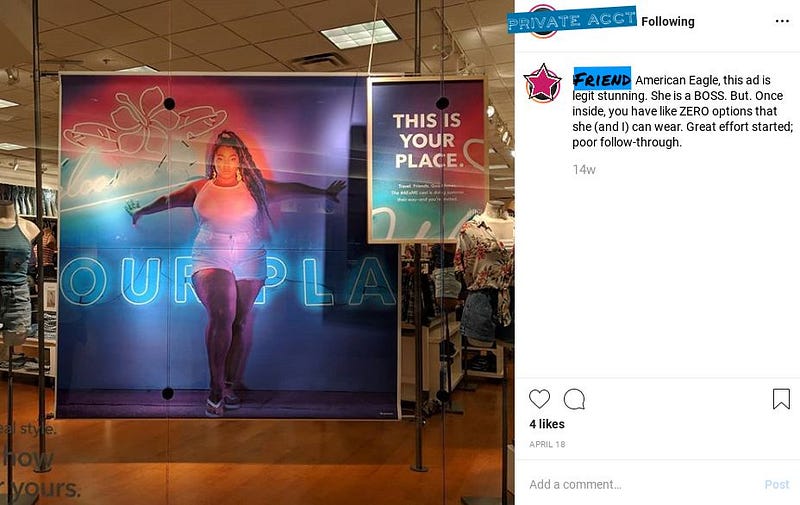
My friend posted this Instagram photo from our American Eagle — a larger-than-life poster of a badass babe with a real body right in their front window. But there’s no follow-through, there were no plus sizes to be found inside the actual store.
Brands like Shapermint use #bodypositive tags on their Facebook ads for garments to squash and mask your natural curves into something smoother and more socially acceptable. Everlane featured plus size/curvy models in their images, positing inclusivity, but only carried sizes up to XL, which are decidedly not inclusive. Brands like Urban Outfitters use plus sized models but don’t carry the sizes that would fit them, or print shirts with slogans like “Riots, Not Diets” and “Every Body is a Good Body” but then don’t carry anything above a size 12. Very few brands are truly inclusive the way that Universal Standard is, with photos of their clothing in the same styles for sizes from 00–40.
Leaving body positivity behind for fat acceptance
Wherever I look, images of people who look like me are noticeably sparse. Shoog McDaniel, a fat positive photographer and artist from Florida articulates the struggle of fat people, saying:
There are certain folks who want to be a part of the body positive movement simply because they want to be part of some kind of marginalized identity. I’ll see someone will write a long post where they’re naked in front of a mirror, and they’ll be like, “I really had to learn to love my body,” and it will be a very normative body — and they’ll be so applauded for that. I think my work really speaks to those who cannot connect to that struggle at all. Because the people that have a hard time accepting themselves in their thin bodies have a vastly different set of experiences than fat people. Fat people are constantly ridiculed, pushed out of places and rejected from doctors, and deal with all of these things that thin people don’t have to deal with. That’s why I feel like I’m involved in the fat positive movement and not really the body positive movement. source
This is why I’m leaving the body positive movement behind for radical fat acceptance. Fat-phobia and discrimination are very real. Only one out of 50 US States has laws against workplace discrimination based on size. As a fat woman, I am less likely to be hired, more likely to be misdiagnosed or dismissed by doctors, and almost never see bodies like mine represented in the media.
Sian Ferguson, in her article Your brand isn’t body positive if you don’t make clothing for fat people, wrote:
Body positivity is a movement that started because of fat acceptance activists. Body positivity should include making the world more accessible to fat people. This includes clothing. Otherwise, you’re commodifying body positivity while excluding those who need it most.
Body positivity isn’t a trendy caption — it should be a part of a broader movement. If you’re using body positive platitudes but you don’t make clothing for people over a size 12, you’re not body positive. You’re saying, “Self-love is great, but only for people who basically already fit the status quo”. As the writer Your Fat Friend writes in this gorgeous piece, body positivity shouldn’t come with caveats about which bodies are acceptable.
Sian asks “what is the point of body positivity if it excludes fat people?” There is certainly a place for other types of body positive thinking. All people deserve to feel comfortable, accepted, and beautiful in their bodies. All people deserve to be respected and not to be discriminated against because of the shape or size of their vessel. That place isn’t the place I need to be.
Recently a commenter on one of my posts said that she never had any expectation of loving her body, and I disagreed with her idea that body love is something we’ve been “sold by fat society.” I replied:
I disagree with the idea that loving your body is a goal that sets us up for failure. Loving your body doesn’t have to mean that you don’t think you have flaws, or that you don’t have bad days. The same way that when you love another human being you don’t like them every moment of every day. I have days where I feel down on myself or dislike the way my body looks or feels. There are specific parts of my body I like less than others. But I still love my body. I love that it is my home. I love that it lets me physically connect with people. I love that it lets me feel touch and pleasure.
Accepting your body is something to be proud of. For me, accepting it was part of falling in love. I don’t love my body because it’s the BEST body or because it’s a BETTER body than someone else’s. I love it because it is my body, and I love myself.
I’m comfortable calling myself fat, because I am. I don’t need euphemisms like curvy and fluffy, instead of masking my existence with more palatable words, I’d like people to acknowledge it. I am a smart, funny, empathetic and loyal woman. I am good enough already, just the way that I am. I have 1,000 truths, and the shape of my body is just one of them.
You might also enjoy…