
Learning Economics By Playing ‘Animal Farm’ with Fisher Price People
How I re-enacted George Orwell’s fable with my daughters
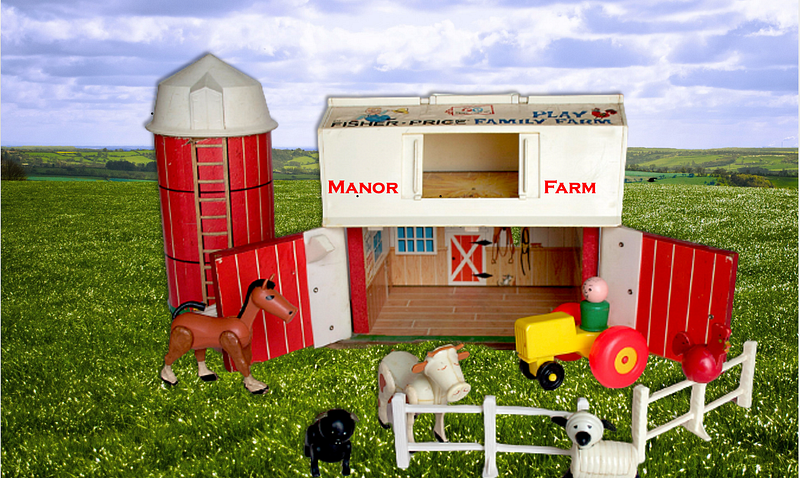
When my daughters Katherine and Sarah* were young, we frequently played Fisher Price farm. I was on the carpet in the den or on the cold, white ceramic of the kitchen — playing.
Sweet Streets. Thomas the Tank Engine. My old Navarone war set. My old wooden blocks.
The Fisher Price Farm — rechristened Manor Farm — wasn’t my old farm, like my awesome airport or my garage or my village that witnessed so much bloodshed in the street fighting with my army men.
By the end of the conflict, the Fisher Price streets looked like scenes from The American Civil War — Bloody Lane at Antietam. Or if you’re from the South and still hold a grudge — The War of Yankee Aggression.
This was Manor Farm Redux — with solid plastic, better, perhaps, for smaller fingers and hands, with more rounded features.
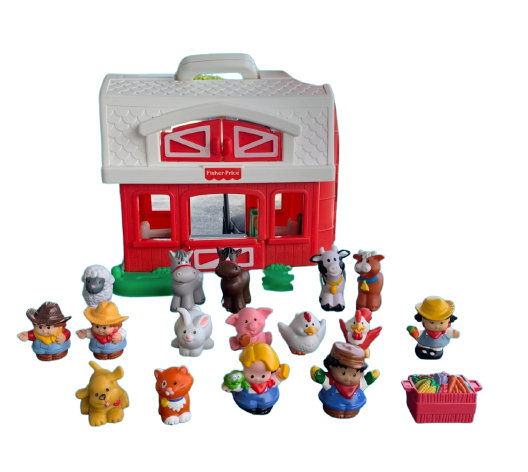
In 1995, it was called “Little People Big Red Barn.”
Playing toys with Dad always meant a history lesson, a lesson on politics, literature, social customs, and lessons on sexism, racism, classism, and economics. Nancy even once threw a shoe while playing Barbies at Ken to re-enact President Bush getting a shoe thrown at him during the Iraq War. So current events were also on the table.
I usually played the Farmer — and my name, usually, was Mr. Smith. My daughters would play with the animals, making funny voices, giving the animals personalities and mannerisms.
Usually, however, as in any fairy tale, All Was Not Well on the Farm.
I recall this one time. My mother-in-law, Nancy McCarthy Mark, was visiting from State College, PA. She was in the kitchen, sipping tea, and working on a New York Times crossword in ink.
Yes, ink. She was that sharp.
As usual, I told Sarah and Katherine, then probably 3 and 7, we would play something called “Animal Farm.” It always sounded fun. A fable. A story about talking animals — Bugs Bunny or Charlotte’s Web or Click Clack Moo — Cows That Type.
This definitely sounded much better than A Critique and Condemnation on the Excesses of Unrestricted Laissez-Faire Capitalism and Why Soviet-Style Marxism is an Opiate for the People Who Will Suffer and Die Under a Dictator Worse Than Mr. Smith.
But that was my lesson. And boy, was it fun — as you’ll soon see. It was also fun hearing, every minute, moans and groans and laughs from my loving and conservative mother-in-law, about “What are you teaching my granddaughters?”
Economics 401. An upper level class.
Before English, I was a business major. I read The Wall Street Journal and The National Review — when such intelligent publications still existed under the “conservative” umbrella charms and wit of George Will, William F. Buckley, Charles Krauthammer, and Bill Kristol.
Ah, those salad days of moderate conservatism when you could disagree, be a patriot, and be charmed by a gentleman like Ronny Reagan and Jack Kemp.
In the 1980s, I supported Reagan as a Young Teenage Conservative. I also wore a tie to school, but that dark story shall wait in the wings until called to the stage.
But I digress, only to salvage my reputation as an evenly-balanced thinker and writer. I parrot not slogans nor follow banners. Like George Orwell, perhaps, who wrote the famous novella, a work he called a “fable,” I like to keep an open mind. And when a pox or a plague needs to be called upon both systems — capitalism and Marxist Socialism, then so be it.
Amen.
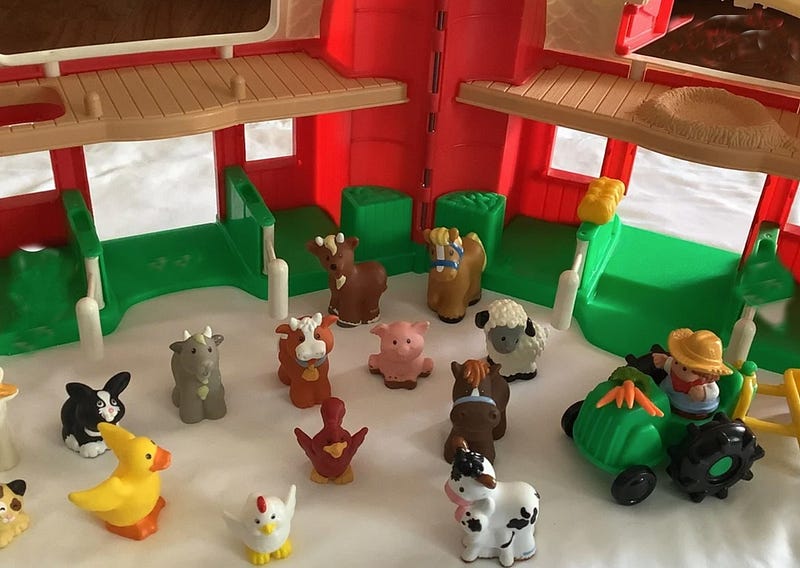
I played Mr. Smith in the yellow straw hat and red kerchief. I drank. I mistreated the animals. Like Sir Topham Hatt from Thomas the Tank Engine, I owned the means of production, das capital, and I wanted to make sure my animals worked hard to make me money.
“Just make sure you’re truly useful, to me,” I said, as I whipped the horse called Boxer.
“Why are you whipping me?” Sarah as Boxer asked. “You’re drunk!”
“You’re not working hard enough!”
That’s when Katherine, the Pink Pig — also known as Napoleon — tells Boxer later, as well as the rest of the animals, that they should revolt against Mr. Smith.
“Why should we do all the work, and get none of the reward?”
That’s when I hear my mother-in-law yell, “Walter! What are you teaching them?”
Just a condensed version of The Communist Manifesto. And a history lesson on the Russian Revolution. And Karl Marx.
Soon, the animals have kidnapped me — Mr. Smith with the Huge Smile in the Yellow Straw Hat, and the Lamb rides the tractor over me.
“Take that, Mr. Man! Mr. Capitalist! Mr. C.E.O! Mr. 1%!”
The animals now have placed me in prison in one of the farm corrals. “See how you like it, penned up like this, only to be slaughtered!”
The play continues, and I paraphrase the Seven Commandments of the Animal Farm. “All animals are equal.”
“Sounds nice, right,” I ask my daughters. “Like ‘All men are created equal’ from our Declaration of Independence.”
“But women couldn't vote, and we had slaves, and we slaughtered the Native Americans,” Katherine must have replied. That’s just Katherine— advanced beyond her years.
“Walter!”
“This is all the Truth, Ma,” I replied. “This is great in theory, but — ”
That’s when I play “Piggies” from the Beatles and Pink Floyd’s “Pigs (Three Little Ones)” from Animals or “War Pigs” from Black Sabbath. The pigs take over — Snowball, Napoleon, and Squealer, filled with a lust for power and privilege. There is just One Pig on the Little People Farm, but it all makes sense.
They ask: wasn’t Napoleon a bad guy?
“Yeah,” I said. “A dictator. He took power after the French Revolution. We got Washington. France got a small Corsican who set the world ablaze in death and destruction.”
The Pig Napoleon takes over — and he kills other animals and sleeps in a bed and starts drinking and wears clothes like humans and smokes cigars — and rewrites the Commandments to support his own Tyranny.
We bury the animals. Then we send the hardest worker — the Horse to the glue factory. The pig then releases Farmer Smith, and we have a nice brandy and celebrate out collective wealth.
“So what is better, girls? Capitalism, where someone owns a company, and hires people to work, or Marxist Socialism where there is no class and no social hierarchy and everyone is equal and gets paid the same?’
But that doesn’t happen on Animal Farm. Napoleon is worse than Mr. Smith.
“I think you answered my question, gals.”
“Walter!”
“Okay — who is ready to play Toxic Male Ken and Steven Meet Barbie in a Club in Barcelona?”
*Names have been changed.


