
THE PARENT ARCHIVES
A Father Teaches Valuable Lessons While Playing Barbie and Ken
Getting real with my daughters about empowering women
One day, seventeen years ago:
My nine-year-old daughter Katherine* discovered Newsweek by the toilet in my bathroom — the impromptu study.
The “naughty” pictures of Britney Spears and Paris Hilton on the cover piqued her interest. She concealed the contraband and read in her bedroom.
“Daddy, did you read this?”
“Well, I was going to. . .”
“Why are girls acting like this?”
I sat down. Good question. Why don’t more ask? I could provide answers, but would that help? Would that be more mansplaining?
After all, belittling sexual imagery is everywhere. The girls on the playground sing “My Humps” and third-grade boys spit out the f-bomb and “bitches” like chewing tobacco.
My younger daughter Sarah* asks, “What’s pole dancing?” Then plays with Bratz dolls at her friends, and Katherine spots Target shirts with bare midriffs with slogans that read, “My eyes are up here.”
What’s a father to do?
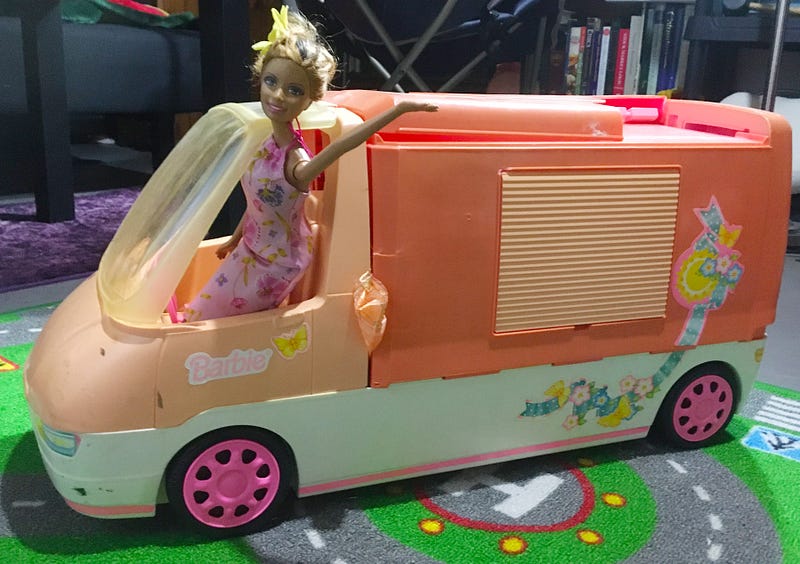
How about role-playing with Barbies? That song about being “plastic and fantastic” was playing back then.
Oftentimes I’m on the floor with my daughters, playing Thomas, Legos, and dolls. The dolls are mostly-naked and multi-ethnic. Most have at least a head. Some limbs. At first glance, it’s more House of the Rising Sun Hospital than a Wholesome Home.
I use carpet time as learning time. Is that better than a lecture about Barbie’s obscene body proportions?
I take the naked Ken doll — or the African American Steven doll (where we role-play the challenges and rewards of interracial dating) or the “buff” Tsar Nicholas II from “Anastasia” and dress the plastic dudes like typical “wolves” — with manly chests exposed and sleeves rolled up and black shiny shoes and baggy white pants. We create a disco with music.
“Now I want you girls to pretend this guy is hitting on Barbie and Stacie,” I tell my daughters. Then I fashion my jerk-macho man voice.
“Hey baby, you’re looking mighty sweet,” I say as The Tsarist Macho-Man. Ken-the-Pimp-Daddy-Player is right by his side. Steven is there, too.
“My name is Katherine,” says my daughter as Barbie, “and I’m not candy.”
“Well, how would you like to shake me up on the dance floor, you hot thing?”
Immediately, Stacie, in the voice of my-five-year-old Sarah, flies across the dance floor and attacks “the wolves” in a series of body attacks — like a Red Riding Hood no longer hoodwinked.
“You leave my sister alone!”
I instruct Sarah physical violence may not be the first option. But I like her style. Perhaps Krav Maga may be in the future (they did, eventually, take courses).
Imagine if girls responded that way? She screams at Ken and Steven to get lost. Calls them creeps. Losers. Katherine corrects Sarah. “Talking mean” to them won’t help them become better men.
Who are these kids?
I have Ken and Steven and the Tsar try all sorts of come-ons. They attempt to buy drinks. Compliment. Prod. They reject every line. Soon the jerks realize the dolls are not their playthings.
For good measure, Sarah slams them again — forgetting the Golden Rule.
Then we change the venue. Instead of a bar (where most of the guys will mostly be there for the alcohol, and therefore, possible alcoholics), we pretend we’re at the Art Museum or a Billy Collins reading at the Free Library.
Or the zoo. Longwood Gardens. The British Museum. The d’Orsay. But there can be many more wolves, there, too — education and pretension and a love of flowers and Monet can be more veneer — Grannie’s nightgown to the Wolf.
It’s then I give them the lesson: how to spot a great person and how to act civilized and empowered — and no push-over. Acting “lady-like” may seem too “1950s” or permissive and submissive. Does it — “lady” — have a negative connotation anymore? There is a balance, right?
Plus — one day — they also need to “own” their own sexuality — and not be based on our media and sexist culture and religious and cultural shaming. The same goes for men — and body shaming and slut shaming.
They should not feel pressured. Rejection is something all need to learn. Never date out of sympathy or pity, or because you feel flattered. If interested, provide your number — and then date. And date. And date.
And never agree to pay the mortgage, unless you’re married and committed, and there’s been a layoff. Life is not easy, but never lower standards or self-respect.
I model this by taking my girls out. Sometimes, just one at a time. “It’s date night with Dad!”
They need to know what to expect: good manners, good conversation, good morals, lots of interests, ethics, intelligence, with or without an expensive degree, a non-racist, non-sexist, and hopefully someone with a good job, or the potential, and a hearty laugh.
When my wife met me, after all, I was a waiter with a Master’s degree in English half-way completed. She took a chance on me, like the ABBA song, and it paid off.
The other day Katherine was explaining to Sarah a political cartoon in Newsweek. What was it about?
“Is that Bush?” Sarah asked. “Why does he have such big ears and a little head?”
Katherine said the cartoonist was making fun of Bush. It was a “caricature.” Then they got into a political debate.
“I love Bush!” Sarah said.
“He’s horrible! Don’t you know about Iraq?”
I just smiled.
My girls will be much more than pretty faces. They’ll know they won’t have to act or dress a certain way to attract attention. Or allow to be “grinded” on the dance floor in simulated sex.
So now we play The White House. I show up as Ken-as-President-Bush and ask Barbie and Stacie what they think of my policies.
I try to deflect Katherine’s right-arm thrust, a Barbie shoe tossed at the head of the president in protest.
*Names of daughters have been changed.
Thank you for reading! For more Walter Bowne, check out:


