EDUCATION FOR INNOVATION
Learn How to Develop a New Product
A step by step guide on how to create a new product
Before we delve in, I’d firstly like to draw your attention to a couple of famous quotes to set the tone:
“I think there’s a world market for maybe 5 computers.” — Thomas Watson, Chairman of IBM 1943
Also, the inventor of the light-bulb said:
“The radio craze will die out in time.” — Thomas Edison. 1922
What about the home computer?
“There is no reason anyone would want a computer in their home.” — Ken Olsen, Founder of Digital Equipment Corp. 1977
As you can see, inventors and market giants can get it wrong and disastrously so, hence the reason for this article to highlight New Product Development.
There are four objectives that this article is designed to achieve:
Objectives
- Explain ways to ideate, validate and develop new products
- List and define steps in the new-product development process
- Understand the stages of the product life cycle
- Learn marketing strategies throughout the product life cycle
New Product Development
NPD is the process for the development of original products, product improvements, modifications or new brands through R&D efforts.
To demonstrate the power of NPD, below is a summary of its impact on Apple:
Apple History
- Steve Jobs’s creativity led to innovations in user-friendly personal computers.
- LaserWriters and the Macintosh firmly established Apple in the desktop publishing marketplace.
By the late 1980s, Apple had lost its status as the market leader and innovator. “Jobs had left” the firm (Weinberger, 2017).
Apple Recovery
- Steve Jobs returned to Apple in 1997, revitalizing the brand by first launching the iMac.
- The Mac OS X breaks ground and becomes a launching pad for next-generation computers and software products.
- Apple leaps market boundaries. The iPod and iTunes changed the face of the music industry— you could say it was the hit of the last decade!
- A design, user-led, risk-seeking culture unfolded thereafter.
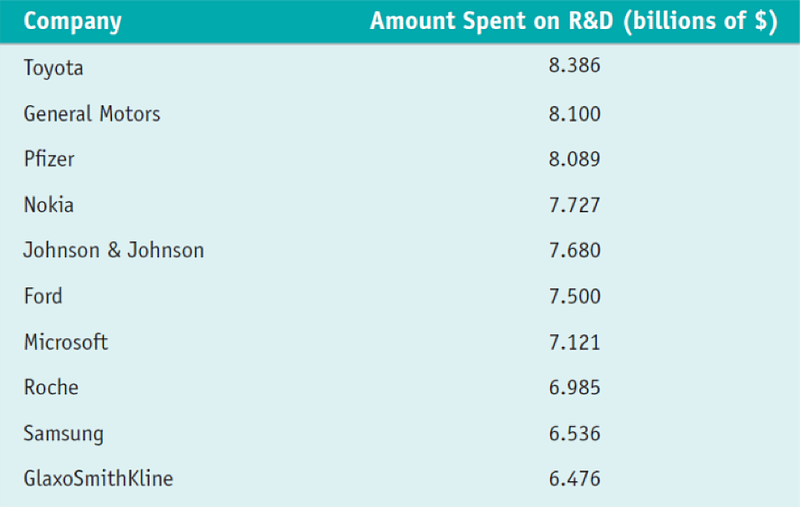
Top 10 Global Companies in R&D Spending (2007)
For reference, the sample list below shows R&D investment, by organisation.
Other Insights
There are two general points worth noting:
- Only 10% of new consumer products are still on the market and profitable after 3 years. Think about earlier iPhone models for instance.
- The industrial product failure rate can be as high as 30% (Dehoff, 2008).
Why do products fail?
- Overestimation of market size
- Design or production problems
- Incorrect positioning, pricing, or advertising
- Launched despite poor market research findings
- Escalating development costs
- Stiff competition
NPD Strategy
Companies release new products in two ways:
- Acquisition — buying a company, license or patent, and
- Via new-product development
This article is about the latter, New-Product Development, touching on:
- Developing new products
- Product improvements or modifications, and
- New brands within a company’s own R&D efforts
To create a successful new product, a company or Entrepreneur must understand consumers, markets, and competitors to develop products that deliver superior value.
Eight Stages of Product Development
Now let's jump into the nuts and bolts of NPD.
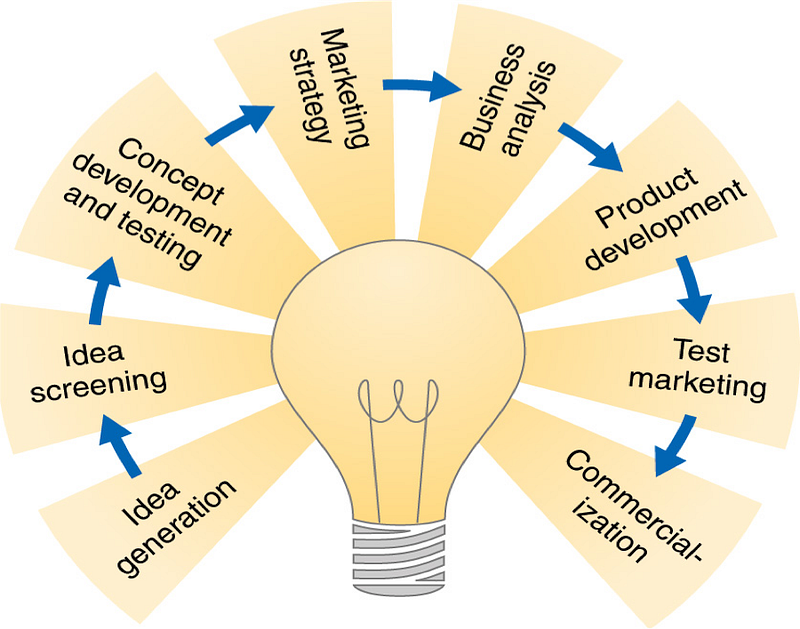
Stage 1: Idea Generation
There are two sources of idea generation in the business world:
- Internal Idea Sources: A business finds new ideas through formal research and development — picking the brains of company executives, employees, scientists, engineers, etc.
- External Idea Sources: New-product ideas also come from observing and listening to customers, competitors, distributors, and suppliers
Idea Generation is the systematic search for new product ideas.
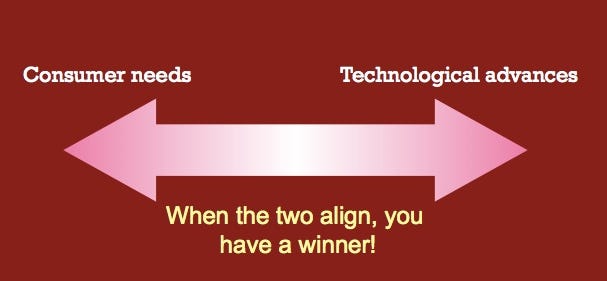
Companies and Entrepreneurs generate hundreds if not thousands of ideas, but only a few make the grade into production.
“Because of shorter product life cycles and faster technological obsolescence, companies are finding that quicker time-to-market with new products has become a competitive advantage.” — Russel Wilner
The search for new product ideas should be systematic.
Companies benefit from an ideas management system that directs the flow of new ideas to a central location — collected, reviewed and evaluated.
Stage 2: Idea Screening
Product development costs increase substantially in later stages. Hence ideas are evaluated against criteria; most are eliminated in this stage.
Idea Screening is an idea-cleansing step — it enables companies to spot good ideas and drop poor ones.
Here are some questions that weed out the good ideas
- Is the product useful to consumers and society?
- Is it a good fit for the business?
- Does it merge with objectives and strategy?
- Are resources available — people, skills, and funding?
- Does it deliver value to customers compared to existing products?
Stage 3: Concept Development and Testing
Product concepts provide more detailed versions of a new product idea.
Concept testing engages with target consumers to evaluate the product concept i.e. user testing.
Concept Development is when an idea is developed into a product concept.
- Product Idea: A possible product idea that a company can foresee itself offering to the market
- Product Concept: A detailed version of the idea with meaningful consumer terms, like user-stories and scenarios.
- Product Image: Consumer perception of an actual or potential product.
- Concept Testing: Conducts user-testing for a new-product concept with groups of target consumers/users.
Exposing the customers to a concept and gauging their reaction to the proposed concept is NPD gold.
Stage 4: Marketing Strategy Development
Strategy statements capture:
- The target market, product positioning, sales, market share, and profit goals for the first few years.
- Product price-point, distribution channels, and marketing budget for the first year of launch.
- Long-term sales, profit goals, and the marketing mix strategy.
What's your strategy statement?
Stage 5: Business Analysis
This involves a review of the sales forecast, costs, and profit projections for a new product to discover if it satisfies the company’s objectives.
- An evaluation of the attractiveness of the proposed product
- To estimate sales, businesses look at historical sales of similar product, along with research data and market surveys
If the concept passes the business analysis stage, it moves from concept into development.
Early-stage prototype or MVP mock-up can be critiqued at this point.
Stage 6: Product Development
A refined prototype or MVP is the output of this stage.
R&D or engineering develops the product concept into a physical or digital product, involving a jump in investment.
R&D designs a prototype to appeal, satisfy and excite consumers. The aim is to deliver an MVP that can be produced quickly and within the budget.
The prototype must include the required functional features, captured and defined during research.
Stage 7: Marketing Testing
At this stage, both the product and marketing programs are aligned with a more-realistic market approach.
- Standard test markets: The company finds a small number of representative test subjects, cities, countries to conduct a full marketing campaign. Continuous user testing, consumer and distributor surveys are distilled to gauge product performance.
- Controlled Test Markets: This involves several research firms, a panel of outlets (online or offline) to carry new products in exchange for a fee.
- Simulated Test Markets: The business or research firm shows ads and promotions for a variety of products, including the new product being tested, to a sample consumer audience. Consumers are rewarded to participate during early launch testing and evaluation.
This armors marketers with insights to measure product performance, adoption, before investing in a full rollout.
In effect, a business can test a new product and its entire marketing program — positioning strategy, advertising, distribution, pricing, branding and packaging, and budget.
Some Pros and Cons
- The product/marketing program introduces a more realistic market setting to better predict the outcome.
- Not suitable for all products.
- It can be an expensive and time-consuming process, but better than having to recoup a major marketing investment if it fails.
Stage 8: Commercialisation
This is when a new product is introduced to the market.
A business must decide upon the timing of the introduction as well as where and when to launch a new product.
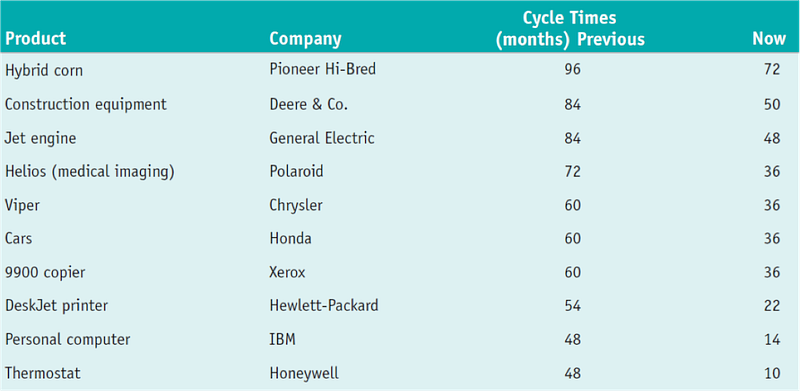
- Sequential Product Development: Under this approach, a company department works alone to complete its stage of the process before passing the new product along to the next department.
- Simultaneous Product Development: Under this approach, business teams work concurrently in a cross-functional fashion, overlapping steps in the product development process to save time and increase effectiveness.
Product Life Cycle
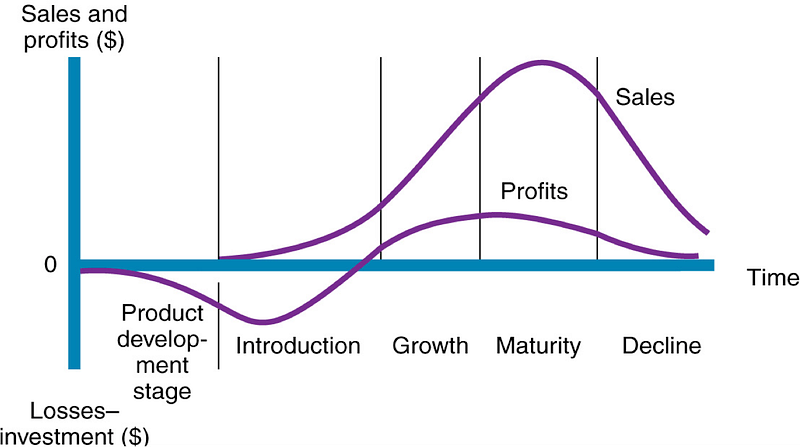
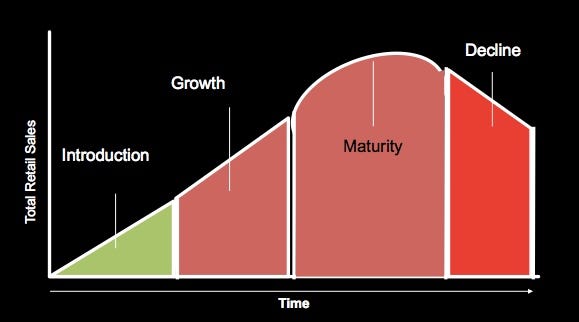
A typical Product Life Cycle (PLC) has five stages — the course of a product’s sales and profits over its lifetime — the stages are:
- Product Development: the business finds and develops a new product idea — sales are zero and investment costs are high
- Introduction: a period of slow sales growth as the product is introduced to the market — profits are non-existent
- Growth: a period of rapid market acceptance and increasing profits
- Maturity: a period of slowdown in sales and growth because the product has achieved acceptance by most potential buyers
- Decline: The period when sales fall off and profits drop
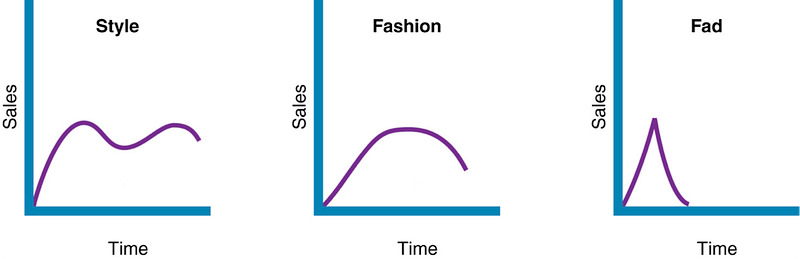
Not all products follow this cycle, such as:
- Fads
- Styles
- Fashions
- Technology
Using the PLC to forecast brand performance or to develop marketing strategies is a tried and tested approach.
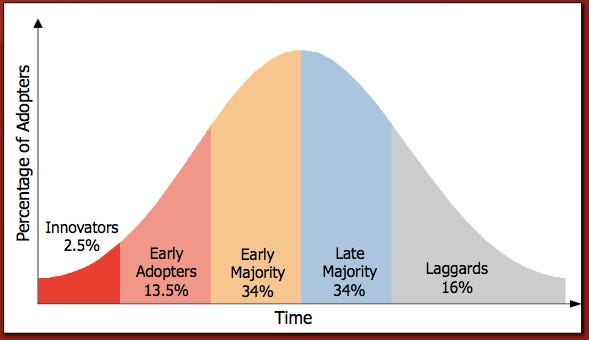
So let’s drill down into each stage to understand the implications from a Sales and Marketing perspective.
Stage 1 — Product Development
Precedes a new product launch, as outlined above.
Stage 2 — Introduction
Commences when the new product is first launched, as per the graph above.
Profits are negative or low due to low sales and high distribution and promotion costs.
A business must choose a launch strategy that is consistent with the intended product positioning — value proposition.
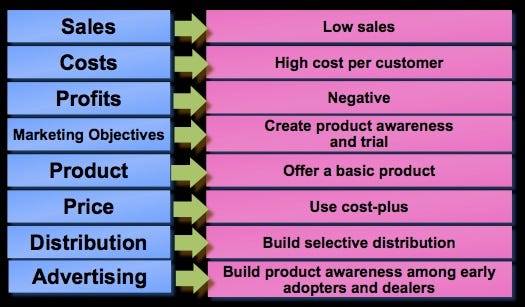
Note that the initial strategy is just the first step in a grander marketing plan for a product’s entire life cycle. Recommendations include:
- Product — Offer a basic product
- Price — Use cost-plus basis to set rate or freemium for digital
- Distribution — Build selective distribution channels
- Advertising — Build awareness among early adopters and channels
- Sales Promotion — High expenditure to deliver early trials
Stage 3— Growth
If the new product satisfies the market, it enters a growth stage in which sales are expected to climb quickly.
Note that new competitors may enter the market at this stage.
New product features may be introduced. The number of distribution channels may increase too, leading to sales growth.
Profits increase as promotion costs are spread over a large volume and production costs should fall.
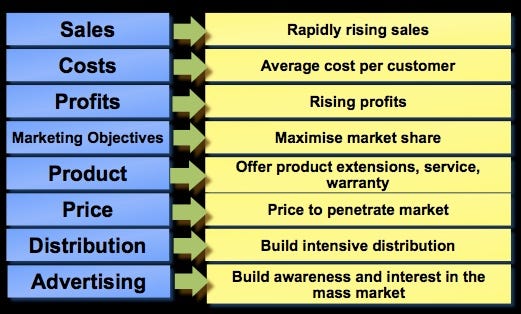
Spending a lot of money on product improvement, promotion, and distribution, can enable a business to become the dominant player in the market. In doing so, however, it sacrifices maximum profit, although this can be recovered during the next stage.
- Product — Offer product extensions, service, warranty, add-ons
- Price — Penetration pricing
- Distribution — Build intensive distribution channels
- Advertising — Build mass-market awareness and interest
- Sales Promotion — Reduce expenditure and take advantage of consumer demand
Stage 4— Maturity
In this stage, a product’s sales growth tends to slow.
Although the maturity stage lasts longer than the previous stages. Most products reside in the maturity stage, certainly in the FMCG space.
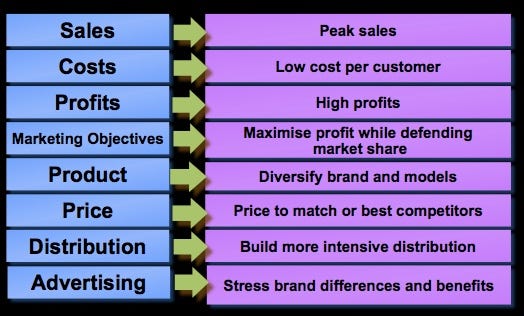
A slowdown in sales growth can result in more producers, new entrants, which leads to more competition. Recommendations include:
- Product — Diversify brand and models
- Price — Match or beat competition
- Distribution — Build intensive distribution channels
- Advertising — Stress brand features and benefits
- Sales Promotion — Encourage brand switching
Stage 5 — Decline
The sales of most products eventually dip — this is the decline stage — unless a variation or improvement occurs, which is then relaunched.
Some companies withdraw from the market, some refine their product offering, others drop smaller market segments and marginal trade channels.
Some businesses may decide to maintain its product, with little change, in the hope that competitors will leave. A highly risky strategy.
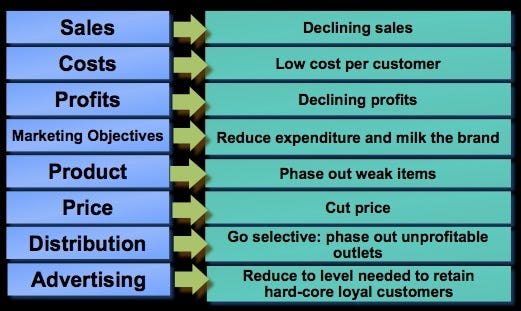
Another strategy is to harvest the product, which means reducing costs, in the hope that sales hold up —a cash-cow for short-run profits.
A business may even decide to drop a product, sell to another company or liquidate to salvage value.
- Product — Phase-out weak variations i.e. simplify the offering
- Price — Cut price
- Distribution — Use selective distribution: phase out costly channels
- Advertising — Reduce to a level required to retain hard-core loyalists
- Sales Promotion — Reduce to a minimal level
Final Thoughts
In conclusion, allow me to remind you what Charles H. Duell, Commissioner of the US patent office, said in 1899:
“Everything that can be invented has been invented.”
Obviously Mr. Duell was way off the mark.
NPD is a proven step-by-step process that works. Look around you today, every building, product or service started as an idea.
The power of product development is incubated in creative thought. Modern businesses know this and now you do too.
Go forth and create folks!
References
- Dehoff, B. (2008). Beyond Borders: The Global Innovation 1000. [online] strategy+business. Available at: https://www.strategy-business.com/article/08405?gko=a47fe [Accessed 3 Mar. 2020].
- Griffin, A. (1997). The Effect of Project and Process Characteristics on Product Development Cycle Time. Journal of Marketing Research, 34(1), p.24.
- Weinberger, M. (2017). This is why Steve Jobs got fired from Apple — and how he came back to save the company. [online] Business Insider. Available at: https://www.businessinsider.com [Accessed 1 Mar. 2020].