What Is the Personality Profile of a Design Thinker?
Unlock your potential by tapping into the creative dimension of your mind.

Contrary to popular opinion, design thinkers are not exclusively the offspring of design schools. The truth is many professionals, from all industries, have had some experience in design.
“You don’t need weird shoes or a black turtleneck to be a design thinker.” (Brown, 20018)
As an ex-Engineer working in the eCommerce and Digital space today, design thinking is natural to me, it always was. However, from experience, many people outside design professions, have an aptitude for design thinking.
In the right environment, with the right development, training, and exposure anyone can unlock this human feature, a function we all possess.
“Abundance has satisfied, and even over-satisfied, the material needs of millions — boosting the significance of beauty and emotion and accelerating individuals’ search for meaning.” (Pink, 2012)
Below are five character traits that reflect design thinkers, design mindsets that each of us can develop to enhance our creative thinking aptitude.
1. Optimism
“No matter how challenging the constraints of a given problem”, design thinkers believe that at least one solution exists and seek it out.
“A pessimist sees the difficulty in every opportunity; an optimist sees the opportunity in every difficulty.”– Winston Churchill
They’re explorers. Their minds relentlessly beaver away to discover a solution that’s “better than the existing alternatives” (Brown, 2018).
2. Empathy
If you’re familiar with the Stanford D School model you’ll recognize that empathy is the first step, preceding all others, highlighting its importance.
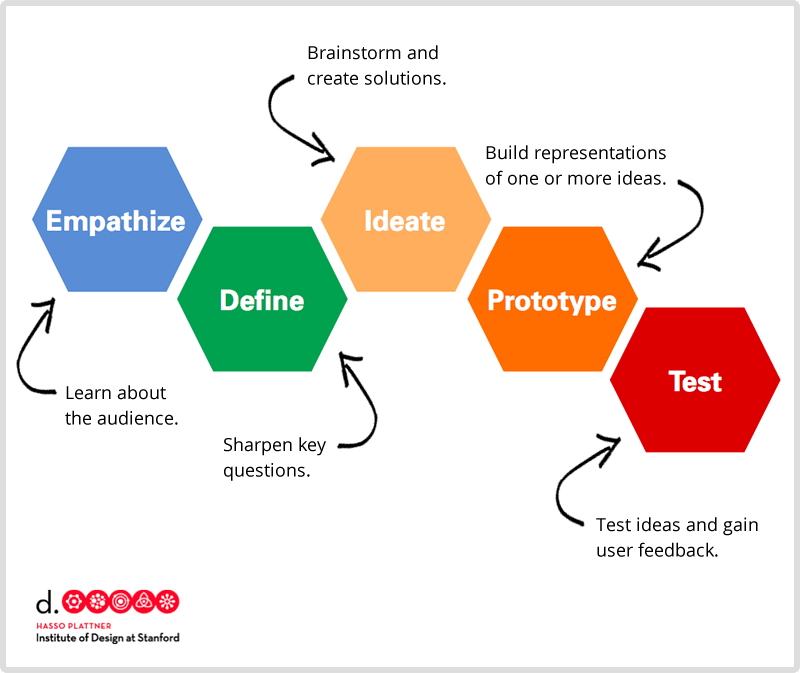
Empathy means that we can imagine the world from multiple viewpoints. From the perspective of others. We practice seeing things through the eyes of colleagues, users, customers, end-users, and consumers.
Design thinkers adopt a “people first” approach to imagine solutions, producing desirable designs to meet the needs of their audience.
Great designers notice things that the untrained eye cannot. They observe the world in minute detail, igniting intimate insights to inspire innovation.
Through awareness, you too can tap into your Design thinkers faculty.
3. Critical Thinking
Design thinkers add data dimensions for a deeper insight into user needs, but they do “not only rely on analytical processes (those that produce choices) but also exhibit the ability to see all of the salient — and sometimes contradictory aspects of a confounding problem and create novel solutions that go beyond and dramatically improve on existing alternatives” (Brown, 2008).
Combining design thinking with critical thinking is a powerful strategy that emerging Startups and Entrepreneurs employ. It is the melting-pot for true Innovation — creative destruction.
4. Curious Mind
There are three types of Innovation, which you can learn more about below.
“Significant innovations don’t come from incremental tweaks”. Design thinkers pose deeper, critical questions to unlock constraints, revealing creative ways that can take them in an entirely new direction (Brown, 2008).
5. Collaborate to Innovate
The ever increasing commercial complexity of services and products has replaced the “myth of the lone creative genius” with a new reality of the collective through enthusiastic interdisciplinary collaborators.
“Thinking like a designer can transform the way you develop products, services, processes — and even strategy.” (Brown, 2008)
The best design thinkers no longer bring one-dimension to the table to work alongside other disciplines; many design thinkers have significant experience in more than one field of expertise today.
Companies employ people from various backgrounds too, bringing together an eclectic mix of beautiful minds. Engineers, Medical Doctors, and Marketers work alongside Industrial Designers, Architects, Lawyers, Psychologists and even Anthropologists in the modern world.
Final Thoughts
To recap, here’s a reminder of the 5 dimensions of design thinkers:
- Optimism — Open your mind to reveal untapped potential.
- Empathy — See the world through the eyes of others.
- Critical Thinking — Critique your design thinking.
- Curiosity — Never stop exploring new frontiers in your mind.
- Collaborate — Don't just connect things, connect with people.
Don't be constrained by the way things are. By drinking from the well of your creative mind you can redefine reality — never stop asking why and what if.
“The need for transformation is, if anything, greater now than ever before.” (Brown, 2008)
References
- Brown, T. (2008). Design Thinking. [online] Harvard Business Review. Available at: https://hbr.org [Accessed 23 Feb. 2020].
- Dr. Soni, P. (2019). Design Thinking is to Innovation what Six Sigma is to Quality. [online] Entrepreneur. Available: www.entrepreneur.com/article [Accessed 23 Feb. 2020].
- Pink, D. (2012). A whole new mind. London: MC, Marshall Cavendish.
- Stanford d.school. (2020). Stanford d.school. [online] Available at: https://dschool.stanford.edu/ [Accessed 23 Feb. 2020].