avatarGianina Buda, PhD

Free AI web copilot to create summaries, insights and extended knowledge, download it at here

3053

Abstract

Your Own</h2> <div><h3>A tool that might surprise you</h3></div> <div><p>medium.com</p></div> </div> <div> <div style="background-image: url(https://miro.readmedium.com/v2/resize:fit:320/0*KIX7vSv0KhbBsYL3)"></div> </div> </div> </a> </div><p id="d751">Today, people use this phrase to express that one should be content with what one has and not go overboard in terms of demands. An alternative that emphasizes this idea is: « <i>vouloir le beurre, l’argent du beurre et le sourire de la crémière </i>» (“to want the butter, the money from (selling) the butter, and the smile of the dairywoman”).</p><h1 id="015a">Origin and related phrases</h1><p id="cf3f">The <a href="https://www.lalanguefrancaise.com/expressions/vouloir-le-beurre-et-l-argent-du-beurre">first mention</a> of this expression seems to date from 1896 (not so long ago!) in an article written by Swiss politician Numa Droz:</p><blockquote id="b47c"><p>« Dans toute transaction commerciale, il faut donner pour recevoir. On ne peut pas, comme on dit vulgairement, avoir le beurre et l’argent du beurre. »</p></blockquote><blockquote id="8832"><p>“In any business transaction, you have to give in order to receive. You cannot, as the vulgar saying goes, have your cake and eat it too.” (ChatGPT translation)</p></blockquote><p id="189b">This phrase conveys the idea that any commercial transaction requires a balance between what one gives and what one receives. It’s not possible to have everything without making a sacrifice or trade-off.</p><p id="cee2">The use of the term <i>beurre</i> in a transactional context is not surprising, as it sometimes refers to money itself. This is illustrated in another French expression, « <i>faire son beurre</i> » (literally: “to make one’s own butter”; actual meaning: “to make one’s own money”).</p><div id="afe4" class="link-block"> <a href="https://readmedium.com/5-surprising-motivation-boosters-to-master-a-new-language-ee80206184be"> <div> <div> <h2>5 Surprising Motivation Boosters to Master a New Language</h2> <div><h3>Fresh takes on language learning I read about this week on Medium</h3></div> <div><p>medium.com</p></div> </div> <div> <div style="background-image: url(https://miro.readmedium.com/v2/resize:fit:320/0*pniOI0lDue3FUJam)"></div> </div> </div> </a> </div><p id="5cc8">Other related French idioms that also preserve the rustic theme are:</p><blockquote id="bcb6"><p>« On ne peut ménager la chèvre et le choux » (literally: “you can’t spare the goat and the cabbage”; actual meaning: “you can’t have it both ways” or “you can’t please everyone”).</p></blockquote><blockquote id="f1b7"><p>« On ne peut pas avoir le lard et le cochon » (literally: “you can’t have both the bacon and the pig”; meaning: “you can’t have it both ways”)

Options

.</p></blockquote><h1 id="d989">Some personal thoughts</h1><p id="43c7">This whole idea of compromise made me think of the compromises we make in learning a new language. For example, I find the fact that I speak Romanian natively both a blessing and a curse when learning French.</p><p id="b120">On the one hand, not only do Romanian and French have common roots as Romance languages, but there are also many borrowed French words in Romanian, such as R: <i>garsonieră</i> — F: <i>garçonnière</i> (studio apartment), R: <i>abajur </i>— F: <i>abat-jour</i> (lampshade), or R: <i>chitanță — </i>F: <i>quittance</i> (receipt).</p><p id="6892">On the other hand, although many Romanian words have French origins, some have different meanings in the two languages (<a href="https://readmedium.com/false-friends-in-french-c2bdda82a7fa">false friends</a>). This can make for some “interesting” confusions between words that are written or are pronounced very similarly: R: <i>util</i> (useful) — F: <i>outil</i> (tool); R: eșarfă (thin, summer scarf) — F: <i>echarpe</i> (thick, winter scarf); or R: <i>pom</i> (fruit tree) — F: <i>pomme</i> (apple).</p><p id="9b6e">Truly mastering a new language is often akin to walking a tightrope between (a) leaning on the similarities between the target language and your native tongue and (b) truly absorbing the particularities of the foreign language.</p><p id="5655">We must be willing to embrace the borrowed words that bring us closer to our goal, but also be prepared for the occasional mix-up. It’s all part of the rich tapestry of language!</p><p id="0af3"><b><i>Thank you for reading this far! Binge on parts <a href="https://medium.com/me/stats/post/aa6bd3e215ce?source=main_stats_page">1</a> | <a href="https://readmedium.com/learn-french-idioms-with-me-2-100-79339df9a445">2</a> | <a href="https://medium.com/me/stats/post/210f1ad5347b?source=main_stats_page">3</a> | <a href="https://medium.com/me/stats/post/cbc37f5712d8?source=main_stats_page">4</a>.</i></b></p><p id="acc6"><b><i>To gain unlimited access to stories like this, you can become a Medium member. It’s $5/month, and if you use my <a href="https://gianinabuda.medium.com/membership">link</a>, I will receive a small commission at no cost to you. Thank you!</i></b></p><p id="02d3"><b><i>If you also love learning and writing about languages, my publication, <a href="https://medium.com/language-lab">Language Lab</a>, is accepting new writers:</i></b></p><div id="d608" class="link-block"> <a href="https://readmedium.com/submit-your-stories-to-language-lab-e1b0347ce070"> <div> <div> <h2>Submit Your Stories to Language Lab</h2> <div><h3>2023 submission guidelines</h3></div> <div><p>medium.com</p></div> </div> <div> <div style="background-image: url(https://miro.readmedium.com/v2/resize:fit:320/0*0JbgZ6OoT8e2vAYc)"></div> </div> </div> </a> </div></article></body>

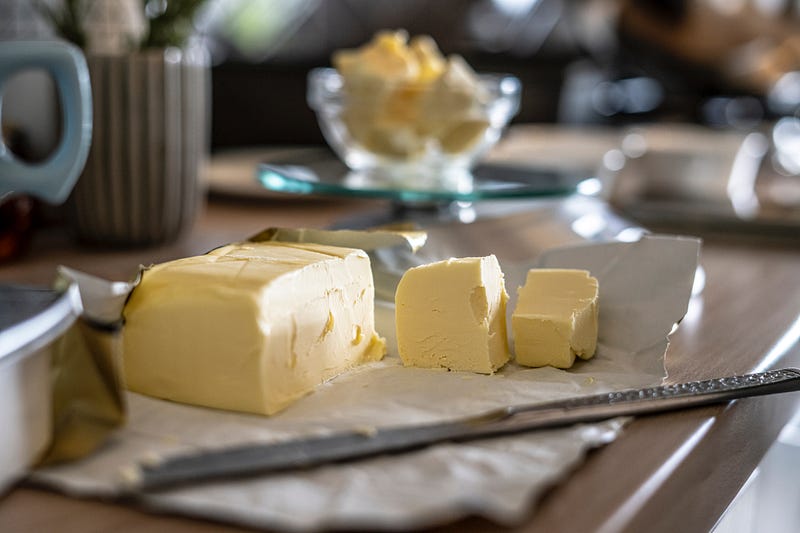
Photo by Sorin Gheorghita on Unsplash

Learn French Idioms with Me #5/100

Avoir le beurre et l’argent du beurre

Parts 1 | 2 | 3 | 4

Learning a new language can be really exciting, but the leap from the conversational level to fluency can seem to last forever.

However, understanding and mastering common idioms can be the key to unlocking fluency and gaining true proficiency in a foreign tongue.

Idiomatic expressions tremendously enhance your communication skills, make you sound more natural, and provide important cultural hints. This is the case with today’s French expression, which points to the popularity of butter in French cuisine: avoir le beurre et l’argent du beurre.

Meaning and examples

This idiom literally means “to have the butter and the money from (selling) the butter.” In English, one would say “to have your cake and eat it, too.” Variations in this expression can include the verbs vouloir (to want), obtenir (to obtain), or réclamer (to claim) le beurre et l’argent du beurre.

In other words, this idiom suggests the necessity of making a choice: you can either have the butter or can sell it and have the money for it, but not both. For example:

« Justement, tu en profites. Tu as le beurre et l’argent du beurre ! »

“Exactly, you are taking advantage of it. You have the butter and the money from the butter!” (ChatGPT translation; Quelques pas sur la terre [1989], Madeleine Chapsal)

Although as learners of French, we might jump at every opportunity to use an idiom we’ve just learned, the ubiquity of this phrase in French has rendered it rather mundane, to the point that its usage is viewed as cliché. (If there are any native French speakers reading this, please let me know in the comments whether this is true!).

Today, people use this phrase to express that one should be content with what one has and not go overboard in terms of demands. An alternative that emphasizes this idea is: « vouloir le beurre, l’argent du beurre et le sourire de la crémière » (“to want the butter, the money from (selling) the butter, and the smile of the dairywoman”).

Origin and related phrases

The first mention of this expression seems to date from 1896 (not so long ago!) in an article written by Swiss politician Numa Droz:

« Dans toute transaction commerciale, il faut donner pour recevoir. On ne peut pas, comme on dit vulgairement, avoir le beurre et l’argent du beurre. »

“In any business transaction, you have to give in order to receive. You cannot, as the vulgar saying goes, have your cake and eat it too.” (ChatGPT translation)

This phrase conveys the idea that any commercial transaction requires a balance between what one gives and what one receives. It’s not possible to have everything without making a sacrifice or trade-off.

The use of the term beurre in a transactional context is not surprising, as it sometimes refers to money itself. This is illustrated in another French expression, « faire son beurre » (literally: “to make one’s own butter”; actual meaning: “to make one’s own money”).

Other related French idioms that also preserve the rustic theme are:

« On ne peut ménager la chèvre et le choux » (literally: “you can’t spare the goat and the cabbage”; actual meaning: “you can’t have it both ways” or “you can’t please everyone”).

« On ne peut pas avoir le lard et le cochon » (literally: “you can’t have both the bacon and the pig”; meaning: “you can’t have it both ways”).

Some personal thoughts

This whole idea of compromise made me think of the compromises we make in learning a new language. For example, I find the fact that I speak Romanian natively both a blessing and a curse when learning French.

On the one hand, not only do Romanian and French have common roots as Romance languages, but there are also many borrowed French words in Romanian, such as R: garsonieră — F: garçonnière (studio apartment), R: abajur — F: abat-jour (lampshade), or R: chitanță — F: quittance (receipt).

On the other hand, although many Romanian words have French origins, some have different meanings in the two languages (false friends). This can make for some “interesting” confusions between words that are written or are pronounced very similarly: R: util (useful) — F: outil (tool); R: eșarfă (thin, summer scarf) — F: echarpe (thick, winter scarf); or R: pom (fruit tree) — F: pomme (apple).

Truly mastering a new language is often akin to walking a tightrope between (a) leaning on the similarities between the target language and your native tongue and (b) truly absorbing the particularities of the foreign language.

We must be willing to embrace the borrowed words that bring us closer to our goal, but also be prepared for the occasional mix-up. It’s all part of the rich tapestry of language!

Thank you for reading this far! Binge on parts 1 | 2 | 3 | 4.

To gain unlimited access to stories like this, you can become a Medium member. It’s $5/month, and if you use my link, I will receive a small commission at no cost to you. Thank you!

If you also love learning and writing about languages, my publication, Language Lab, is accepting new writers:

Language
Language Learning
French
Polyglot
Language Acquisition
Recommended from ReadMedium