
LANGUAGE
How to Deal with False Friends in Foreign Languages
You have to keep your guard up with these ones

When I am learning new words in French, my brain always tries to make connections with words in other languages I know, in an attempt to help me memorize them. While knowing foreign languages can be highly valuable at times (especially if they are from the same family of languages), it can also really mess with you when the words have completely different meanings despite their similar form.
Take, for example, the French word conservateur which means “preservative” in English. All very simple and wholesome, right? Well, wait just a second. Let me now tell you that I am also a Romanian native speaker.
In Romanian, we have two words that are painfully similar to these two above, although they mean entirely different things.
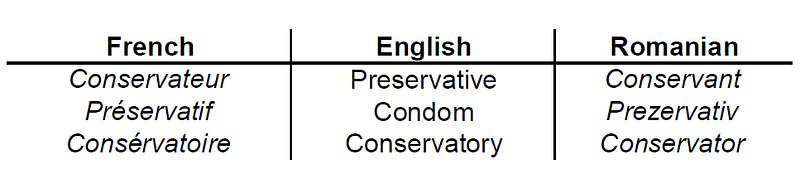
Similar to the French conservateur (en. “preservative”), there exists the Romanian word conservator (en. “conservatory”), while the Romanian prezervativ is translated as préservatif in French and as “condom” in English.
Just to close the loop we’ve started, the French conservateur is translated as conservant in Romanian, while the Romanian conservator means consérvatoire in French.
If you feel like you’ve gone crazy (as I do), check out the summary below:
How can anyone learn anything when such confusions are prone to arise?
And how does the brain remember and differentiate between “false friends” (words that look similar but have different meanings)?

Background and context are important
We should remember that we don’t learn words in a vacuum and that the context will always contribute to identifying the meaning of a certain word.
A case study on Spanish-speaking engineering students compared the comprehension level of 1st-year and 3rd-year university students when reading an English technical text that contained several English-Spanish “false friends.” The analysis showed that:
“the difference in background knowledge, rather than language level, seemed to be the main reason accounting for the students’ understanding of the meaning of the text.”
In other words, if I’ve actually lived in the US and bought cans of beans that said “preservative-free” on them, I have a better chance of remembering the meaning of “preservative” and the relationship “preservative”-conservant. Therefore, when I learn the French conservateur, my brain can match it with the Romanian conservant in terms of form and meaning and with “preservative” in terms of meaning only. Well done, brain!
I am sure that all adult language learners wish they were still children so that they could learn a language organically. Unfortunately, the process is different for adults, who “have developed cues to comprehend a new language based on their mother tongue principles,” state the authors of the above-mentioned case study.
Coming back to my initial conundrum, the French word conservateur also has other meanings — conservative, for example, which is also written similarly in Romanian (conservator). So let’s not be too conservative when learning new words; keep an open mind. Use the context and all your experience to remember the next false friend you’ll encounter in your language-learning journey.
À bientôt! See you soon!
© Gianina Buda, PhD 2020
Thank you for reading! If you wish to support me, please clap, comment, or share this article. And if you are interested in becoming a Medium member, you can use my link (I will receive a portion of your membership at no extra cost for you).
More of my work you might like: