
SCIENCE & TECHNOLOGY
Neuromorphic Electronics Headed Toward Human Brain Efficiency
Korean scientists built a transistor that behaves like a synapse 85.1 % of the time.
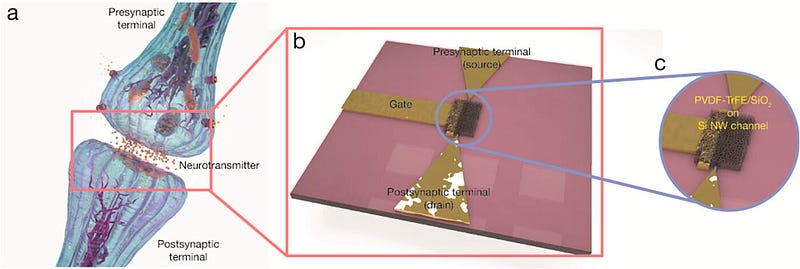
The human brain is a network of neurons that is remarkably efficient at processing information. Its hundred billion neurons communicate via one quadrillion synapses, forming a massively parallel and low-power computing system. To achieve these enviable features, today’s electronic components need to overcome a few practical hurdles: their synthesis process needs to be reproducible and robust, they should be stable, reliable, and mimic the electrochemical functionality of a synapse with high fidelity.
A synapse transmits input electric signals between neurons. But what a synaptic transistor needs to successfully reproduce is a biological process called spike-timing-dependent plasticity. In other words, the system should optimize its properties based on functions carried out in the past, just as a synapse regulates its activity based on its history.
This is directly related to learning: the efficacy of a synapse can undergo plastic changes (changes that are irreversible for at least a given period of time), such as potentiation (a persistent strengthening of its activity) or depression (a decrease in efficiency). These phenomena could be roughly seen as correlated to learning and forgetting, respectively.
In a first-of-its-kind multi-institutional study, Korean scientists recently built and demonstrated the experimental application of a prototype of a synaptic transistor. The device synergistically combines the reliability and robustness of silicon nanowires with the synaptic plasticity of ferroelectric polymers, forming what is called a ferroelectric field transistor (FeFET).
When stimulating the device with an increasing number of electric pulses, which mimics the neuronal activity, the FeFET exhibited symmetrical potentiation and depression, an important neuromorphic feature. Furthermore, a computer model based on artificial neural networks trained on real synaptic data showed that the device could recognize handwritten digits in images 85.1% of the time.
The integrability of the prototype in an inverter circuit (which outputs the opposite logic-level of its input; for example, a high voltage when the input is a low voltage). In this setup, the FeFET showed an acceptable noise margin of 41.6% and low power consumption of 0.6 μW per logic gate.
As the authors state in their paper, “This reflects that the FeFET synapse transistor can be a building block for the (sic) low power consumption logic device applications.”
Source: “Brain-inspired ferroelectric Si nanowire synaptic device” by M. Lee, W. Park, H. Son, J. Seo, O. Kwon, S. Oh, M. G. Hahm, U. J. Kim, and B. Cho, Journal of Applied Physics (2021). The article can be accessed at: https://doi.org/10.1063/5.0035220.
Thank you for reading! If you wish to support me, please clap, comment, or share this article. And if you are interested in becoming a Medium member, you can use my link (I will receive a portion of your membership at no extra cost for you).
More of my work you might like: