
What Can the Brazil Nut Teach Us About Materials Design?
Three fibrous layers and a high volume of hollow space make this a tough nut to crack
On April 22nd, 2020, scientists at the Federal University of São Carlos, Brazil and Technische Universität Berlin, Germany published in the Nature journal Scientific Reports a study of the internal structure of the Brazil nut mesocarp (shell). The results could lead to the synthesis of novel composite materials with improved impact and puncture resistance.
“Biophysics is not so much a subject matter as it is a point of view.” — Otto H. Schmitt
In this quote, the American biophysicist Otto Herbert Schmitt explains how biophysics is a two-way street: looking at biological problems using the methodologies of physical sciences as well as looking at physical problems from a biologist’s perspective. Later on, he coined the term “biomimetics” for describing the latter type of thinking.
Used interchangeably with “biomimicry,” biomimetics refers to solving real-world problems by drawing inspiration from nature. The concept is not at all new, having been adopted as far back as in the Renaissance by Leonardo da Vinci in his quest for human-powered flight. Today, we continue to learn from termites about architecture and solar power control or from mosquitoes about how to create less painful needles.
So what makes the Brazil nut so inspiring? First, the shell that covers the seed (what we call the Brazil nut) of the Bertholletia excelsa fruit has an exceptional compressive strength and impact resistance, being able to remain intact after falls from even 50 m high.
The researchers found a few reasons that might explain these intriguing properties. One can be understood by looking at the mesocarp (the shell) at the macroscopic level. Its structure consists of three layers of fibers with alternating orientations: longitudinal, latitudinal, and again longitudinal (with a radial distribution in between layers, as seen in the figure below).
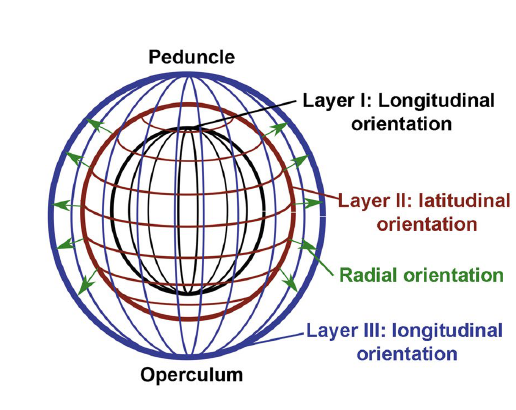
“For what are these layers useful?” you may ask. There are two advantages to this structure. The diverse orientations of the constituent fibers may prevent the propagation of cracks and strengthen the shell by reducing the anisotropy (which represents the existence of a preferential direction in the context of a certain property); think of how a paper towel tears more easily along the circumference of the roll than perpendicular to it.
Although in the paper towel example, this phenomenon may be a feature when you do not want to use an entire square of paper, the existence of such preferential directions generally represents a vulnerability of the material.
Compared to other types of nutshells, another curiosity about the Brazil nut mesocarp is a high percentage (around 13%) of hollow space, comprising channels and cracked surfaces. These features are thought to also stop the diffusion of cracks and optimize stiffness and overall weight.
A last interesting property of these enduring nuts consists in the presence of a series of foam-like cells (sclereids) between — and not in separate layers from — the fibers. This structure reminds us of a technology used in the aerospace industry, also called “syntactic loads,” wherein a stiff skin is filled with a soft, foamy core. The effect is a reduced density and improved bending stiffness.
In the end, how can we utilize these discoveries and design a novel material with enhanced mechanical properties? Fortunately, 3D printing allows the synthesis of composite materials made of either glass or carbon fibers, the orientation of which can be controlled. What is more, free space can also be incorporated during the printing process in order to mimic the hollowness of the Brazil nut shell.
Therefore, whether we call it biomimetics, bionics, biomimicry, biognosis, or biologically-inspired design, the practicality of this approach cannot be contested, however surprising and unorthodox nature’s way of doing things may appear. I will leave you with a quote from Jonathan Swift’s satire of the Royal Society:
“There was a most ingenious architect who had contrived a new method for building houses, by beginning at the roof, and working downwards to the foundation; which he justified to me by the like practice of those two prudent insects the bee and the spider.”
Thank you for reading! If you wish to support me, please clap, comment, or share this article. And if you are interested in becoming a Medium member, you can use my link (I will receive a portion of your membership at no extra cost for you).
More of my work you might like:


