
Layaway is Back, Baby!
Buy now. Pay later. Damn the consequences.
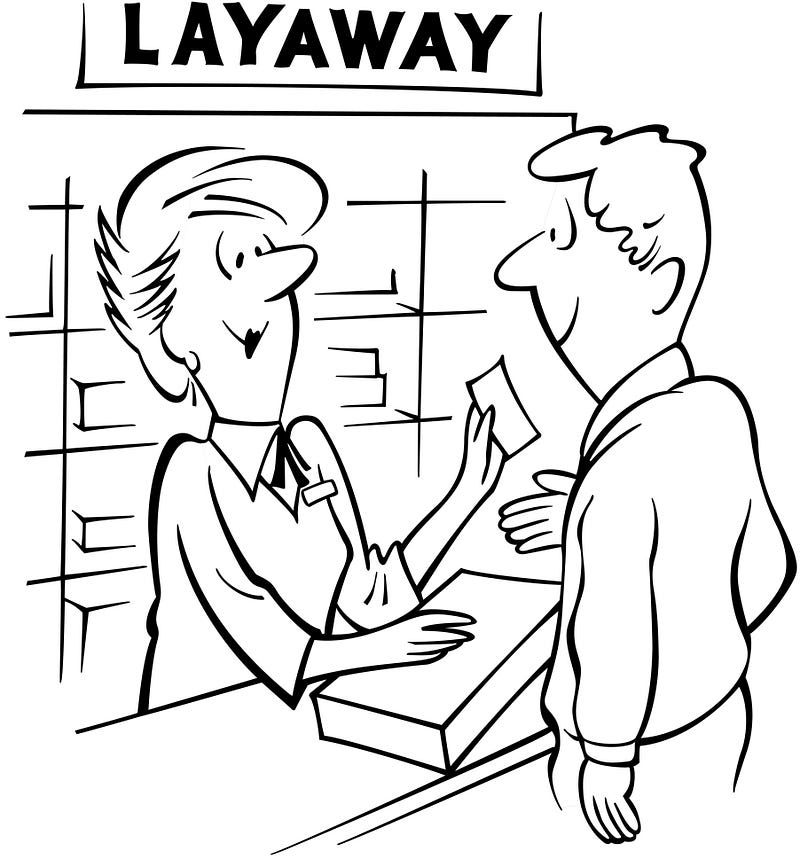
Layaway is a relic from long, long ago; when credit cards were rare and people bought things with (gasp!) actual cash.
Oh, the humanity!
You can be forgiven if you thought layaway had met its demise in this digital age, but alas, it is making a comeback.
Bigly.
What Exactly Is Layaway?
Readers of a certain age are likely familiar with layaway. It was definitely a staple of my childhood, especially in the months leading up to Christmas.
For those of you who have no idea what I’m talking about, let me lay down some knowledge the 1980’s.
Layaway is simply paying for something with cash installments. You would go to the store and pick out the item you want, just like a regular purchase. Only this time, you would head to the back of the store and hand the item over to an employee.
It sounds a little backwards, right?
The store employees would wrap whatever it was you were buying in a huge plastic bag, tag it, then put it in a cart where it got whisked away into the Raiders of the Lost Ark inventory in the backroom.
You would give a token amount of money, arrange a payment schedule, then be on your merry way. Every week or so, you would stop by the store, make a payment, then head home.
I remember many a post-Halloween shopping trip to Kmart where my mom would hide Christmas presents under her coat in the shopping cart, then make my sister and me sit about 50 feet away from the layaway counter while she got everything sorted out.
(I’ve always liked surprises, so it didn’t bother me too much that my Christmas present was so close to being seen, but it absolutely drove my sister nuts.)
Then, every weekend, when we had a few extra minutes that the work week didn’t afford, my mom would drive us to the store and make us wait in the car while she made her payment.
And that’s how we got Christmas presents.
The Allure of Layaway
Layaway has some big things going for it.
0% Interest Rate
For a financial product that basically mimics a line of credit, no interest is a huge benefit. The store holds your product, and you pay only the purchase cost over time.
On the surface, it is actually a detriment to the store, as they have to hold on to more physical inventory, which costs them money. But that is more than made up for by the increased purchases by offering layaway.
Not only do layaway stores see more foot traffic, people buy more when they use layaway as opposed to cash.
According to Adobe, “buy now, pay later” experienced 215% year-over-year growth in the first two months of 2021. Its researchers noted that more retailers are signing up — which makes sense given that consumers using the service place orders that are 18% larger than shoppers who don’t. (emphasis added)
Flexible Payment Plans
Traditionally, layaway payment schedules are weekly or biweekly. Those schedules are, as Captain Barbossa was say, “more like guidelines than actual rules.”
If you can’t come up with the cash this particular week, you’re not incurring any fees; you’re just pushing back your ownership date by 7 days.
Any other credit instrument has much more demanding schedules, accompanied with much more punishing fees. ($35 late fee, anyone?)
Delayed Gratification
The psychological impact of physically choosing the item you desire from the store, for all intents and purposes “possessing” it, then handing said item to a store employee, effectively “losing” the object of your desire, is not to be understated.
It’s painful to have something in your hands and then let it go, no matter how pure or logical your intentions. However, that pain is a strong driver to keep up with your payment plans.
If you were to put the same purchase on a credit card, then you would already have your purchase in your home, readily accessible whenever you want it. The credit card bill has now lost all of its meaning and been transformed into just another bothersome debt.
The only reason to pay it off is to avoid wrecking your credit score, which, for many people, is nowhere near as powerful as pursuing something tangible.
Why Is Layaway Coming Back?
The simple reason is that people are running out of money, but corporate America still wants to wring every last dollar they can out of us.
The economy sucks, good paying jobs are scarce, enhanced unemployment aid is ending, the rent moratorium is on life support, and the stimulus money has been spent.
Credit card balances have declines substantially in the past 18 months, and people are hesitant to go back to those double digit interest rates.
Layaway offers a non-credit card option, which is attracting more and more buyers. But corporations have never been able to resist hijacking a trend. Right now, they’re doing a better job than Pepsi did with the BLM protests, but we’ll see how it goes.
Companies, both retailers and financial services, are going in big.
Square, which owns the Cash App, announced Sunday that it’s buying Afterpay for $29 billion, the largest acquisition of an Australian company ever.
Meanwhile, Sweden’s Klarna raised money in June at a nearly $46 billion valuation. Affirm, a San Francisco company that went public earlier this year, is now valued at nearly $15 billion (and its stock is up 8% in premarket trading).
Even the big boys of Visa and Mastercard are getting in the game.
Visa and Mastercard like to democratize payment capabilities — they standardize services and offer them to all players. So they are lowering the barriers-to-entry for BNPL — not good for PayPal, Afterpay, Affirm, and Klarna.
Even Apple is looking to get into the game. God help us all if layaway becomes integrated into our iPhones.
What Can Go Wrong?
You might be thinking that layaway is a great deal. I mean, who wouldn’t love a credit line with 0% interest and flexible payment schedules.
There are some pitfalls, however.
- Layaway is credit.
This means that you are taking out a loan, and it becomes part of your credit history. No longer is this just a local store giving you time to pay off your purchase. Layaway is becoming big business, and it’s all digitally recorded.
- Increased temptation.
Just like our national reckoning with credit cards, layaway can give you a false sense of financial security. Don’t fall for the trap of having five layaway payments that would otherwise equal a single purchase.
- Fewer regulations.
Layaway is much less regulated than credit cards and other types of “pay later” alternates. If your item is discontinued or you need to return a purchase, there could be many more hoops to jump through than if you had just paid with cash, or even your Visa card.
The Takeaway
Layaway is a great option for people who are buying something they need, as it allows them to avoid the sky high interest rates of credit cards. However, it can easily be abused, resulting in even more debt.
While consumer debt on credit cards went down in 2021, I worry that people are merely shifting their debt. The stimulus money paid off credit card balances, but now people are back to their old habits of spending more than they earn, and layaway just makes that cheaper via the 0% interest.
If you do use layaway, treat it just like any other bill. Pay it on time, in full, every time. Anything else, and you’re just setting yourself up for failure.
The Latest Stories From Money. Daily.
- Is An Emergency Fund Really That Important?
- Mortgage Math
- Why You Can’t Afford to Buy a House
- I Betrayed My Renting Brethren and Bought a House in the Suburbs
- How to Attack Your Finances
Don’t miss my next article! Click here to get notified when I publish new material.
If you love the articles published in Money. Daily. become a member of the Medium and get full access to our full archives.
This article is for informational purposes only, it should not be considered Financial or Legal Advice. Not all information will be accurate. Consult a financial professional before making any major financial decisions.


