
Latakia
This word is smoking cool
Today’s New York Times Spelling Bee letters:
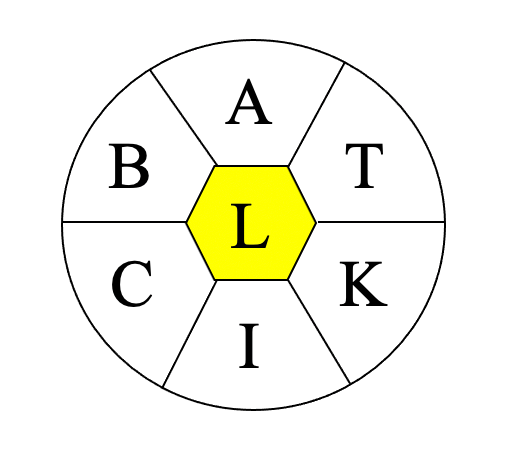
A, B, C, I, K, T, and center L (all words must include L)
Merriam-Webster says…
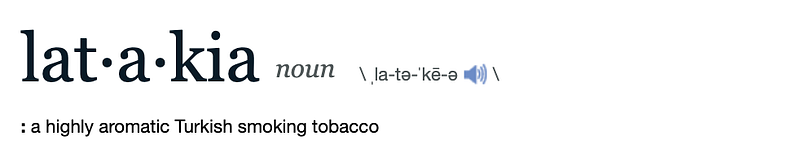
Silly little dictionary! Don’t you know latakia can’t possibly be a word if the New York Times says it ain’t?
For further fascinating facts, check out the Spelling Bee Master.
What’s your favorite dord* from today’s puzzle?
My Two Cents
Happy International Pipe Smoking Day!
Yes, that’s a thing.
Today being February 20th, I couldn’t pass up the opportunity to dedicate this column to a tobacco-related word: latakia. Trust me, in the pipe-smoking community this tobacco a big deal and people usually either hate it or love it.
The expression “smoking cool” in the subtitle of this column is “pipe talk” for a pipe that smokes smoothly and doesn’t burn hot in your hands.
latakia the tobacco
Just two days ago I happened to tackle eponyms in my column. Some words in English that are now common nouns originated from the names of people or places. Latakia the tobacco is one such case, being named for the port city of Latakia in Syria, where most of the leaf’s production was done until the beginning of this century. Latakia tobacco is sun dried and smoke cured.
The specific type of tobacco seed used to produce Syrian latakia is unknown, and the little data manufacturers had way back when may have been destroyed on purpose. Sir William Turner Thiselton-Dyer, a leading British botanist, and the third director of the Royal Botanic Gardens wrote the following about latakia in 1876:
In all accounts which I have seen of the sources of tobacco, that of Latakia is stated to be produced by Nicotiana rustics*, a species largely cultivated on the coast of the Mediterranean, and which undoubtedly yields Turkish tobacco. It is extremely distinct from N. Tabacum, and is known at once by its greenish yellow flowers with a rather short cylindrical corolla-tube and roundish obtuse limb-segments. Turkish tobacco, as imported into this country, consists of the leaves, which are comparatively small in size, ovate, and distinctly stalked. They are done up into small parcels, tied together by their stalks. Their colour is a pale brownish-yellow.
There os some consensus that Latakia was first produced either using a variety of Nicotiana Tabacum called shekk-el-bint (with narrow leaves measuring ten to twelve inches in length) or a Turkish variant known as Yayladag.
With latakia, the leaves are not stitched together as done during the sun-drying process of most Oriental varieties. The leaves are left on the stalk and are kept whole, including the flowers. Then they are hung or laid on the ground to dry over a period of three or more weeks.
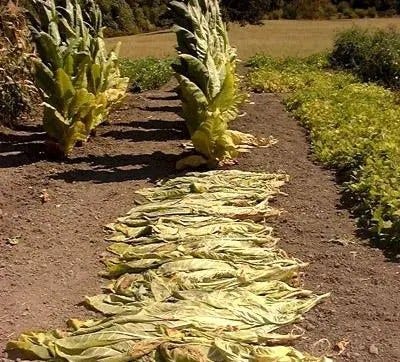
After that, the dry leaves are taken to store houses before being purchase by brokers to finish the smoke-curing process. The leaves and flowers are taken to storehouses, where they are smoked for a period of 13 to 15 weeks. The smoke is derived from burning a combination of woods and herbs, which influence the eventual taste of the leaf.
There is a myth about latakia being cured over smoking camel dung, but this is completely not true and probably a result of some prejudice against the locals who made the tobacco.
Latakia is mainly used in tobacco blends to add complexity and to control its burn rate… which might help your pipe “smoke cool”.
Tobacco blending is both an art and a science, and although the latter is now the more common way of producing blends (think about your local shop and the pouches of Captain Black and Amphora that it sells), there are still artisanal blenders around, like the master G.L. Pease.
Below are some tobacco tins I have in my own collection. You can see they list the tobaccos used to create the mixture. I’ll explain a bit about each type. (All the information below about the tobacco taken from pipedia.org. Yes, there’s a wikipedia created specifically for pipe smokers!)
First up is Cellar Reserve, which contains Virginia, burley, cavendish, and a touch of perique.
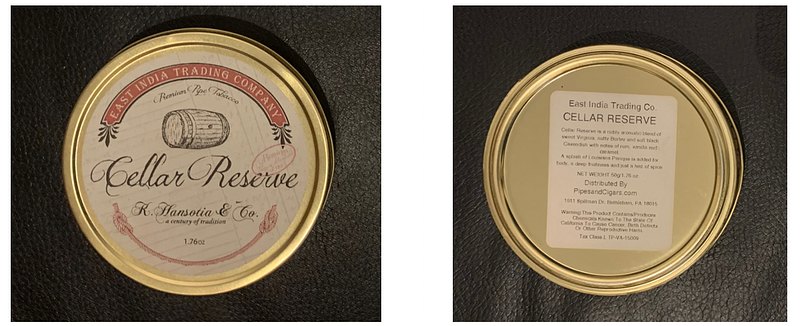
Virginia Despite the name, Virginias are grown in numerous locales. There are several varieties, but their main feature is their relatively high sugar content. Virginias are often used as the base tobacco in many blends, but they can be smoked “straight” (pure), too. Straight Virginias undergo changes in flavor as they age, similar to fine wines. Lighter in body than Oriental blends, they have a subtle complexity of flavor that makes them a favorite of many experienced smokers.
Burley This is a light, air-cured tobacco used mainly for cigarettes. It’s a low-sugar, high-nicotine, slow-burning tobacco with a very subtle flavor. In pipe tobacco, burley is often used as a base for aromatics or to change the burning characteristics of a blend. In the United States 70% of burley is produced in Kentucky.
Cavendish This term refers more a process of curing and a method of cutting tobacco than a type of it. The processing and the cut are used to bring out the natural sweet taste in the tobacco. Cavendish can be produced out of any tobacco type but is usually one of, or a blend of Kentucky, Virginia, and Burley and is most commonly used for pipe tobacco and cigars. The process begins by pressing the tobacco leaves into a cake about an inch thick. Heat from fire or steam is applied, and the tobacco is allowed to ferment. This is said to result in a sweet and mild tobacco.
Perique This “spice” tobacco is grown only in St. James Parish, Louisiana. Perique is subjected to extreme pressure and is allowed to ferment as it is cured, which results in a very distinctive tobacco. Perique is a spice tobacco, usually used in Virginia blends. It has a dark, oily appearance, and a taste of pepper and figs. Its flavor is very strong, so it isn’t usually found in high percentages in a blend. It can be smoked straight, but isn’t intended to be.
Next is Astleys, which aside from Virginia also has Turkish tobacco and latakia.
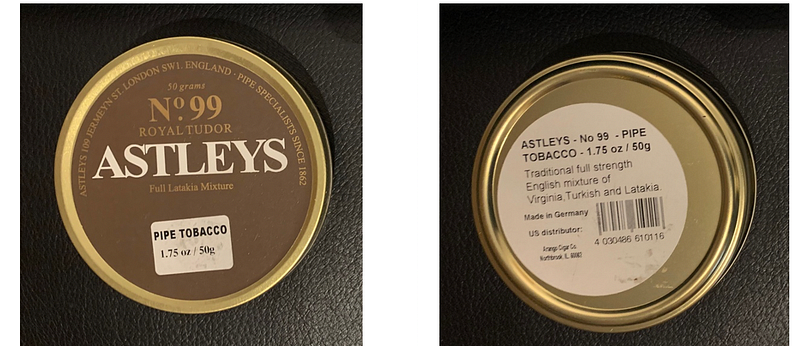
Turkish This term refers to any number of tobaccos grown in numerous locales throughout the eastern Mediterranean region. Common “Turkish” varieties include Basma, Smyrna, Xanthi, Samsun, Izmir, Drama, and Yenidje. Generally, these names are derived from the region in which they are grown. Turkish tobaccos have a somewhat sweet, spicy flavor that gives “body” to many blends.
Latakia Our word of the day is tobacco cured over a stone pine or oak wood fire, which gives it an intense smoky-peppery taste and smell. Too strong to smoke straight, it’s used as a “condiment”, especially in English mixtures and some American Classic blends.
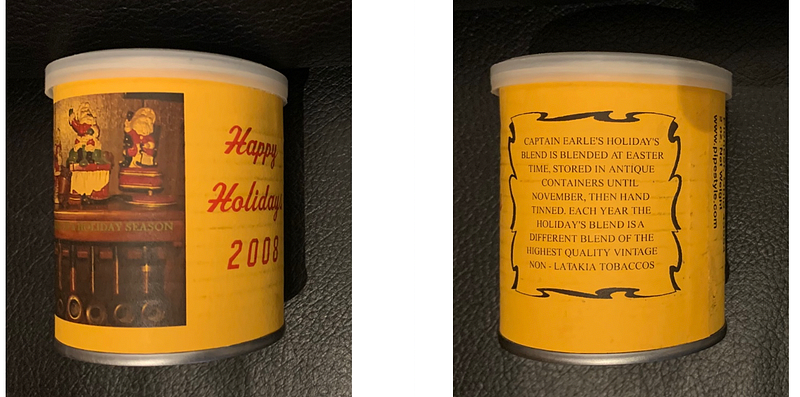
And finally, here is Captain Earle’s holiday, blend. It doesn’t specify the tobacco types except to say that it doesn’t include latakia at all. For those who can’t stand that leaf.
Latakia the city
The city of Latakia is the main port of Syria, as well as the capital of the Latakia Governorate (which is similar to an administrative province). The city was founded in the 4th century BC by the Seleucids: Greeks who had their own mini empire for some 250 years after the division of the much larger empire founded by Alexander the Great.
After that, the are was ruled by a bunch of different peoples: ancient Romans, Ummayads, Abbasids, Arabs, Seljuk Turks, Crusaders, Ayyubids, Mamluks, and finally the Ottomans, who held on to it for quite a while. Then World War I happened and the Ottoman Empire disappeared, leaving only pieces of furniture on which you could rest your legs.
Latakia was then under French mandate, became the Alawite State for a while, tried declaring its independence, and finally ended up as part of Syria during World War II.
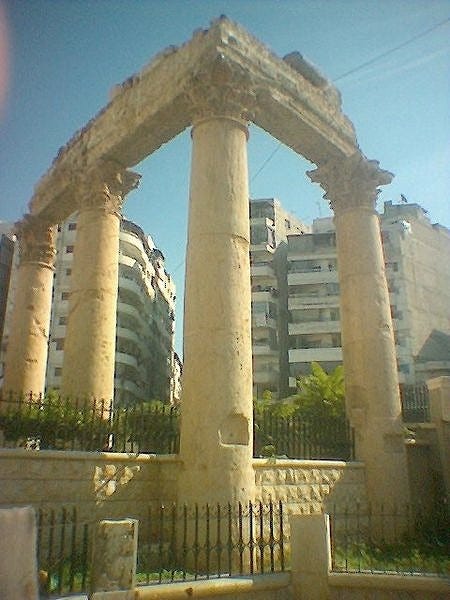
Mainly due to earthquakes, most of the classical buildings in Latakia no longer exist. Those that remain include a Roman triumphal arch and Corinthian columns known as the Colonnade of Bacchus, that Greek-Roman multitasking god of grape-harvesting, winemaking, orchards and fruit, vegetation, fertility, insanity, ritual madness, religious ecstasy, festivity and theatre. Whew! I got tired just typing that list. Anyway, here’s what’s left of his temple:
The American Board of Commissioners for Foreign Missions recorded the results of one first censuses, done in 1825. The results showed a population of some 6,000 to 8,000 Muslims, 1,000 Greek Orthodox Christians, 30 Armenian Christians, 30 Maronite Catholics, and 30 Jews. I don’t know about you, but I find that exact coincidence in the number of Armenians, Maronites, and Jews a bit odd. The 2004 census lists more than 380,000 people in the city and almost 425,000 in the metro area. Since the beginning of the Syrian civil war, the number of residents has greatly increased.
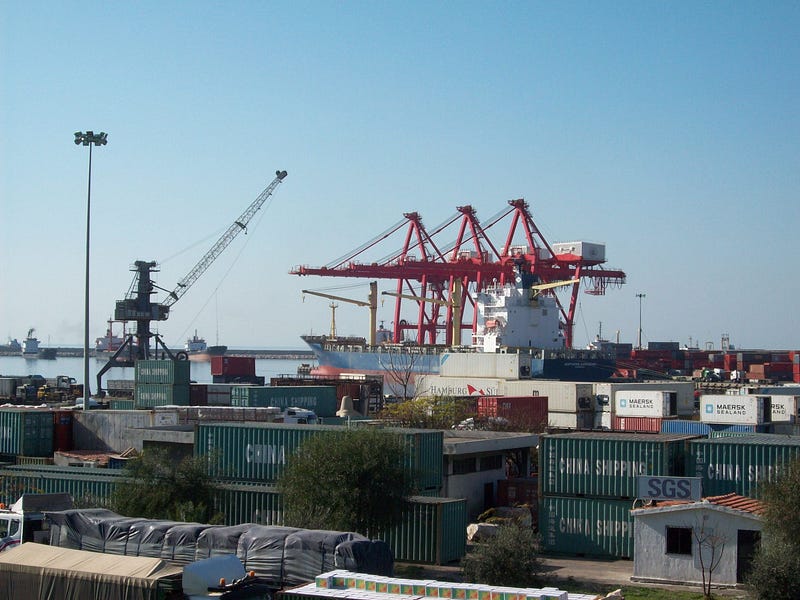
The port of Latakia was established in February of 1950 and has become Syria’s main seaport, boosting the city’s importance. According to the World Port Source, “the Port of Lattakia serves a vast agricultural region. The Port of Lattakia exports many products including pottery, cereals, fruit, eggs, cotton, tobacco, vegetable oil, asphalt, and bitumen… After Beirut and Tripoli stopped operating as functional ports after 1975, traffic in the Port of Lattakia increased dramatically. In 1971, the Port of Lattakia handled more than 1.6 million tons of cargo. During the 1970s, the port was improved and expanded. In 1981, almost 3.6 million tons of cargo passed through the Port of Lattakia.” Not sure why the World Port Source spells the city’s name with two t’s.
The port has its own website with some cool photos, but text appears to be only in Arabic. The photo below is not one of the cool photos from the website, though. It’s an uncool photo that Wikipedia says is public domain.
That’s it for today! If you’re a pipe smoker, I hope you were able to partake in a bowl in honor of International Pipe Smoking Day. If you’re not a pipe smoker (but are of legal age wherever you live), perhaps after reading this column you’d care to join us in the celebration. You can try an aromatic blend, a burley, a Virginia, or even an English mixture. However, if you’re craving some latakia, you’re out of luck. And that’s because the editors of the Spelling Bee decided that latakia is a dord*.
You can check out my previous entry on another dord* here:
What the heck is a dord, you ask? Here’s the answer: