avatarAvi Kotzer

Free AI web copilot to create summaries, insights and extended knowledge, download it at here

3627

Abstract

<a href="https://en.wikipedia.org/wiki/Minim_(unit)">minim</a>, and the <a href="https://en.wikipedia.org/wiki/Scruple_(unit)">fluid scruple</a>.</p><p id="dd95">The perch is also known as the rod, which is what <i>vara</i> means in Spanish. See how I managed to cleverly circle back to our word of the day? Thank you for the standing ovation! On to our subject matter…</p><h2 id="1ef2">The rain in Spain is measured in plain</h2><p id="48ca">Our friends at Merriam-Webster explain that the word <i>vara</i> comes to English “borrowed from American Spanish, from Spanish, “pole,” going back to Latin <i>vāra</i> “any of various branched structures or implements,” noun derivative from feminine of <i>vārus</i> “bent outwards with converging extremities, bow-legged,” of uncertain origin.</p><p id="466f">Although per the dictionary the Texas unit of length is equal to 33.33 inches (84.66 centimeters), the Spanish <i>vara</i> had different measurements depending on the time period and the country using it. As a result of Spain colonizing a great chunk of the Americas between the 15th and 18th centuries, the <i>vara</i> became a surveying unit that appeared in many deeds in the southern United States, and was also used in many parts of Latin America.</p><figure id="dd78"><img src="https://cdn-images-1.readmedium.com/v2/resize:fit:800/1*xSY1dezyE2ZjVPEb4bPcvg.png"><figcaption>Credit: Online Archive of California</figcaption></figure><p id="e32c">Above is a document that mentions two lots of 50 <i>varas</i> each. The writing on the top right says “Plat of two 50 vara lots in Mission Dolores, finally confirmed to the heirs of Francisco de Haro”. In this case, <b>plat</b> is a synonym for <b>plot</b>.</p><p id="3287">I’m not sure if this is the same Francisco de Haro who served as the first alcalde (mayor) of San Francisco between 1834 and 1835, pre-statehood. Here he is, relieved that his plat of two 50 <i>vara</i> lots were finally confirmed to his heirs.</p><figure id="a840"><img src="https://cdn-images-1.readmedium.com/v2/resize:fit:800/0*Ab7S00hCTmYPN4LT.jpg"><figcaption>Image by Unk Nown</figcaption></figure><p id="432d">Haro himself is confirmed… to have served in the <b>Presidio</b> of San Francisco, that is. However, there is no confirmation about whether or not he ever beat up somebody in a fight using only his <a href="https://www.youtube.com/watch?v=9Dka54jH9po">right thumb</a>.</p><p id="2a61">Below is a table of units of length used in Spain around 1801, with their modern metric equivalents. Note that even though the translations to English are common terms of the customary system, they are not equivalent. The inch, foot, yard, and mile are shorter than what Americans use today.</p><figure id="8458"><img src="https://cdn-images-1.readmedium.com/v2/resize:fit:800/1*0sINVV5XtWGve5v9kfY3bQ.png"><figcaption>Credit: wikipedia.com</figcaption></figure><p id="81dd">A tract of land measuring 100 <i>varas</i> squared (which is not the same as 100 square <i>varas</i>) is referred to as a <b>manzana</b>. Those of you who speak Spanish as a second language may be familiar with this term as a fruit ––apple–– but it also translates as “block”, in the urban architecture sense. Apparently there is no etymological difference between the apple <i>manzana</i> and the block <i>manzana</i>. In other words, some city planner centuries ago decided to use the apple as a metaphor for a bunch of buildings placed on the same lot, and the metaphor stuck.</p><p id="7f7c">Usage of the <i>manzana</i> as “city block” will vary depending on which Spanish-speaking country you visit. In some places i

Options

t refers to <b>both</b> the entire block of buildings (that is, all four sides enclosing them) and the distance between two corners of one side. This parallels the usage of “block in English. In some countries, however, <i>cuadra</i> is used to indicate one side of a block, with four <i>cuadras</i> then making up the perimeter of one <i>manzana</i>.</p><h2 id="d706">Portugal the country, not the man</h2><p id="ff27">Portugal and its biggest former colony, Brazil, adopted the metric system in the 19th century. Before that, well, things were complicated. The Portuguese used several systems of weights and measures influenced by the ancient Romans, Northern European countries, and even Islam.</p><p id="924e">By mid-14th century people got sick and tired of the confusion and requested their king to standardize units for the entire country. That took almost 150 years to get done. Even in 1455, King Alfonso V still accepted six different regional standards. But at the beginning of the 16th century, Manuel I finally put an end to the squabbling by creating an official Portuguese system of units that lasted some three plus centuries, until the metric system was adopted in 1814. Portugal was the second country in the world to do so, after France.</p><p id="3e83">Here is King Manuel I, chastising some weird plant for not using the measurements he established.</p><figure id="8d5c"><img src="https://cdn-images-1.readmedium.com/v2/resize:fit:800/0*FfYABIJJ3lDxPlH8.jpg"><figcaption>Art by Unk Nown</figcaption></figure><p id="126f">The Portuguese <i>vara</i> was a bit closer to the meter than the Spanish one, albeit longer. Below is a table with Portuguese units of length in use before conversion to the metric system.</p><figure id="a4fc"><img src="https://cdn-images-1.readmedium.com/v2/resize:fit:800/1*N3pAeN78BrKpKXvL-uSKsw.png"><figcaption>Credit: wikipedia.com</figcaption></figure><p id="e436">Although there are some similarities to the Spanish units, there are also some additional ones, like the cubit and the toise.</p><p id="a00a">Now you know. Next time you’re in Texas and want to measure exactly 33.33 inches of something, don’t ask for a <i>vara</i>… because the editors of the Spelling Bee decided that <i>vara</i> is a dord*.</p><p id="37a1">You can check out my previous entry on another <b>dord* </b>here:</p><div id="8c61" class="link-block"> <a href="https://readmedium.com/tomfool-b5011e3074a"> <div> <div> <h2>Tomfool</h2> <div><h3>I jester can’t wait to tell you about this word! (groan)</h3></div> <div><p>medium.com</p></div> </div> <div> <div style="background-image: url(https://miro.readmedium.com/v2/resize:fit:320/0*gMBd_O34zscUzdr3)"></div> </div> </div> </a> </div><p id="0234">What the heck is a <b>dord, </b>you ask? Here’s the answer:</p><div id="7e78" class="link-block"> <a href="https://www.merriam-webster.com/words-at-play/dord-a-ghost-word"> <div> <div> <h2>'Dord': A Ghost Word</h2> <div><h3>One of the questions people like to ask lexicographers is this: Can you sneak something into the dictionary? Can you…</h3></div> <div><p>www.merriam-webster.com</p></div> </div> <div> <div style="background-image: url(https://miro.readmedium.com/v2/resize:fit:320/0*TxOZnggDRO0Nh46R)"></div> </div> </div> </a> </div></article></body>

Vara

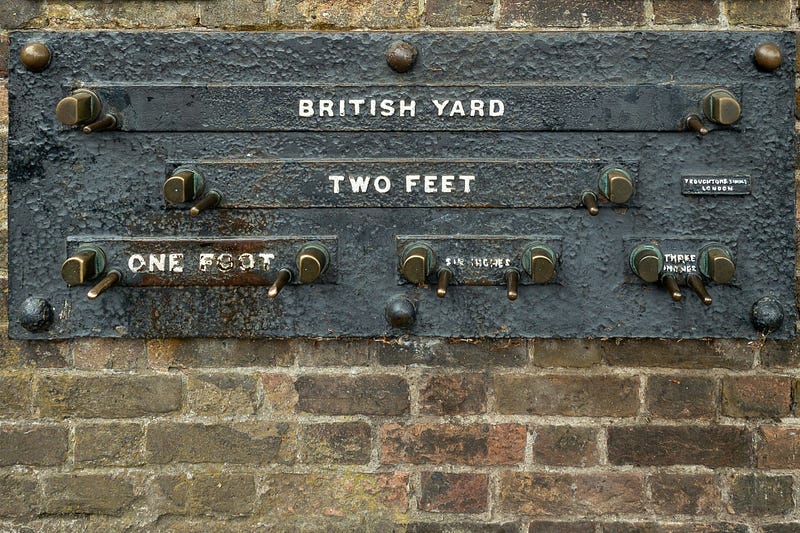
Spare the rod, spoil the measurement
Credit: wikimedia commons

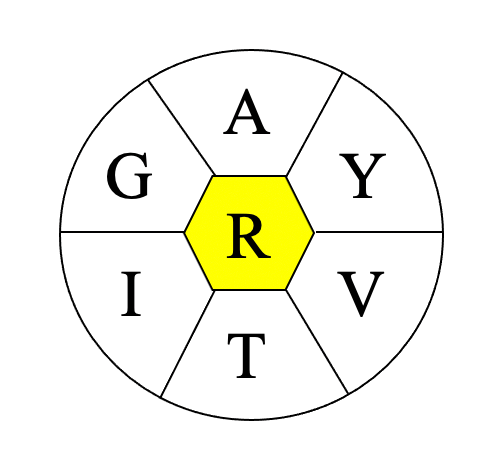
Today’s New York Times Spelling Bee letters:
Art: Iva Reztok

A, G, I, T, V, Y, and center R (all words must include R)

Merriam-Webster says…

Credit: merriam-webster.com

Silly little dictionary! Don’t you know vara can’t possibly be a word if the New York Times says it ain’t?

For further fascinating facts, check out the Spelling Bee Master.

What’s your favorite dord* from today’s puzzle?

My Two Cents

The dictionary’s definition is very specific, but not quite accurate. At least not historically. The vara was also a Spanish and Portuguese unit of measurement that, despite having the same name in both countries, didn’t represent the same thing.

That’s not unusual, though. For thousands of years civilizations and cultures across the globe used very different units of measurement that, for the most part, were a bitch to convert into. It’s a minor miracle that in the previous century we finally managed to develop a homogenous system ––previously called metric but now referred to as International System of Units (SI)–– that most countries in the world are party to.

Most countries except the United States, of course. And a few others of course. But in terms of population, we are closing in on 400 million people who simply refuse to use meters, kilos, and liters on a daily basis. And those people appear in aqua on this map:
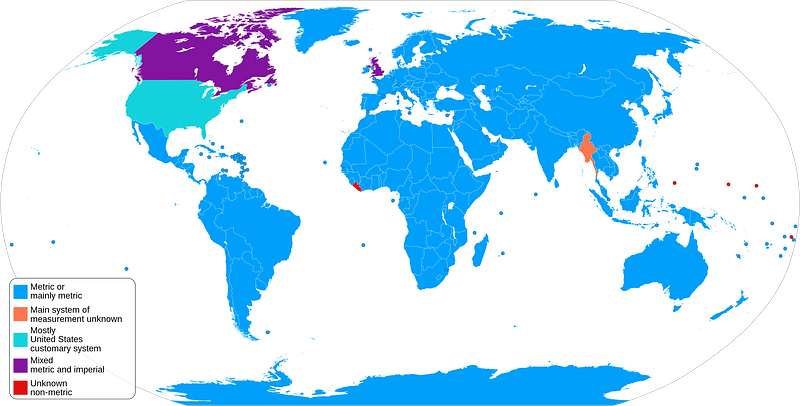
Image by Goran tek-en

The red country on the African continent is Liberia, and the orange country in Asia is Myanmar (formerly Burma). Canada and the United Kingdom are in purple, but in both cases their citizens mostly use metric, although not exclusively. So they’re sort of bi-measurement, one could say.

Interestingly, although both the British Imperial and United States customary system of measurement came from the earlier English systems used until 1825, they are not 100% equivalent. This is especially noticeable when measuring volume. The yard in both systems, however, was standardized in 1959 to measure exactly 0.9144 meters in the U.S. and 0.9144 metres in the U.K. and Canada.

Most people familiar with both these non-metric systems have probably heard of the inch, the foot, the mile, the acre, the quart, the gallon, the ounce, and the pound. But there are some other, more quaint names for units of measurement: the twip, the barleycorn, the perch, the rood, the minim, and the fluid scruple.

The perch is also known as the rod, which is what vara means in Spanish. See how I managed to cleverly circle back to our word of the day? Thank you for the standing ovation! On to our subject matter…

The rain in Spain is measured in plain

Our friends at Merriam-Webster explain that the word vara comes to English “borrowed from American Spanish, from Spanish, “pole,” going back to Latin vāra “any of various branched structures or implements,” noun derivative from feminine of vārus “bent outwards with converging extremities, bow-legged,” of uncertain origin.

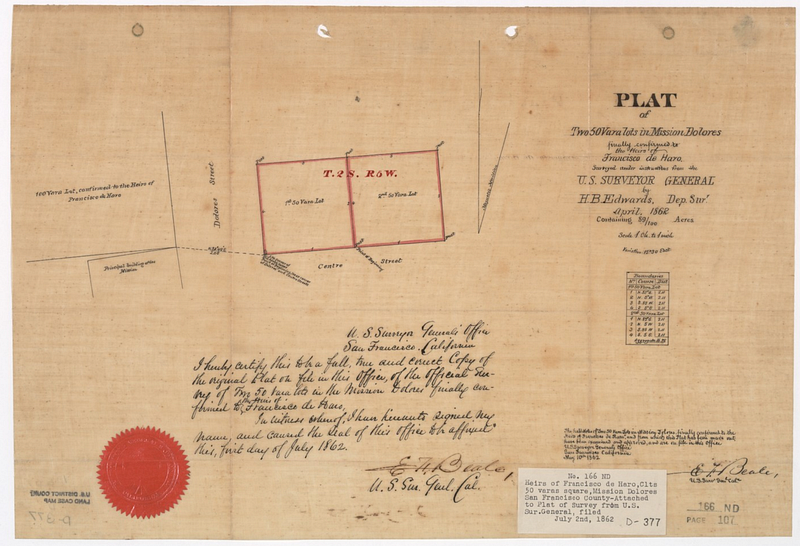
Although per the dictionary the Texas unit of length is equal to 33.33 inches (84.66 centimeters), the Spanish vara had different measurements depending on the time period and the country using it. As a result of Spain colonizing a great chunk of the Americas between the 15th and 18th centuries, the vara became a surveying unit that appeared in many deeds in the southern United States, and was also used in many parts of Latin America.
Credit: Online Archive of California

Above is a document that mentions two lots of 50 varas each. The writing on the top right says “Plat of two 50 vara lots in Mission Dolores, finally confirmed to the heirs of Francisco de Haro”. In this case, plat is a synonym for plot.

I’m not sure if this is the same Francisco de Haro who served as the first alcalde (mayor) of San Francisco between 1834 and 1835, pre-statehood. Here he is, relieved that his plat of two 50 vara lots were finally confirmed to his heirs.
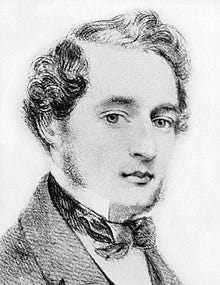
Image by Unk Nown

Haro himself is confirmed… to have served in the Presidio of San Francisco, that is. However, there is no confirmation about whether or not he ever beat up somebody in a fight using only his right thumb.

Below is a table of units of length used in Spain around 1801, with their modern metric equivalents. Note that even though the translations to English are common terms of the customary system, they are not equivalent. The inch, foot, yard, and mile are shorter than what Americans use today.
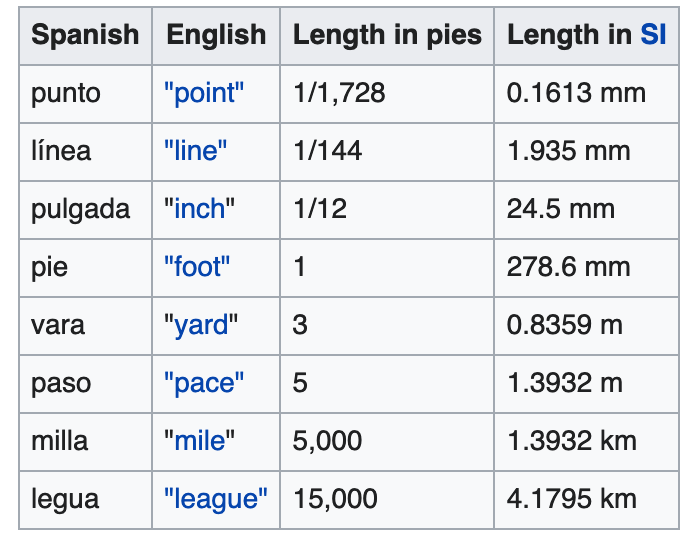
Credit: wikipedia.com

A tract of land measuring 100 varas squared (which is not the same as 100 square varas) is referred to as a manzana. Those of you who speak Spanish as a second language may be familiar with this term as a fruit ––apple–– but it also translates as “block”, in the urban architecture sense. Apparently there is no etymological difference between the apple manzana and the block manzana. In other words, some city planner centuries ago decided to use the apple as a metaphor for a bunch of buildings placed on the same lot, and the metaphor stuck.

Usage of the manzana as “city block” will vary depending on which Spanish-speaking country you visit. In some places it refers to both the entire block of buildings (that is, all four sides enclosing them) and the distance between two corners of one side. This parallels the usage of “block in English. In some countries, however, cuadra is used to indicate one side of a block, with four cuadras then making up the perimeter of one manzana.

Portugal the country, not the man

Portugal and its biggest former colony, Brazil, adopted the metric system in the 19th century. Before that, well, things were complicated. The Portuguese used several systems of weights and measures influenced by the ancient Romans, Northern European countries, and even Islam.

By mid-14th century people got sick and tired of the confusion and requested their king to standardize units for the entire country. That took almost 150 years to get done. Even in 1455, King Alfonso V still accepted six different regional standards. But at the beginning of the 16th century, Manuel I finally put an end to the squabbling by creating an official Portuguese system of units that lasted some three plus centuries, until the metric system was adopted in 1814. Portugal was the second country in the world to do so, after France.

Here is King Manuel I, chastising some weird plant for not using the measurements he established.
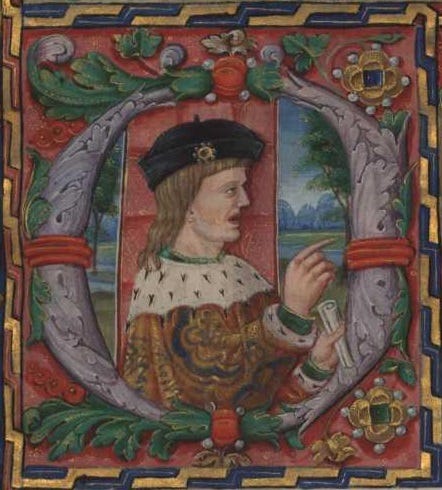
Art by Unk Nown

The Portuguese vara was a bit closer to the meter than the Spanish one, albeit longer. Below is a table with Portuguese units of length in use before conversion to the metric system.
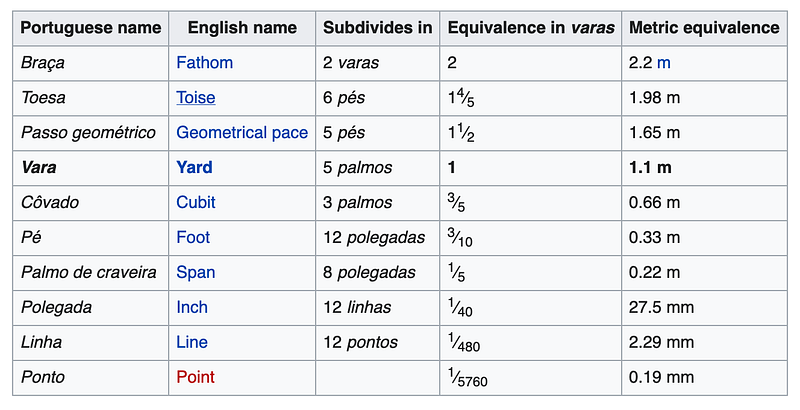
Credit: wikipedia.com

Although there are some similarities to the Spanish units, there are also some additional ones, like the cubit and the toise.

Now you know. Next time you’re in Texas and want to measure exactly 33.33 inches of something, don’t ask for a vara… because the editors of the Spelling Bee decided that vara is a dord*.

You can check out my previous entry on another dord* here:

What the heck is a dord, you ask? Here’s the answer:

Spelling Bee
Language
History
Measurement
Spain
Recommended from ReadMedium