
Tomfool
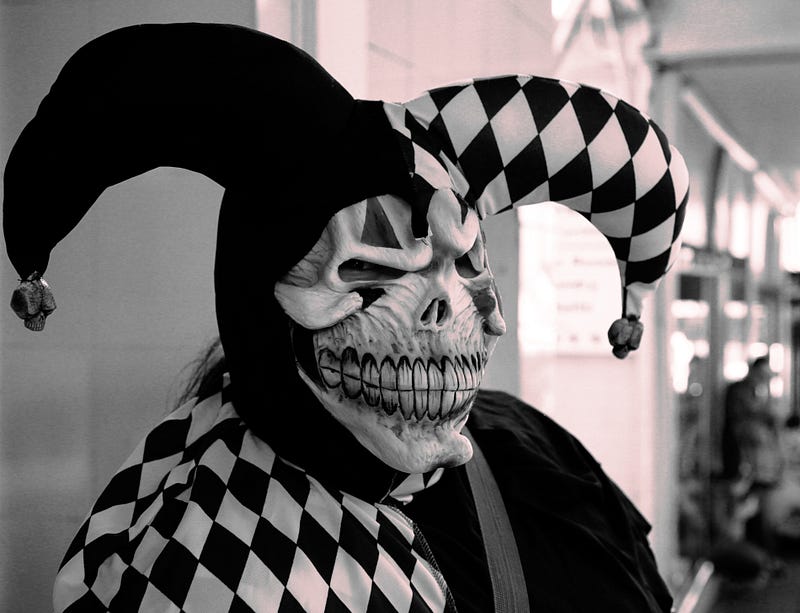
I jest can’t wait to tell you about this word! (groan)
Today’s New York Times Spelling Bee letters:
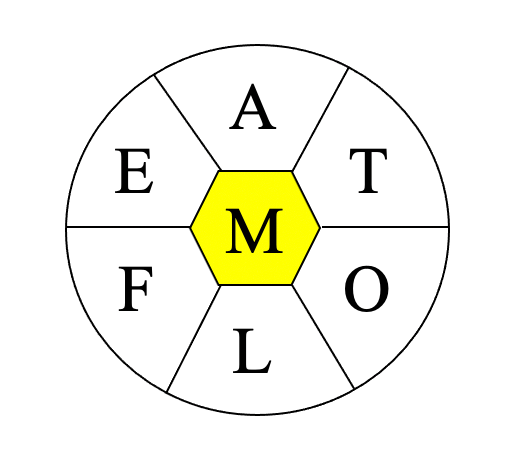
A, E, F, L, O, T, and center M (all words must include M)
Merriam-Webster says…
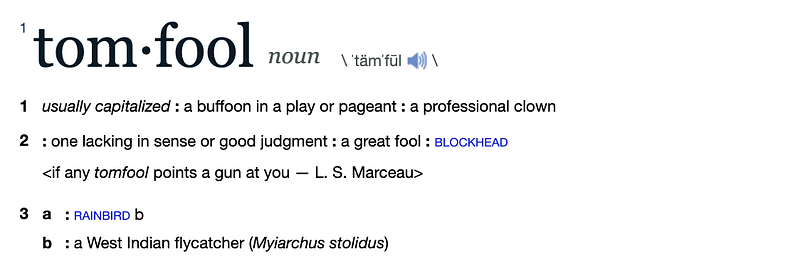
Silly little dictionary! Don’t you know tomfool can’t possibly be a word if the New York Times says it ain’t?
For further fascinating facts, check out the Spelling Bee Master.
What’s your favorite dord* from today’s puzzle?
My Two Cents
I was intrigued by the third entry for today’s word: “rainbird” or “a West Indian flycatcher (Myiarchus stolidus)”. And the dictionary has the following list of species for “rainbird”:
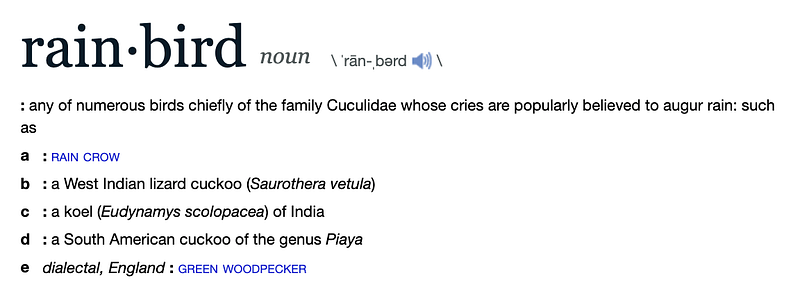
The koel looks particularly nasty…
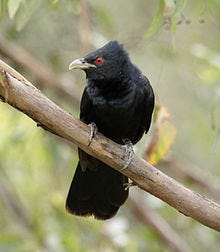
…but maybe it’s just pissed that everyone keeps calling it a “tomfool”.
In reality, most of the references I found in connection with birds were “tom fool” or “Tom Fool”: two words, not one. This was after an excruciating and intense ten-minute online search. I would gone up to fifteen, but, well, it’s Friday.
What’s in a name?
There are many words in English that are eponyms, or terms named after people or places related to the current meaning of said terms. Some you may already be aware of, like America (named after Italian Map maker Amerigo Vespucci), sandwich (named after John Montagu, 4th Earl of Sandwich and English diplomat) or saxophone (named after its inventor, Adolphe Sax).
Here are some examples of words whose origins you may not have known (and if you did, kudos to you, of course).
§ bloomers, named after Mrs. Amelia Bloomer, American woman’s rights and temperance advocate. Although she did not invent the underwear named after her, she became associated with it after heavily promoting its use.
§ boycott Charles C. Boycott was an English land agent in Ireland who was ostracized in 1880 for refusing to reduce rents.
§ chauvinism is an example of a double eponym. It comes to English from the French chauvinisme, itself from chauvin, meaning “warmonger”. Now, the origin of chauvin is the fictional character named Chauvin, a very patriotic soldier in a play. There’s the first eponym. The play was written by Charles T. and Jean Hippolyte Cogniard, who decided to name that Chauvin character after Nicolas Chauvin, a real-life French soldier very devoted to Napoleon. That’s eponym number two.)
§ dunce & dunce cap Our ironic eponym of the day. John Duns Scotus was one of the most brilliant thinkers of the Middle Ages. As our friends at Merriam-Webster explain:
So ingenious were the theological and metaphysical speculations of this thinker that he was given the name “the Subtle Doctor.” However, in the 16th century, his followers became a conservative element in English universities, and they tended to resist the new learning of humanism. As result, dunsman and the shortened form duns (later respelled as we have it today), became terms of scorn, meaning first “sophist” or “pedant” and gradually taking on the modern sense “slow-witted person.”
§ jumbo Jumbo was a huge elephant exhibited by P. T. Barnum after purchasing him in 1882 from the London for the tidy sum of $10,000, despite the efforts of 100,000 English school children who wrote to Queen Victoria begging her to stop the sale. Thanks to Barnum’s circus advertising, the name “Jumbo” became a synonym for “huge.” When the Brooklyn Bridge was opened and people feared it would collapse, Barnum sent Jumbo and 20 other elephants to prove the bridge was sturdy. You can read about poor Jumbo’s short and sad life here.
Surely you’re jesting… I’m not, and don’t call me Shirley, either
The dictionary explains that tomfool comes from the earlier version, Tom foole, from Tom, shortened form of the proper name Thomas + foole (fool, as in “a person lacking in judgment or prudence”).
It’s believed the term originally used as a synonym for jester, and may have even predated it. The account rolls of Durham Abbey ––now Durham Cathedral–– show payments made to a Thome Fole, a jester who may have been using that monicker as his stage name. He was given money for his outfit (while he was alive) and for his funeral (while he was dead).
A jester, fool or joker was part of the household of noblemen or monarchs, especially during medieval and Renaissance times. Tomfools were employed to entertain guests during visits. Some of them freelanced as nomadic performers who worked for tips at town fairs and markets.
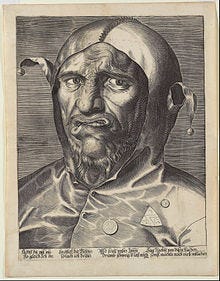
Today there are only two types of jesters left. Those that perform at historically-themed events, like Renaissance fairs, and those that “work” in Congress or Parliament.
The word jester came from the Middle English gestour, meaning “reciter of romances, minstrel, entertainer,” from the word gesten, “to recite romances” + the suffix -our.
The common belief is that tomfools wore brightly colored clothes and eccentric hats in a motley pattern, similar to what you may have seen depicted in almost every movie or TV show about kings and queens living centuries ago. Jesters entertained by performing songs, playing music, telling stories and jokes, juggling, and even performing magic tricks.
Many people associate jesters with countries in the United Kingdom, but other countries such as Poland, Germany, and even Japan also had them. Here in Spain, where I live, little people were often hired as buffoons to entertain the king and his family, especially the children. In of his iconic Spanish paintings, Las Meninas, painter Velázquez depicted two dwarfs: the German Maria Bárbola, who had hydrocephalus, and the Italian Nicolasito Portusato.
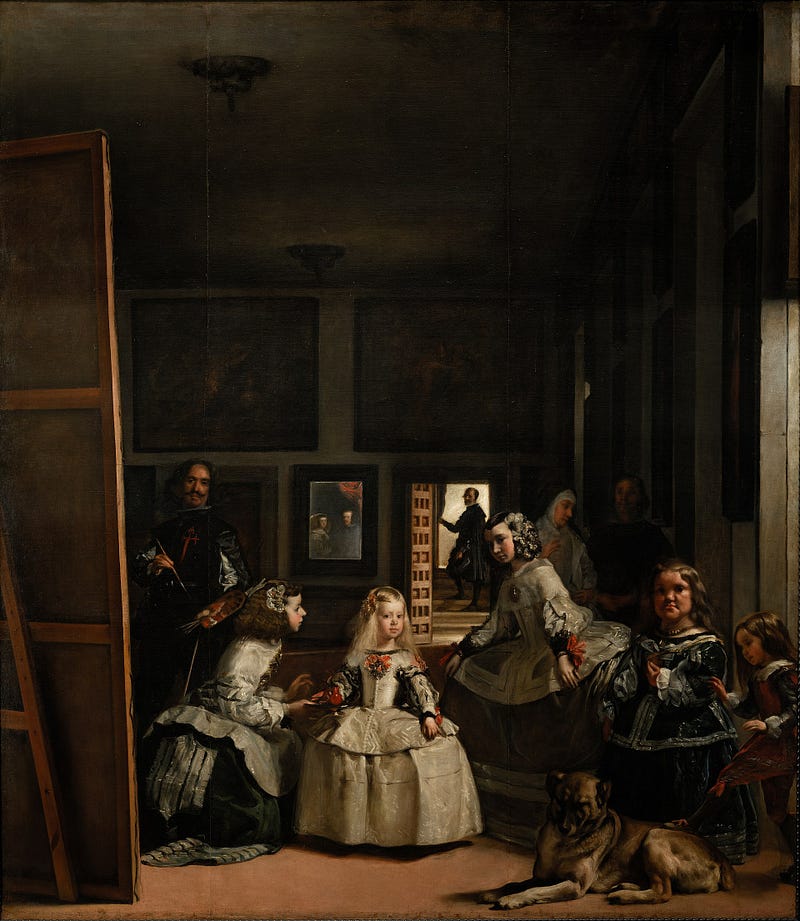
The two jesters are on the far right.
The profession of court tomfool died out in most countries by the nineteenth century. The last British nobles to keep jesters were the Queen Mother’s family, the Bowes-Lyons.
However, there have been a few court jesters in recent times, believe it or not. In 1999 Tonga king Taufa’ahau Tupou IV appointed JD Bogdanoff to that role. What were Bogdanoff’s credentials? Well, he wasn’t “working” in Congress or Parliament, but he was a former Bank of America financial adviser. What could possibly go wrong with that combination? Everything, as it turns out. Bogdanoff was later embroiled in a financial scandal and was accused of mismanaging millions of dollars.
In 2015, the town of Conwy in North Wales appointed Russel Erwood as the official resident jester. The post had been vacant since the end of the 13th century. You can read about Erwood here.
Well, happy Friday, dear readers. I hope you enjoy the upcoming weekend and have a really good time. Just don’t go around being a tomfool. Oh wait, you can’t… because the editors of the Spelling Bee decided that tomfool is a dord*.
You can check out my previous entry on another dord* here:
*What the heck is a dord, you ask? Here’s the answer: