
Bailey
A wall, a drink, a bridge, and a cartoon soldier
Today’s New York Times Spelling Bee letters:
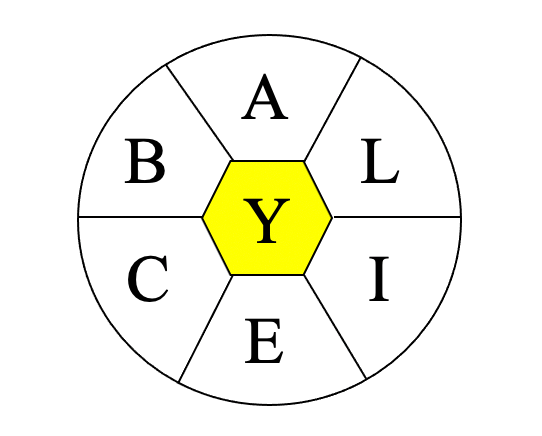
A, B, C, E, I, L, and center Y (all words must include Y)
Merriam-Webster says…
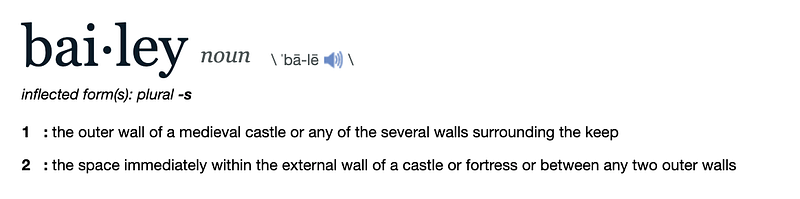
Silly little dictionary! Don’t you know bailey can’t possibly be a word if the New York Times says it ain’t?
For further fascinating facts, check out the Spelling Bee Master.
What’s your favorite dord* from today’s puzzle?
My Two Cents
The first thing that pops into my head when I hear bailey is a comic strip I grew up reading. Then again, I’m no spring chicken, not even a summer chicken. More like a fall turkey at this point. Anyway, this comic strip, called Beetle Bailey, is still published and was still produced by its original creator, Mort Walker, almost until his death in 2018 at the age of 94. Impressive!
But obviously Bailey with a capital B cannot be accepted by the Spelling Bee because proper nouns are verboten by the rules. But there is one bailey that is not capitalized, and should have been included in today’s list of answers.
Lowercase b
Our friends at Merriam-Webster explain that the word bailey comes from Middle English bailli, meaning “palisade” or “bailey”, from the Anglo-French baille, balie.
The 1911 edition of the Encyclopedia Britannica further clarifies that the word could be “a corruption of Ballium by some, and derived by others from the Fr. baille, a corruption of bataille, because there the soldiers were drilled in battle array”.
Essentially, baileys (or wards, as they are sometimes called) are the fortifications of a castle; but the word is also used to refer to the space between fortifications. Go figure!
In her book Understanding the Castle Ruins of England and Wales, Lisa Hull explains this about baileys:
Whether made of earth or stone, the typical medieval castle featured at least one defended courtyard or ward, the bailey. Some castles featured an outer bailey and an inner bailey, the functions of which varied… The bailey was often an enclosed area adjoining a motte or an open area enclosed by masonry walls or earthen embankments in which the main activities of daily life in the castle took place. The inner bailey commonly contained the hall and kitchen block, residential chambers, and the chapel, whereas the outer bailey typically held workshops, stables, and ocher ancillary facilities. In castles with only one bailey, the enclosed area would normally hold all of these facilities.
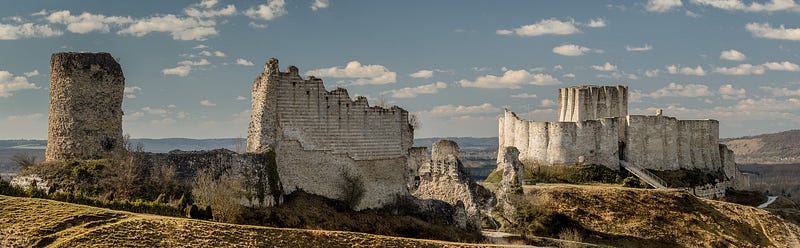
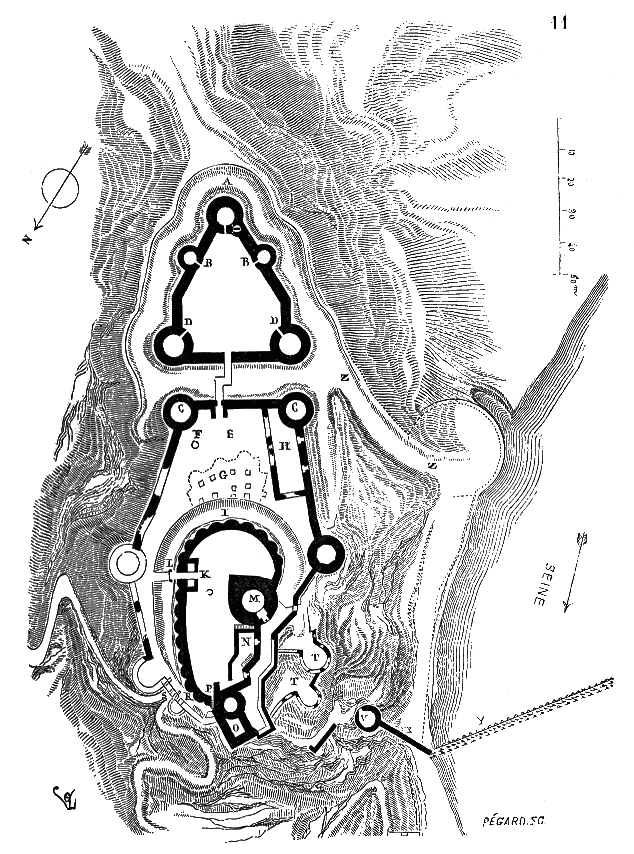
Since a picture is worth a thousand words, I’m gonna go ahead and use that resource to clarify. Here is very pretty photo of the ruins of the Château Gaillar castle in Normandy, France. The keep and wall around the inner bailey are on the far right. From the middle to left are the remains of the outer bailey and a tower.
And here is the layout of the baileys in a plan drafted by Eugene Viollet-le-Duc, a nineteenth-century architect experienced in renovating castles. (Note that North is downwards and to the left, not up.) At the bottom is the keep and its inner bailey, the same ones we see to the far right above. The outer bailey is at the top. In other words, if you shifted the drawing 90 degrees to the left, the layout would match the photo more closely.
Uppercase B
There are a ton of Baileys with a capital B, but I’m going to focus on only three of them. Why? Cause it’s my column and I mostly do as I please around here. [Update November 8, 2023] I also sometimes take suggestions, especially from loyal readers. So I’m including a fourth Bailey, right off the bat here:
James Anthony McGinnis does not seem like a Bailey at all, but that’s because we started off with his birth name. He adopted the surname Bailey from Colonel Frederic Harrison Bailey, who discovered McGinnis while the latter worked at a hotel. The colonel was a nephew of circus pioneer Hachaliah Bailey. And, as we all know, Circus + Bailey = P. T. Barnum. Well, that equation may not be mathematically (or even grammatically) sound, but you know what I’m getting at.
James Anthony Bailey established the famous Barnum and Bailey’s Circus with Phineas Taylor Barnum, who seeing how Bailey’s own circus outperformed his, cleverly managed to convince J. A. that it was worth coming together as one. The original name of the enterprise was “P.T. Barnum’s Greatest Show On Earth, And The Great London Circus, Sanger’s Royal British Menagerie and The Grand International Allied Shows United”, but after people lost weeks of their lives repeating that over and over, it was shortened to “Barnum and Bailey’s Circus”.
It was Bailey who masterminded the acquisition of Jumbo, billed as the largest elephant in the world…
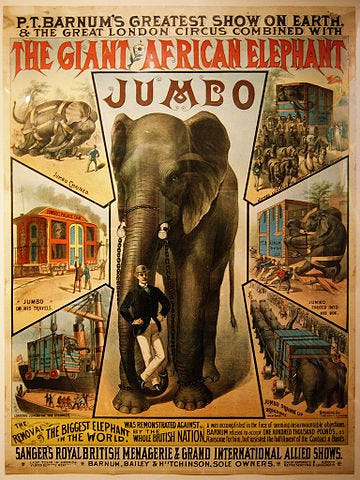
…and inspiration for the 747’s nickname “jumbo jet”. Jumbo the elephant helped Barnum and Bailey earn a ton of money, and was one of the elephants who in 1884 crossed the Brooklyn Bridge (opened a year earlier) to help prove that it was safe to use.
Towards the end of the 19th century, Bailey also managed Buffalo Bill’s Wild West Show. Sadly, he died in 1906 at a 58 years of age from erysipelas, which is a fancy name for a common bacterial infection of the superficial layer of the skin. However, 117 years ago we didn’t have the antibiotics we do today. So that was the end of Bailey. Barnum had died 15 years earlier, but at the riper age of 80. [End of update]
Of course, one of the first thing that people who love liqueurs do when they hear Bailey is add an “s” to the end of the word, and then pour themselves a drink. Namely, this one:
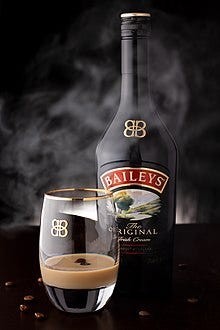
Baileys Irish Cream was created by Tom Jago of Gilbeys of Ireland (a brewing and wine distribution company), was introduced in 1974 as the first Irish cream on the market, and took its name from a restaurant owned by John Chesterman, who had granted W&A Gilbey permission to use it.
According to the Baileys’ web site, “It took two years of trial and error but by 1974 we had added the finest spirits, rich chocolate and vanilla flavors (with some other flavors and ingredients) along with a little magic, to create the Baileys recipe we now know and love.”
Today there are almost a dozen different products in the Baileys line. Well, writing this section of the article got me thirsty. I’m gonna pour myself some Baileys on ice. Be right back…
Okay, where were we? Right, Baileys with a capital B. Here’s number two for today: the Bailey bridge. This bridge was developed at the beginning of World War II as portable, pre-fabricated, truss or beam structure. It was especially used by British, Canadian and American military engineering units. The construction of the Bailey bridge requires no special tools or heavy equipment. It was conceived so that its wood and steel parts would be small and light, and could be lifted by hand without the need for cranes or other machinery.
Donald Bailey was just a regular old civil engineer in the British War Office whose hobby was model bridges. He didn’t drink any Baileys liqueur because it hadn’t yet been invented. I’m not sure if he drank any alcoholic beverages at all, but he did like to come up with ideas for bridge designs. In 1936 he submitted one of them in 1936 but no one took him seriously because Europe wasn’t in the midst of a horrible war that killed millions and millions of people. So the proposal was soundly rejected. Or maybe silently rejected. I can’t be sure as I wasn’t there.
Undeterred, Bailey went back to sketching and got more creative, submitting another idea in 1940, this time as a sketch on the back of an envelope. Perhaps impressed by Bailey’s chutzpah ––or maybe just because this time around the British were involved in a horrible war that was killing millions and millions of people–– the Ministry of Supply gave him an odd Valentine’s Day gift by requesting he complete a full-scale prototype in two and a half months.
Bailey immediately went to work on it while smoking his trusted pipe, and came up with this:
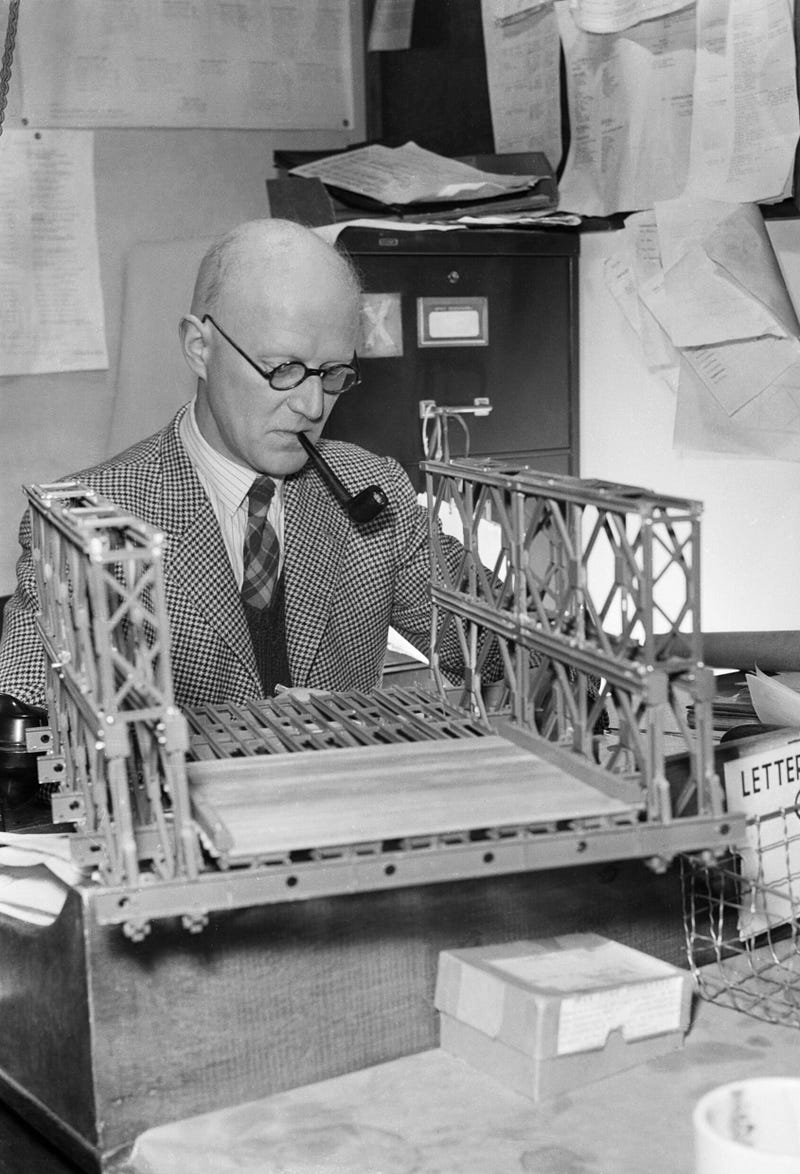
Although that bridge was great for mice crossing a stream, it wasn’t particularly well-suited for soldiers trying to get to the other side of a wide river while being shelled with mortar. Eventually the English engineer and his team solved all the issues and the Bailey bridge became a huge success.
Here are some Royal Engineers laying wood planks over stringers to construct the roadbed of a Bailey bridge in Italy, in September of 1943.
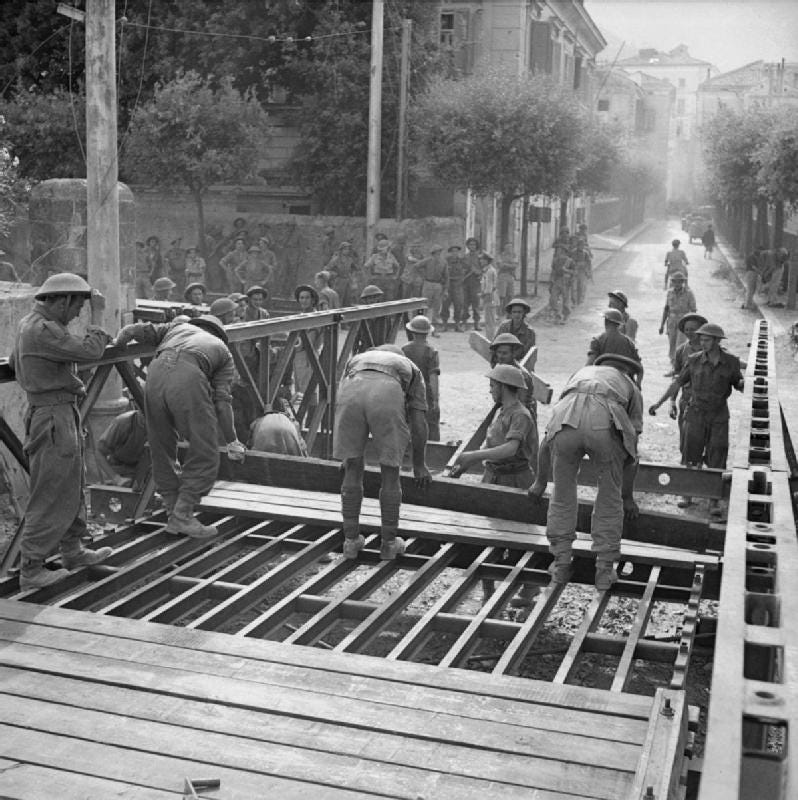
How awesome was the Bailey bridge? Well, Field Marshal Bernard Montgomery said that “without the Bailey bridge, we should not have won the war.”
From a military bridge we can smoothly segue to a military cartoon, and circle back to the beginning of today’s column: Beetle Bailey.
Beetle Bailey is an American comic strip created by cartoonist Mort Walker. It has been continuously published since September 4, 1950. It began as a college-themed strip and floundered during its first six months, to the point that distributor King Features Syndicate was ready to drop it. Fortunately for Walker ––and vey unfortunately for millions of Koreans–– the Korean War had begun that same year. So in 1951 Walker had Beetle enlist in the Army. Dozens of newspapers quickly did the patriotic thing and began publishing the irreverent comic strip. Success!
Walker redesigned the cast of characters and set them on a fictional United States Army post named Camp Swampy (inspired by Camp Crowder, where Walker himself had once been stationed while in the Army). The main character is Beetle Bailey, an antihero and anti-soldier who loves to nap and does his best to avoid any sort of work. This pisses off the main antagonist, Bailey’s senior NCO, Sergeant Snorkel. Many of the strips are of the Bailey vs Snorkel type, with Bailey trying to pull one over his sarge and Snorkel (often accompanied by his dog Otto, a canine mini-me of sorts) beating up on Beetle both verbally and physically.
One running gag over the decades has Sergeant Snorkel hanging helplessly from a small tree branch after having fallen off a cliff. This joke first appeared in August of 1956. While it’s never shown how Snorkel ends up in this conundrum, or how he gets out of it, he somehow always finds a way to dangle from the same branch, yelling for help.
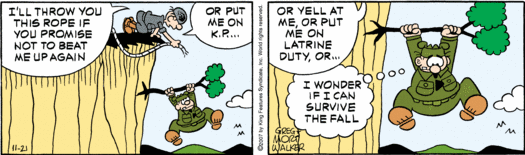
No one on the base ever seems to see combat themselves, with the exception of military drills. In fact, they seem to be frozen in time: they wear uniforms in the fashion of the late 1940s to early 1970s (green fatigues and baseball caps), and use the open jeep model as the basic military vehicle. In that sense, Beetle Bailey functions as an everlasting time capsule of Army days gone by.
Besides Bailey, Snorkel, and Otto, the other main characters are:
- Brigadier General Amos T. Halftrack: the incompetent commander of Camp Swampy who will never say no a to a good martini or an 18-hole golf game, much to his wife Martha’s dismay. In the politically incorrect yesteryears he would often harasses his secretary, Miss Buxley –– who was much smarter and more capable than her boss.
- Miss Buxley: the beautiful, blonde, civilian secretary of the army base, occasional given to dating some of the soldiers. Buxley has an apparent interest in Beetle and later becomes his girlfriend, but is constantly pursued by Killer.
- Private “Killer” Diller: notorious ladies’ man and good friend of Beetle.
- Lieutenant Sonny Fuzz: Cartoonist Walker said he modeled the earnest, anal-retentive and “by the book” character on himself. Fuzz is always trying to impress his uninterested superiors (especially General Halftrack), and rub his success in the noses of everyone else.
- Lieutenant Jackson Flap: The strip’s first black character, introduced in 1970. He originally had an afro but later shaved it off.
- Cookie (Cornelius) Jowls: The mess sergeant, who smokes cigarettes while preparing the mess hall’s menu famous for rubbery meatballs and rawhide steak. He does not believe in sanitary food preparation measures except for his chef hat, and is almost always seen wearing a tank top. Walker once described him as “the sum of all Army cooks I’ve met in my life.”
- Private Zero: A buck-toothed, naïve farm boy who takes commands literally and misunderstands practically everything. Sometimes Zero enrages Sarge even more than Beetle does.
- Private Plato: Camp Swampy’s resident intellectual; bespectacled, given to scrawling long-winded, analytical, often philosophical graffiti. Named after Plato the Greek philosopher, but based on Walker’s pal and fellow cartoonist Dik Browne (creator of Hagar the Horrible and with whom Walker drew the comic strip Hi and Lois).
Interesting factoid that won’t affect your life in any meaningful way: Lois Flagston and Beetle Bailey are siblings.
In 2002, Walker decided to ask his readers for help choosing a new character that would fit the digital age. And so began a write-in contest to choose Camp Swampy’s resident computer geek. It received more than 84,000 entries and helped raise more than $100,000 for the Fisher House Foundation, a non-profit organization that provides housing for families of patients at military and veterans hospitals.
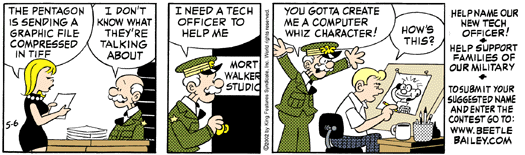
On July 4th of that year, the entry sent in by by Earl Hemminger of Springfield, Virginia, was announced as the winner and the character of Chip Gizmo was added to the list of Beetle Bailey regulars.
Throughout its decades-long run, Mort Walker’s comic strip has not shied away from controversy. After the Korean War ended, Army brass felt that Beetle Bailey encouraged soldiers to disrespect their officers. The strip was banned in the Tokyo Stars and Stripes, but the sympathetic publicity made Beetle Bailey even more popular and even more papers picked it up. By the time Walker won the National Cartoonist Society’s award as the best cartoonist of the year for 1953, Beetle Bailey had become a worldwide success.
As a kid, I used to read the comic strip in English, despite growing up in a Spanish-speaking country, where it was renamed as Beto el recluta. (Recluta means “recruit”). I haven’t really followed Beetle’s antics in a couple of decades, but writing today’s column made me nostalgic for that type of simple but entertaining humor.
You can read the daily escapades of Beetle Bailey and his pals here:
Well, that’s about it for today. If you ever happen to be crossing a military bridge to get to a castle wall and dig up a buried comic strip about a soldier nicknamed Beetle, all while holding some Irish cream in your hand… well, first of all, wow! You definitely need to write a story about that here on Medium. Oh, and also, you’re probably making that story up, because it’s all about baileys, which don’t really exist because the editors of the Spelling Bee decided that bailey is a dord*.
You can check out my previous entry on another dord* here:
*What the heck is a dord, you ask? Here’s the answer: