avatarAvi Kotzer

Free AI web copilot to create summaries, insights and extended knowledge, download it at here

4241

Abstract

was advertised with a simple slogan: “You Press the Button, We Do the Rest.”</p><p id="714f">The only thing not simple was the patent drawing Eastman made:</p><figure id="7985"><img src="https://cdn-images-1.readmedium.com/v2/resize:fit:800/1*NZgi7u48W0eROB6QEPU1Tg.png"><figcaption>Credit: wikipedia.com</figcaption></figure><p id="8f65">The Kodak cameras’ ease of use and (as time went by) low cost made the company the leading brand in consumer photography for over a century. Terms such as Kodachrome and “Kodak moment” became familiar to everyone across the globe. The company’s name even spawned a verb: to <i>kodak</i>, or take pictures with a Kodak camera. Are you reading this, editors of the Spelling Bee?!?</p><figure id="0ae5"><img src="https://cdn-images-1.readmedium.com/v2/resize:fit:800/0*LdKH2dwMPTIafTiO"><figcaption>Credit: Business Insider</figcaption></figure><p id="0454">Yes! Let the children <i>kodak</i>, indeed!</p><p id="463d">It was probably a good thing Eastman was dead when things began falling apart in the 1990s, although that has not prevented him from rolling in his grave for the last few decades almost without interruption.</p><p id="05b4">What felled the giant tree of photography? The digital and internet era, of course. The biggest irony of them all is that Kodak was the first company to invent and develop a digital camera:</p><figure id="0720"><img src="https://cdn-images-1.readmedium.com/v2/resize:fit:800/1*TcLNvkechb5IsRAYieEFZA.png"><figcaption>Screenshot by Iva Reztok</figcaption></figure><p id="eb36">Hmm, the above patent looks easier to figure out than Eastman’s original one. Go figure!</p><p id="54b0">Company execs feared their own invention would threaten their photographic film business. Eventually Kodak got into digital cameras, but it was too little too late, sorta like what happened with Blockbuster and Netflix. Kodak ended up filing for bankruptcy in January 2012, almost exactly 10 years from today. Ernest Scheyder wrote an interesting article about the whole fiasco, which you can read <a href="https://www.reuters.com/article/us-kodak-bankruptcy/focus-on-past-glory-kept-kodak-from-digital-win-idUSTRE80I1N020120119">here</a>.</p><p id="380d">No one talked or heard or read or wrote about Kodak too much after that… until July of 2020. That’s when the company’s stock went up 2,189% in two days. Yeah, that’s a comma, not a decimal point. More than two thousand percent. This after the government announced it would approve a 765 million loan for Kodak to begin manufacturing… no, not film… drugs!</p><p id="bc9f">As wikipedia sums up: “The Trump administration announced that it planned to give Kodak a 765 million loan for manufacturing ingredients used in pharmaceuticals, to rebuild the national stockpile depleted by the COVID-19 pandemic and reduce dependency on foreign factories… Within two days, the company’s stock price had gained as much as 2,189% from its price at the close of July 27 on the NYSE. The <i>New York Times</i> reported that one day before the White House announced the loan, Kodak CEO Jim Continenza was given 1.75 million stock options, some of which he was able to execute immediately. The funding was put on hold as the U.S. Securities and Exchange Commission began probing allegations of insider trading by Kodak executives ahead of the deal’s announcement, and the funding agency’s inspector general announced scrutiny into the loan terms.”</p><p id="df79">Today, Kodak’s stock hovers around $4.50, about double what it was a year and half ago, but nowhere near what it leaped to after that whole shady drug-manufacturing plan was hatched.</p><p id="f8b7">As far as Kodak’s future is concerned, who knows what the future will develop. (Sorry, I just couldn’t resist!)</p><h2 id="f30f">Eponyms</h2><p id="8ad9">Merriam-Webster defines <i>eponym</i> as “one for whom or which something is or is believed to be named” and “a name (as of a drug or a disease) based on or derived from an eponym”.</p><p id="cb94">Earlier I mentioned some common eponyms, <i>kleenex</i> (the noun) and <i>xerox</i> (the verb). For those of you not familiar with <i>xerox</i>, it was used a lot in the 1980s and 1990s in the sense of “to make a photocopy”. T

Options

hat’s because Xerox the company was the first one to commercialize the photocopy machine, the 914 model, in 1959.</p><figure id="2475"><img src="https://cdn-images-1.readmedium.com/v2/resize:fit:800/0*KZBPIc1cmyt1KqXt.jpg"><figcaption>Credit: Fayr Youse</figcaption></figure><p id="47a8">It only looks tiny in the picture; that thing took up a whole effin’ room back then. Just like the ones in your office today. Hmmm….</p><p id="1e61">There are tons of words we use on daily basis that derives from someone or something’s name. A few of the better-known ones are <b>Shirley Temple</b> (alcoholic beverage), <b>saxophone</b>, <b>frisbee</b>, and <b>popsicle</b>.</p><p id="8fca">Did you know, however, that the words <b>bloomer</b> (as in the underpants), <b>dumpster</b>, and <b>ping pong</b> all come from people’s or product’s names? So does the infamous term <a href="https://en.wikipedia.org/wiki/Gerrymandering"><b>gerrymandering</b></a>, whose origin is very interesting because not only is it related to a person (former governor Elbridge Gerry of Massachusetts) but is also a <i>portmanteau</i>, or blend of two words: the governor’s last name and “salamander”. Salamander… not because what the governor did was slimy (which it was), but because one of the districts he contorted resembled a salamander when mapped. American engraver and miniature painter Elkanah Tisdale drew a political cartoon of the map:</p><figure id="5583"><img src="https://cdn-images-1.readmedium.com/v2/resize:fit:800/0*-gyyQRdCWe9UnH91.png"><figcaption>Credit: Elkanah Tisdale</figcaption></figure><p id="037e">Yeah, that Elkanah clearly had weird ideas about how salamanders were supposed to look. Perhaps he had spent too much time engraving and not enough time outdoors.</p><p id="3b00">Anyway, dictionary.com has a plethora of these eponyms, if you’d like to peruse some of them.</p><div id="7bdb" class="link-block"> <a href="https://www.dictionary.com/e/s/famous-names-inspired-common-words/#whats-an-eponym"> <div> <div> <h2>Famous Names That Inspired Common Words</h2> <div><h3>You know lots of eponyms -words based on or derived from a person's name. They include many commonly used words in a…</h3></div> <div><p>www.dictionary.com</p></div> </div> <div> <div style="background-image: url(https://miro.readmedium.com/v2/resize:fit:320/0*wk3X85iAlYKaX8_M)"></div> </div> </div> </a> </div><p id="67e1">So, we conclude today’s column with the usual rant: despite the incredible importance and dominance of Kodak during most of the 20th century, the editors of the Spelling Bee opted not to include the word <i>kodak</i> in today’s game, effectively declaring it a dord*.</p><p id="4722">You can check out my previous entry on another <b>dord* </b>here:</p><div id="2490" class="link-block"> <a href="https://readmedium.com/cocoyam-eaf81a6906e6"> <div> <div> <h2>Cocoyam</h2> <div><h3>This word has little to do with coconuts or yams… and nothing to do with the photo below</h3></div> <div><p>medium.com</p></div> </div> <div> <div style="background-image: url(https://miro.readmedium.com/v2/resize:fit:320/0*LxcjsGRlYxvB-YpT)"></div> </div> </div> </a> </div><p id="c43b">*What the heck is a <b>dord, </b>you ask? Here’s the answer:</p><div id="3253" class="link-block"> <a href="https://www.merriam-webster.com/words-at-play/dord-a-ghost-word"> <div> <div> <h2>'Dord': A Ghost Word</h2> <div><h3>One of the questions people like to ask lexicographers is this: Can you sneak something into the dictionary? Can you…</h3></div> <div><p>www.merriam-webster.com</p></div> </div> <div> <div style="background-image: url(https://miro.readmedium.com/v2/resize:fit:320/0*pUU2bEg7XRN0plxl)"></div> </div> </div> </a> </div></article></body>

kodak

It’s a camera, it’s a moment… it’s a verb!
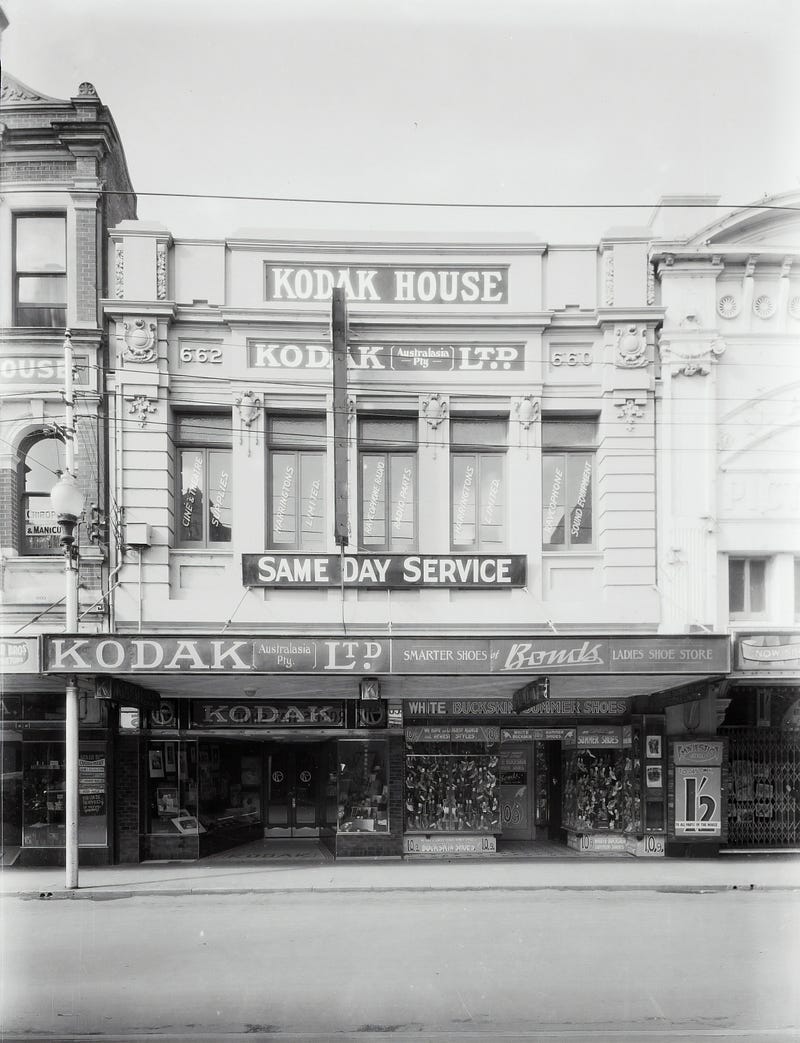
Photo by Museums Victoria on Unsplash

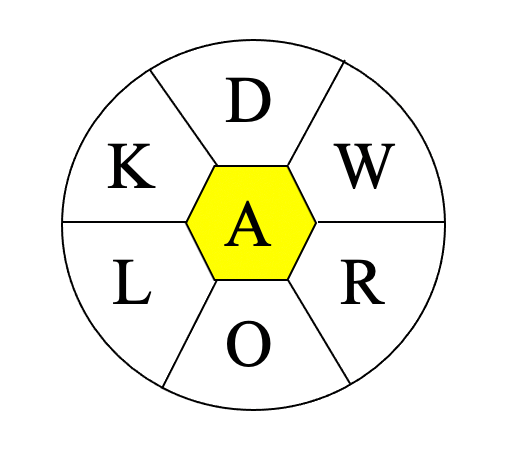
Today’s New York Times Spelling Bee letters:
Credit: Iva Reztok

D, K, L, O, R, W, and center A (all words must include A)

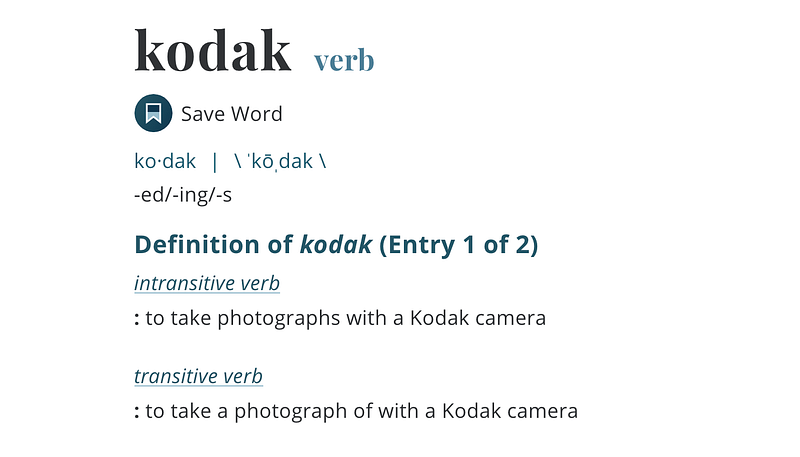
Merriam-Webster says…
Credit: merriam-webster.com

Silly little dictionary! Don’t you know kodak can’t possibly be a word if the New York Times says it ain’t?

For further fascinating facts, check out the Spelling Bee Master.

What’s your favorite dord* from today’s puzzle?

My Two Cents

In the title of today’s column, I’ve deliberately left the word kodak with an initial lowercase k in order to make a grammatical point (or at least I think it’s a grammatical point). It’s not just a proper noun, but also a verb.

Having played the Spelling Bee game for several years now, I can honestly say I have no idea what criteria the New York Times uses when determining which names are only proper nouns––and therefore not accepted, as per the rules–– and which ones also qualify as “regular words”.

For example, in yesterday’s puzzle the word morocco was acceptable (as the fine leather); in previous editions I’ve seen panama (the hat) as valid, too. I don’t recall if I’ve ever run into the possibility of testing xerox and kleenex. If you’re a regular reader of this column (and I’d like to take the opportunity to thank both of you), you may already know that balboa is not accepted but, as today’s game proves, dollar is. And yet… they are both currencies!

More on eponymous words later. First, though, let’s tackle…

The rise and fall and rise and fall of a camera company

After George Eastman perfected the first practical film roll and invented his own camera, he managed to convince Henry Alvah Strong to throw some money his way so he could establish the Eastman Kodak company in 1892. Kodak was a name Eastman had come up together with his mother, using an Anagrams game set. An advertisement the company placed in Photoplay magazine explained, “was simply invented — made up from letters of the alphabet to meet our trade-mark requirements. It was short and euphonious and likely to stick in the public mind.”

Yeah, I also had to look up euphonious, which means “pleasing to the ear”.

Kodak sold Eastman’s camera, preloaded with a 100-photo roll of film, for $25. This was the 1890s, mind you, so those $25 were the equivalent of like $25,000 today. Perhaps, I exaggerate a bit, but $25 back in the late 19th century did go a long way. You could probably pay several month’s rent across most of the country or, alternatively, about a an hour and half of rent in San Francisco or Manhattan.

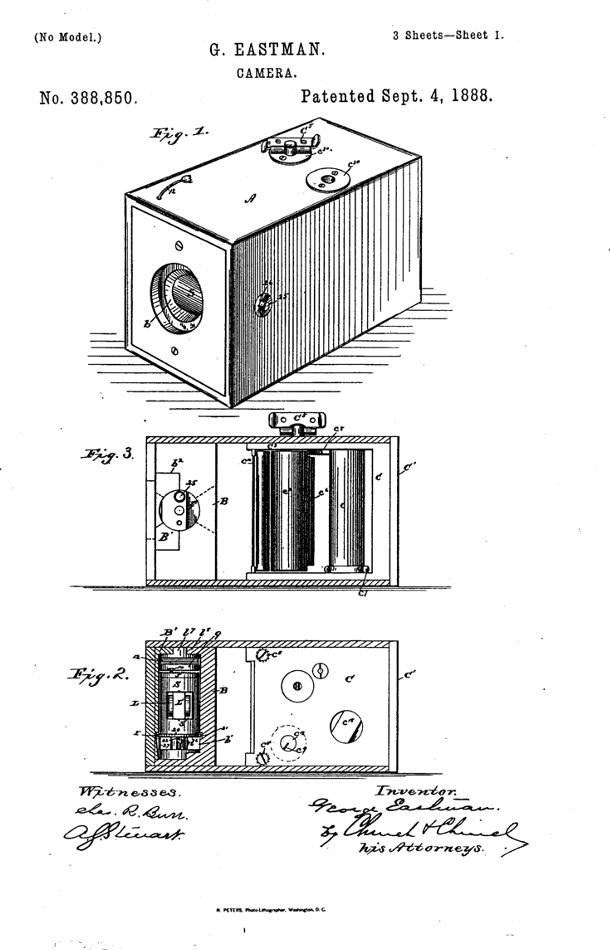
Nevertheless, despite its price Eastman’s camera became quite successful, probably because it was a simple box with a simple button you pressed in order to take simple pictures. This was advertised with a simple slogan: “You Press the Button, We Do the Rest.”

The only thing not simple was the patent drawing Eastman made:
Credit: wikipedia.com

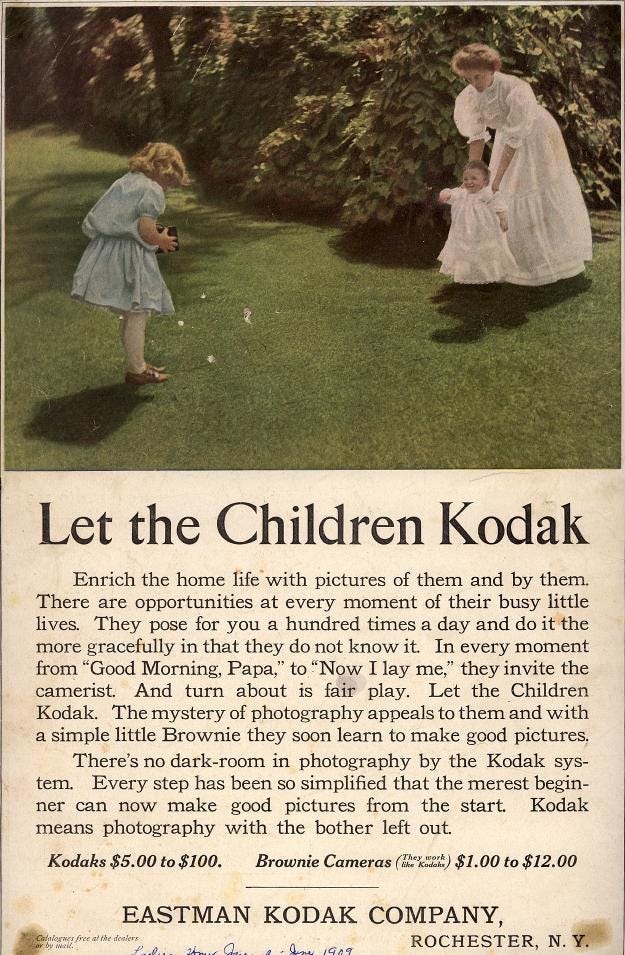
The Kodak cameras’ ease of use and (as time went by) low cost made the company the leading brand in consumer photography for over a century. Terms such as Kodachrome and “Kodak moment” became familiar to everyone across the globe. The company’s name even spawned a verb: to kodak, or take pictures with a Kodak camera. Are you reading this, editors of the Spelling Bee?!?
Credit: Business Insider

Yes! Let the children kodak, indeed!

It was probably a good thing Eastman was dead when things began falling apart in the 1990s, although that has not prevented him from rolling in his grave for the last few decades almost without interruption.

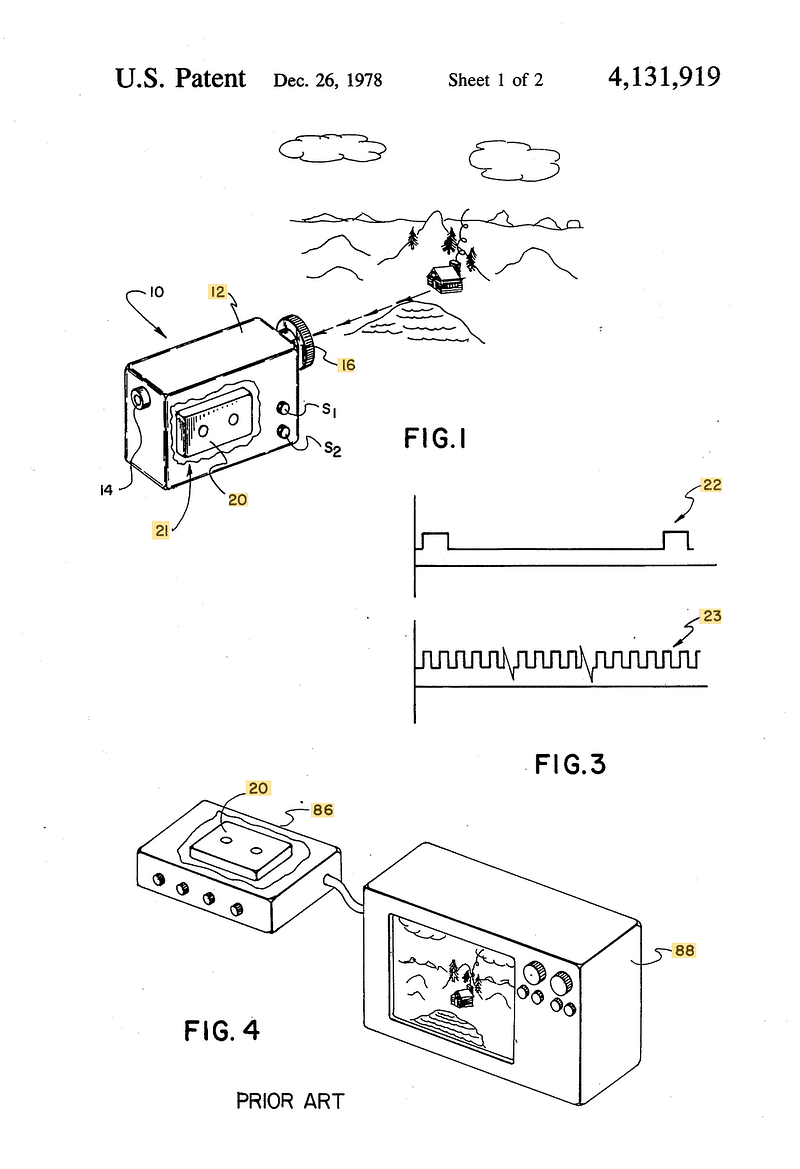
What felled the giant tree of photography? The digital and internet era, of course. The biggest irony of them all is that Kodak was the first company to invent and develop a digital camera:
Screenshot by Iva Reztok

Hmm, the above patent looks easier to figure out than Eastman’s original one. Go figure!

Company execs feared their own invention would threaten their photographic film business. Eventually Kodak got into digital cameras, but it was too little too late, sorta like what happened with Blockbuster and Netflix. Kodak ended up filing for bankruptcy in January 2012, almost exactly 10 years from today. Ernest Scheyder wrote an interesting article about the whole fiasco, which you can read here.

No one talked or heard or read or wrote about Kodak too much after that… until July of 2020. That’s when the company’s stock went up 2,189% in two days. Yeah, that’s a comma, not a decimal point. More than two thousand percent. This after the government announced it would approve a $765 million loan for Kodak to begin manufacturing… no, not film… drugs!

As wikipedia sums up: “The Trump administration announced that it planned to give Kodak a $765 million loan for manufacturing ingredients used in pharmaceuticals, to rebuild the national stockpile depleted by the COVID-19 pandemic and reduce dependency on foreign factories… Within two days, the company’s stock price had gained as much as 2,189% from its price at the close of July 27 on the NYSE. The New York Times reported that one day before the White House announced the loan, Kodak CEO Jim Continenza was given 1.75 million stock options, some of which he was able to execute immediately. The funding was put on hold as the U.S. Securities and Exchange Commission began probing allegations of insider trading by Kodak executives ahead of the deal’s announcement, and the funding agency’s inspector general announced scrutiny into the loan terms.”

Today, Kodak’s stock hovers around $4.50, about double what it was a year and half ago, but nowhere near what it leaped to after that whole shady drug-manufacturing plan was hatched.

As far as Kodak’s future is concerned, who knows what the future will develop. (Sorry, I just couldn’t resist!)

Eponyms

Merriam-Webster defines eponym as “one for whom or which something is or is believed to be named” and “a name (as of a drug or a disease) based on or derived from an eponym”.

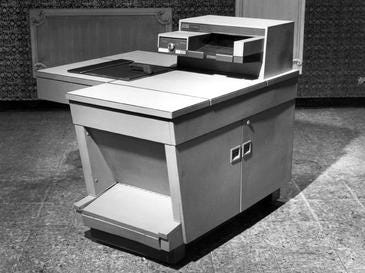
Earlier I mentioned some common eponyms, kleenex (the noun) and xerox (the verb). For those of you not familiar with xerox, it was used a lot in the 1980s and 1990s in the sense of “to make a photocopy”. That’s because Xerox the company was the first one to commercialize the photocopy machine, the 914 model, in 1959.
Credit: Fayr Youse

It only looks tiny in the picture; that thing took up a whole effin’ room back then. Just like the ones in your office today. Hmmm….

There are tons of words we use on daily basis that derives from someone or something’s name. A few of the better-known ones are Shirley Temple (alcoholic beverage), saxophone, frisbee, and popsicle.

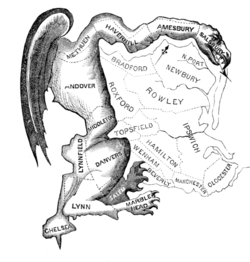
Did you know, however, that the words bloomer (as in the underpants), dumpster, and ping pong all come from people’s or product’s names? So does the infamous term gerrymandering, whose origin is very interesting because not only is it related to a person (former governor Elbridge Gerry of Massachusetts) but is also a portmanteau, or blend of two words: the governor’s last name and “salamander”. Salamander… not because what the governor did was slimy (which it was), but because one of the districts he contorted resembled a salamander when mapped. American engraver and miniature painter Elkanah Tisdale drew a political cartoon of the map:
Credit: Elkanah Tisdale

Yeah, that Elkanah clearly had weird ideas about how salamanders were supposed to look. Perhaps he had spent too much time engraving and not enough time outdoors.

Anyway, dictionary.com has a plethora of these eponyms, if you’d like to peruse some of them.

So, we conclude today’s column with the usual rant: despite the incredible importance and dominance of Kodak during most of the 20th century, the editors of the Spelling Bee opted not to include the word kodak in today’s game, effectively declaring it a dord*.

You can check out my previous entry on another dord* here:

*What the heck is a dord, you ask? Here’s the answer:

Spelling Bee
Language
Photography
History
Eponym
Recommended from ReadMedium