
Cocoyam
This word has little to do with coconuts or yams… and nothing to do with the photo below

Today’s New York Times Spelling Bee letters:
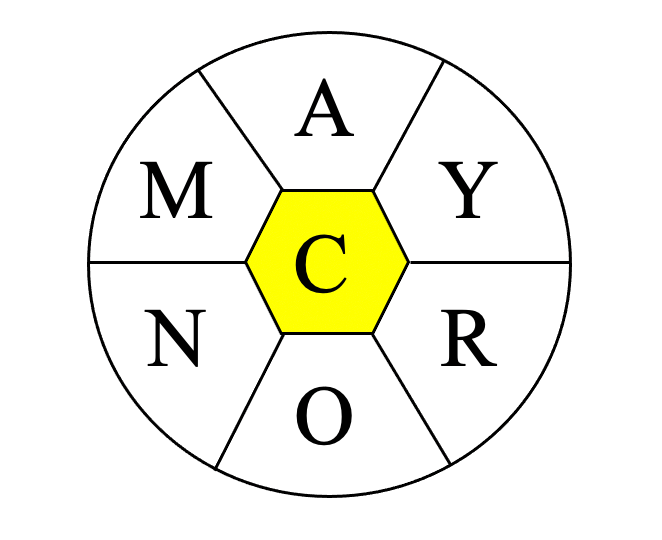
A, M, N, O, R, Y, and center C (all words must include C)
Merriam-Webster says…
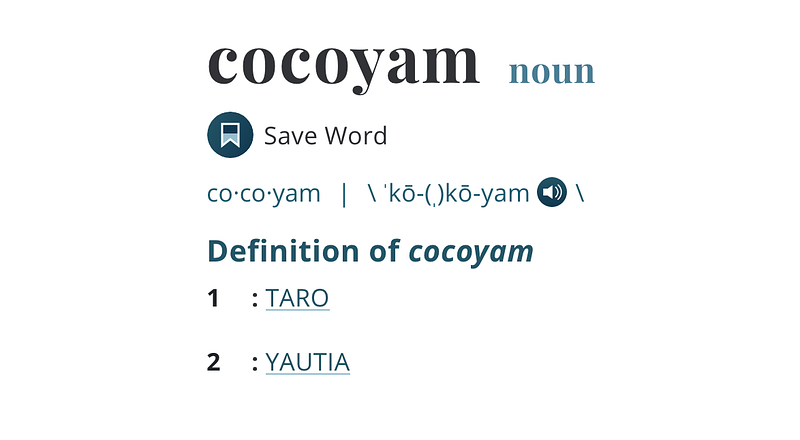
Silly little dictionary! Don’t you know cocoyam can’t possibly be a word if the New York Times says it ain’t?
For further fascinating facts, check out the Spelling Bee Master.
What’s your favorite dord* from today’s puzzle?
My Two Cents
To (mis)quote someone who ––unlike me–– was a great writer and humorist: “Rumors of my demise have been greatly exaggerated”.
If the above phrase sounds familiar, congratulations…you seem to know your Mark Twain quite well. But why (mis)quote? Well, according to Amy Weiss of The Imaging Channel, “Twain actually wrote a variation of this in several letters after hearing that a newspaper had mistakenly reported his demise.” Her research determined that the most authentic version of that famous quote is ‘The report of my death was an exaggeration”.
I prefer the variant I chose.
In any case, what’s true is all those endless news reports and viral memes about my death turned out to be false. Oh, you found no endless news reports and no viral memes about me? Well, look harder then! Nothing? Nothing at all? Hmmm… perhaps I’m thinking about that other Avi Kotzer who lives in a parallel universe in which his four-and-a-half-month internet silence does fuel endless news reports and viral memes.
Sigh…
With a new year come new resolutions, mostly similar to the previous year’s, but with higher hopes that this time around that we won’t quit the gym after a couple of weeks, won’t give up on daily meditations a month in, and won’t stop posting daily stories on Medium after almost eight months and four thousand followers… some of whom actually even scroll through my articles slowly and help me earn 13 or even 31 cents!
To that handful of mediumers who actually read my column, I thank you from the bottom of my heart and apologize from the top of my… well, you get the idea.
On with today’s daily dord!
(Oh, and in case you’re wondering about the photo of the elephant, I figured it would be easier to attract attention to this story with a close-up photo of an adorable animal than a picture of a plant most people can’t identify. Please excuse the ruse; I’ve been absent since August and really really really need to get my “reads” back up to a dozen a day.)
Old cocoyam
Merriam-Webster’s initial entry for cocoyam requires additional clicking, as two one-word definitions pop up when you type in the word.
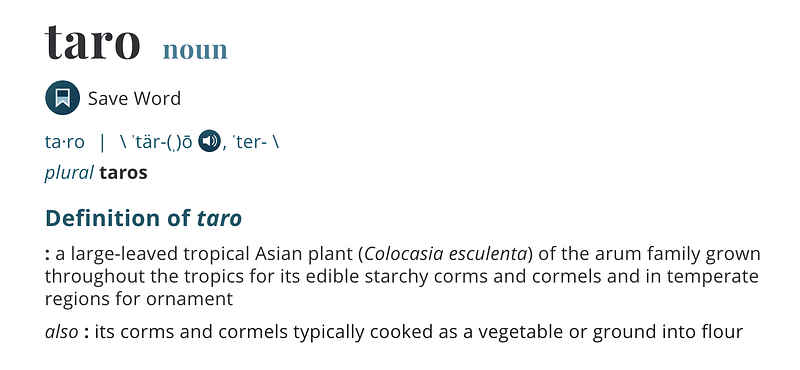
This is the taro many of us have come to love or hate (or love and hate!) while eating bags of Terra Chips, which became popular in the late 1990s and early 2000s. The original bag contained a variety of what were considered less than traditional sources for chips:
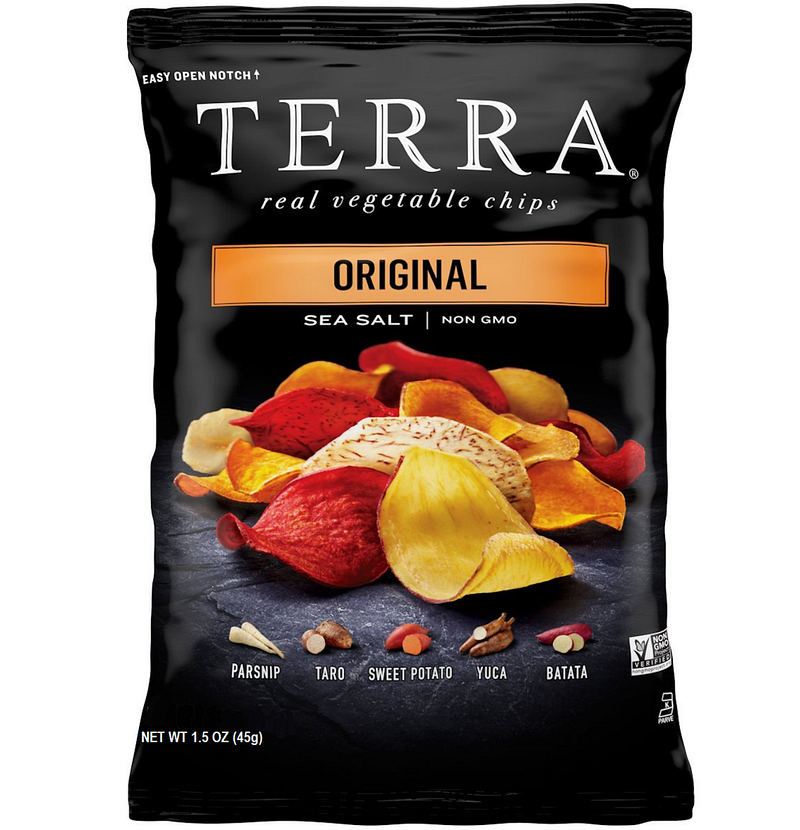
The photo in the middle and tuber key at the bottom seemed easy enough to follow, but once you opened the bag confusion set in as to what you were putting in your mouth. That’s because (1) the taro and the yuca look very similar in the picture and (2) sweet potatoes and batatas are often and easily confused with each other and with yams.
The Library of Congress website has an article that may or may not clear up this mess for you.
The good news is that after decades of eating and studying and researching these Terra chips, I came to the definitive conclusion that taro was the white chip with the characteristic purplish-brown lines. The bad news is I could have saved myself years upon years of quasi-scientific investigation by simply checking the company’s website:
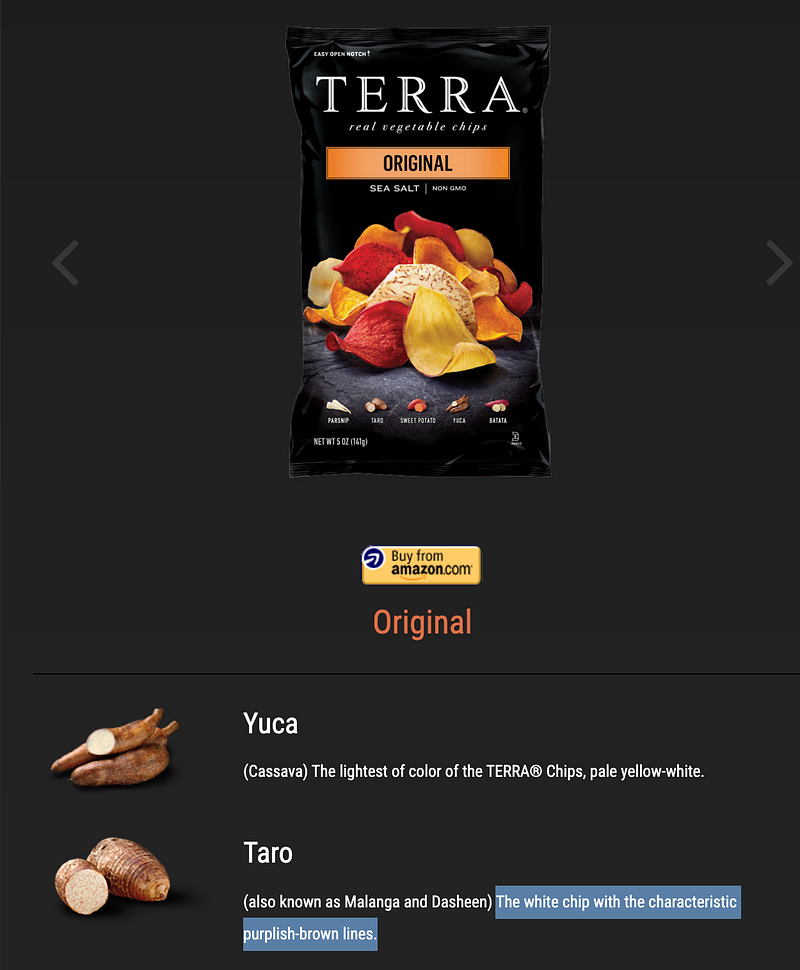
The English term taro was borrowed from the New Zeleand Maoris when Captain Cook first saw their plantations of Colocasia tubers way back in 1769. But it took the captain’s cook to figure out how to boil this root vegetable into an edible form… and another 200 years and change for two New York chefs to turn it into a million-dollar foodie venture and sell it to the Hain Celestial Group.
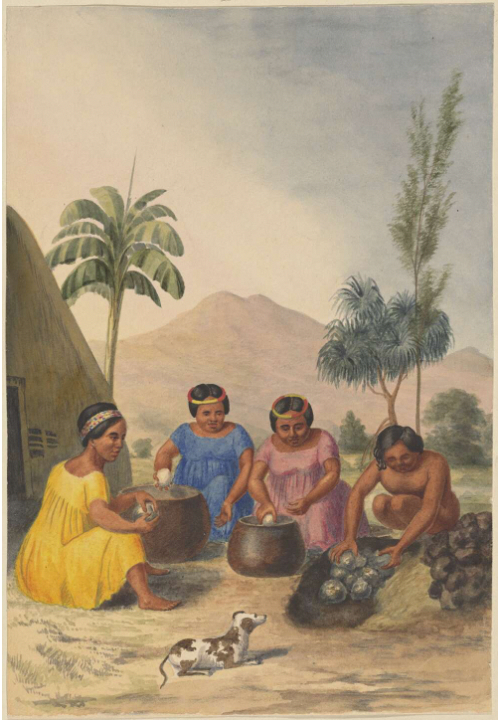
In Hawaii and other parts of Polynesia, the taro is known as kalo. This tidbit serves as en excuse to copy and paste this pretty watercolor by James Gay Sawkins, which shows some Polynesian women cleaning kalo:
Taro is used to prepare poi, a Hawaiian staple. And by staple, I mean

For further educational purposes, here are the parts of the Ye Olde Cocoyame:
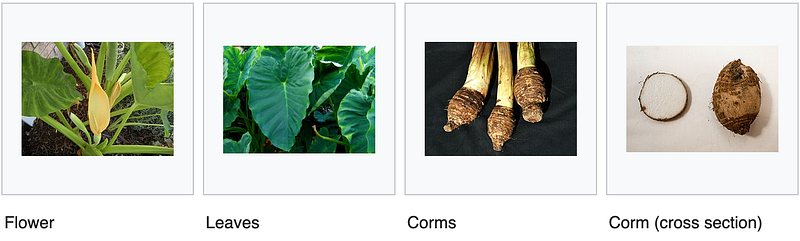
Yes, that’s corm with an “m”, not an “n”. Obviously. Because otherwise it would be corn. What’s a corm, you ask? Well, according to our friends at the dictionary, it’s “a rounded thick modified underground stem base bearing membranous or scaly leaves and buds and acting as a vegetative reproductive structure”. They also suggest you compare “corm” to the words “bulb” and “tuber”, but don’t feel obligated to do so. There is no “corm comparison” mandate, don’t worry.
New and improved cocoyam
This is what Merriam-Webster reveals when we click on the other definition of cocoyam:
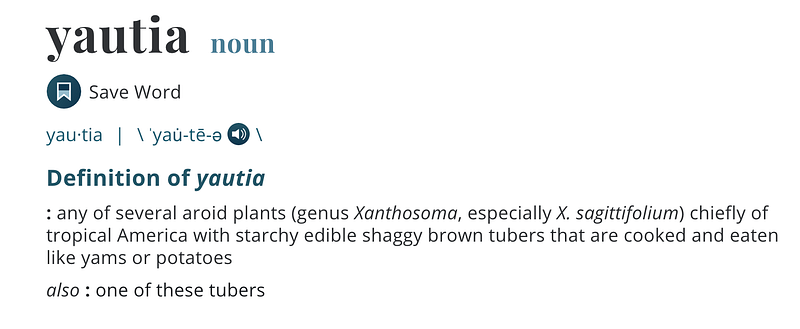
As happens with many new and improved products, most people prefer the original version. But that’s because they haven’t really given this one a try. While yautía is the American Spanish form of the original Taino word for this plant, the “New World” cocoyam is known by many other names: mafafa, otoe, malanga, cocoñame, bore, chonque, macabo, rascadera, quequisque, tania y tiquizque. Oh, and also “elephant’s ear”, as that is what the large leafs seem to resemble.
Wait a second… maybe that photo at the top of the article does have a connection with our word of the day!
In Venezuela, where I grew up, the plant is called ocumo. It’s quite popular, especially considering Venezuela is the world’s second-largest producer of this tuber (or corm or bulb — I’m not sure anymore). Over there we like to prepare “torticas de ocumo”, something akin to hash browns or latkes, but made of this starchy bulb (or corm or tuber) instead of potatoes.
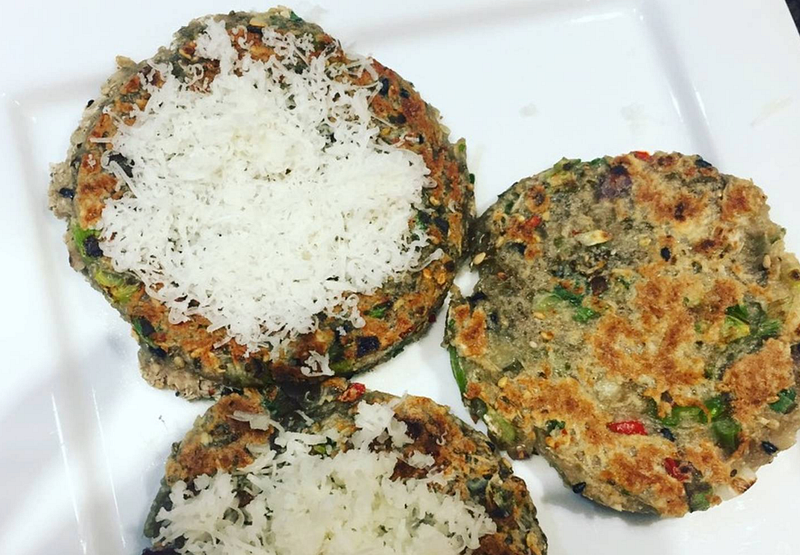
And here is a simple and easy recipe, courtesy of Amanda Torres:
And yet… despite serving as a word for two different root vegetables (or corms or tubers or bulbs) that can be made into delicious fritters , the editors of the Spelling Bee decided that the word cocoyam is a dord*.
You can check out my last 2021 entry on another dord* here:
*What the heck is a dord, you ask? Here’s the answer: