avatarAvi Kotzer

Free AI web copilot to create summaries, insights and extended knowledge, download it at here

2618

Abstract

li><b><i>Cejuela</i> (nut or hueso):</b> Found on both ends of the <i>cuatro</i>, close to the head of the instrument and in the overall body of it, it keeps the strings in place also helps with the tuning.</li><li><b><i>Trastes</i> (fret): </b>There are 18 to 20 frets in a traditional Puerto Rican <i>cuatro</i>. They are used to divide the arm of the <i>cuatro</i> into sections, where each section produces a different note and a different sound.</li><li><b><i>Diapasón</i> (diapason): </b>This is an addition placed under the frets, to make the musician’s hand more comfortable as they are playing.</li><li><b><i>Rosetas</i> (rosette):</b> A circular ornament present at the mouth of the instrument that serves to prevent feedback.</li><li><b><i>Cuerdas</i> (string): </b>The strings are the main element that produce sound. They can be struck with a pick or by hand, just like with the guitar.</li><li><b><i>Puente</i> (bridge): </b>The bridge keeps the strings steady; the <i>cejuela</i> on it also helps.</li><li><b><i>Caja</i> <i>armónica</i> (harmonic box):</b> The overall body of the <i>cuatro </i>that gives it its characteristic shape and modifies the sound of the strings.</li></ul><p id="3655">Here is Maribel Delgado playing the Puerto Rican cuatro:</p> <figure id="09e7"> <div> <div> <img class="ratio" src="http://placehold.it/16x9"> <iframe class="" src="https://cdn.embedly.com/widgets/media.html?src=https%3A%2F%2Fwww.youtube.com%2Fembed%2FHHwFkHd2K6o%3Ffeature%3Doembed&amp;display_name=YouTube&amp;url=https%3A%2F%2Fwww.youtube.com%2Fwatch%3Fv%3DHHwFkHd2K6o&amp;image=https%3A%2F%2Fi.ytimg.com%2Fvi%2FHHwFkHd2K6o%2Fhqdefault.jpg&amp;key=a19fcc184b9711e1b4764040d3dc5c07&amp;type=text%2Fhtml&amp;schema=youtube" allowfullscreen="" frameborder="0" height="480" width="854"> </div> </div> </figure></iframe></div></div></figure><p id="8251">The Puerto Rican is tuned in fourths from low to high, with <b>B</b> and <b>E</b> in octaves and <b>A</b>, <b>D</b>, and <b>G</b> in unisons: <b>B</b>3 <b>B</b>2 — <b>E</b>4 <b>E</b>3 — <b>A</b>3 <b>A</b>3 — <b>D</b>4 <b>D</b>4 — <b>G</b>4 <b>G</b>4 . (I’m any musicians reading this will understand this better than I do.)</p><h2 id="068c">Venezuela</h2><p id="0816">The Venezuelan <i>cuatro</i> always had, still has, and hopefully will forever have four strings. They are usually single and made of nylon, and tuned <b>A</b>3–<b>D</b>4–<b>F</b>♯ 4–<b>B</b>3 . The instrument is very similar in shape and tuning to the ukulele, but their character and pl

Options

aying technique are different.</p><p id="4d4c">Venezuelan<i> cuatros</i> may come in two distinct styles:</p><figure id="e086"><img src="https://cdn-images-1.readmedium.com/v2/resize:fit:800/1*6D3vwZ-LZhValsTXSlKHTw.png"><figcaption>Screenshot collage by Iva Reztok</figcaption></figure><p id="0346">And here is C5 Trío, a Venezuelan ensemble, this time playing with three <i>cuatros</i> and one bass.</p> <figure id="ce0f"> <div> <div> <img class="ratio" src="http://placehold.it/16x9"> <iframe class="" src="https://cdn.embedly.com/widgets/media.html?src=https%3A%2F%2Fwww.youtube.com%2Fembed%2FNZ123ysut9s%3Ffeature%3Doembed&amp;display_name=YouTube&amp;url=https%3A%2F%2Fwww.youtube.com%2Fwatch%3Fv%3DNZ123ysut9s&amp;image=https%3A%2F%2Fi.ytimg.com%2Fvi%2FNZ123ysut9s%2Fhqdefault.jpg&amp;key=a19fcc184b9711e1b4764040d3dc5c07&amp;type=text%2Fhtml&amp;schema=youtube" allowfullscreen="" frameborder="0" height="480" width="854"> </div> </div> </figure></iframe></div></div></figure><p id="871f">Despite the beautiful music you just heard from these traditional string instruments, the editors of the Spelling Bee decided that the word <i>cuatro</i> is a dord*.</p><p id="66fd">You can check out my previous entry on another <b>dord* </b>here:</p><div id="927b" class="link-block"> <a href="https://readmedium.com/lenticel-de58b2ffe949"> <div> <div> <h2>Lenticel</h2> <div><h3>We all need to catch our breath today!</h3></div> <div><p>medium.com</p></div> </div> <div> <div style="background-image: url(https://miro.readmedium.com/v2/resize:fit:320/0*mGJroWfRcTO8965g)"></div> </div> </div> </a> </div><p id="01d0">*What the heck is a <b>dord, </b>you ask? Here’s the answer:</p><div id="9156" class="link-block"> <a href="https://www.merriam-webster.com/words-at-play/dord-a-ghost-word"> <div> <div> <h2>'Dord': A Ghost Word</h2> <div><h3>One of the questions people like to ask lexicographers is this: Can you sneak something into the dictionary? Can you…</h3></div> <div><p>www.merriam-webster.com</p></div> </div> <div> <div style="background-image: url(https://miro.readmedium.com/v2/resize:fit:320/0*hwqyhR2CP8jU78FT)"></div> </div> </div> </a> </div></article></body>

Cuatro

This lovely four-string instrument couldn’t charm the Spelling Bee

Photo by Wilfredor

Yesterday’s New York Times Spelling Bee letters:
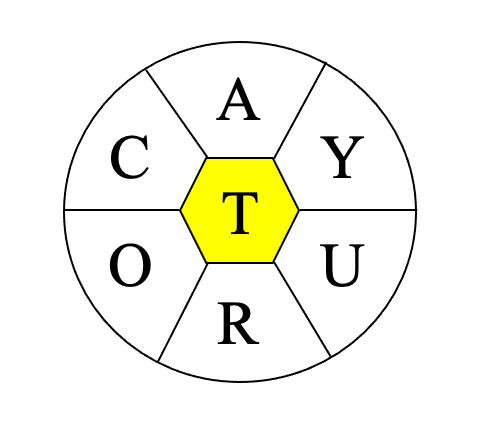
Art: Iva Reztok

A, C, O, R, U, Y, and center T (all words must include T)

Merriam-Webster says…
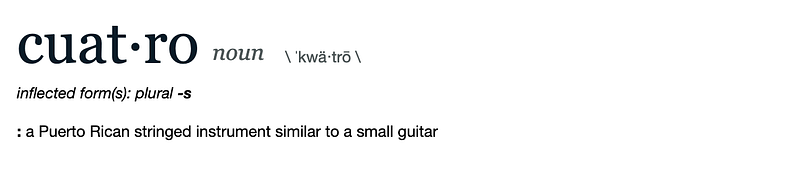
Credit: merriam-webster.com

Silly little dictionary! Don’t you know cuatro can’t possibly be a word if the New York Times says it ain’t?

For further fascinating facts, check out the Spelling Bee Master.

What’s your favorite dord* from the puzzle?

My Two Cents

Even people who are not fluent in Spanish may know that the word cuatro means “four” in English. I would have thought that was the origin of the musical instrument’s name, and it is… sorta.

The dictionary explains that it does indeed come from American Spanish (meaning the Spanish of the Americas as opposed to that of Spain), from the Latin quattuor; from the instrument’s four courses of strings.

Puerto Rico

Merriam-Webster defines the cuatro as Puerto Rican, but I can tell you that, having grown up in Venezuela, it’s also very much one of that country’s emblematic musical instrument.

And here’s the irony of the dictionary’s definition: the Puerto Rican cuatro doesn’t have four strings. Although historically it did, the modern version has five courses of strings, usually doubled, as you can see below from the pegbox with 10 pegs.
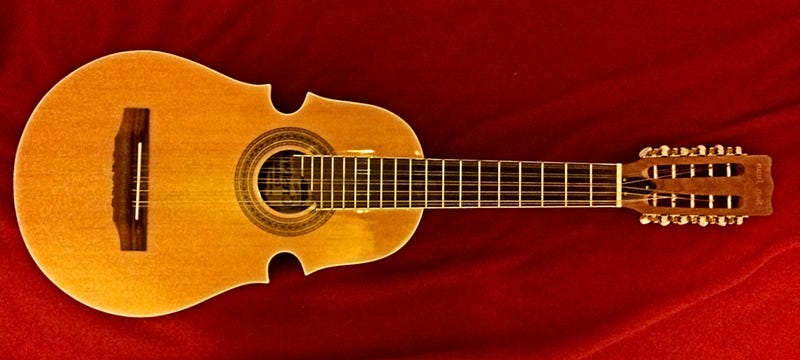
Photo by Fox625

As Wikipedia explains, these are the components of the cuatro that work together to give its characteristic sound:

  • Clavijero (pegbox): This is found at the head of the cuatro; it allows the strings to be tuned
  • Cejuela (nut or hueso): Found on both ends of the cuatro, close to the head of the instrument and in the overall body of it, it keeps the strings in place also helps with the tuning.
  • Trastes (fret): There are 18 to 20 frets in a traditional Puerto Rican cuatro. They are used to divide the arm of the cuatro into sections, where each section produces a different note and a different sound.
  • Diapasón (diapason): This is an addition placed under the frets, to make the musician’s hand more comfortable as they are playing.
  • Rosetas (rosette): A circular ornament present at the mouth of the instrument that serves to prevent feedback.
  • Cuerdas (string): The strings are the main element that produce sound. They can be struck with a pick or by hand, just like with the guitar.
  • Puente (bridge): The bridge keeps the strings steady; the cejuela on it also helps.
  • Caja armónica (harmonic box): The overall body of the cuatro that gives it its characteristic shape and modifies the sound of the strings.

Here is Maribel Delgado playing the Puerto Rican cuatro:

The Puerto Rican is tuned in fourths from low to high, with B and E in octaves and A, D, and G in unisons: B3 B2 — E4 E3 — A3 A3 — D4 D4 — G4 G4 . (I’m any musicians reading this will understand this better than I do.)

Venezuela

The Venezuelan cuatro always had, still has, and hopefully will forever have four strings. They are usually single and made of nylon, and tuned A3–D4–F♯ 4–B3 . The instrument is very similar in shape and tuning to the ukulele, but their character and playing technique are different.

Venezuelan cuatros may come in two distinct styles:
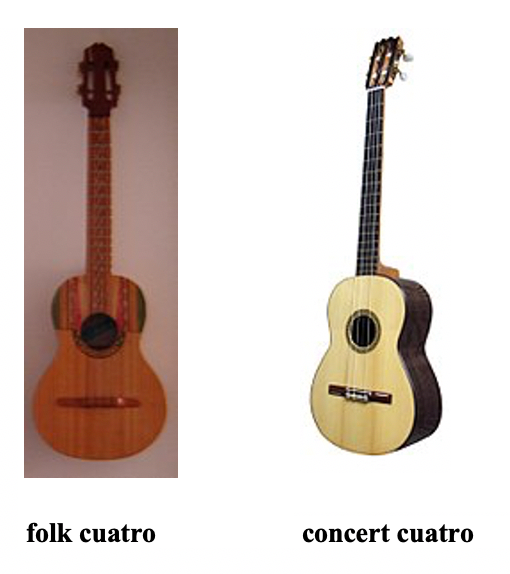
Screenshot collage by Iva Reztok

And here is C5 Trío, a Venezuelan ensemble, this time playing with three cuatros and one bass.

Despite the beautiful music you just heard from these traditional string instruments, the editors of the Spelling Bee decided that the word cuatro is a dord*.

You can check out my previous entry on another dord* here:

*What the heck is a dord, you ask? Here’s the answer:

Spelling Bee
Language
Music
History
Venezuela
Recommended from ReadMedium