
Kinnikinnick
Not surprisingly, the New York Times rejected this smoking word
Today’s New York Times Spelling Bee letters:
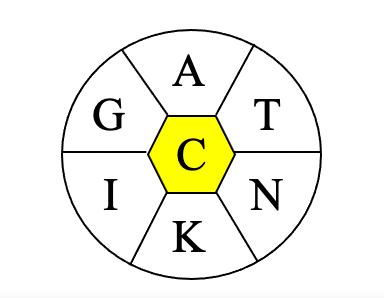
A, G, I, K, N, T, and center C (all words must include C).
Merriam-Webster says…
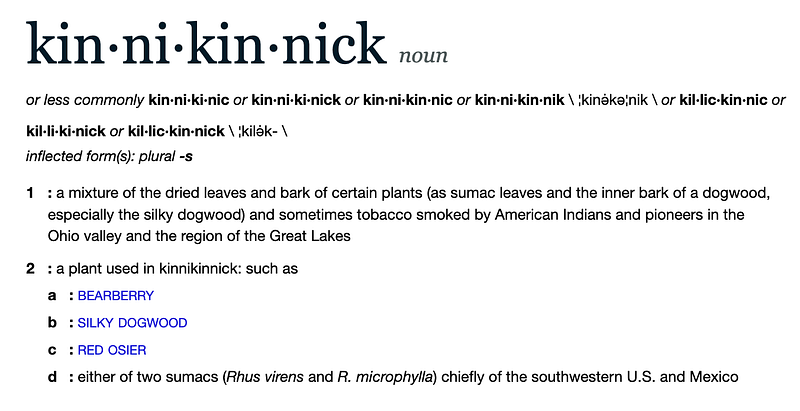
Silly little dictionary! Don’t you know that kinnikinnick can’t possibly be a word if the New York Times says it ain’t?
For further fascinating facts, check out the Spelling Bee Master.
What’s your favorite dord* from today’s puzzle?
My Two Cents
Smoking is bad for you. Everyone agrees, right? Well, except when it comes to weed, which is being promoted and legalized in many parts of the world, including the U.S. And with good reason. Marijuana can provide relief for chronic pain and anxiety. There are plenty of studies that back that up.
There are also studies that have looked into the effects of marijuana smoke on the lungs. According to the American Lung Association, “Smoke from marijuana combustion has been shown to contain many of the same toxins, irritants and carcinogens as tobacco smoke”.
Which brings us to tobacco. A word that for centuries has encompassed any and all forms of smoking the plant, regardless of their effects on your body. Today most people don’t know and can’t be bothered about the differences between machine-made cigarettes, natural cigarette tobacco, chaw, dipping tobacco, snuff, cigars, and pipes.
I’m not even going to get into all the subdivisions within the above categories. But you can check the list here.
As I write this article, I hold between my lips what is known as a nose-warmer pipe.
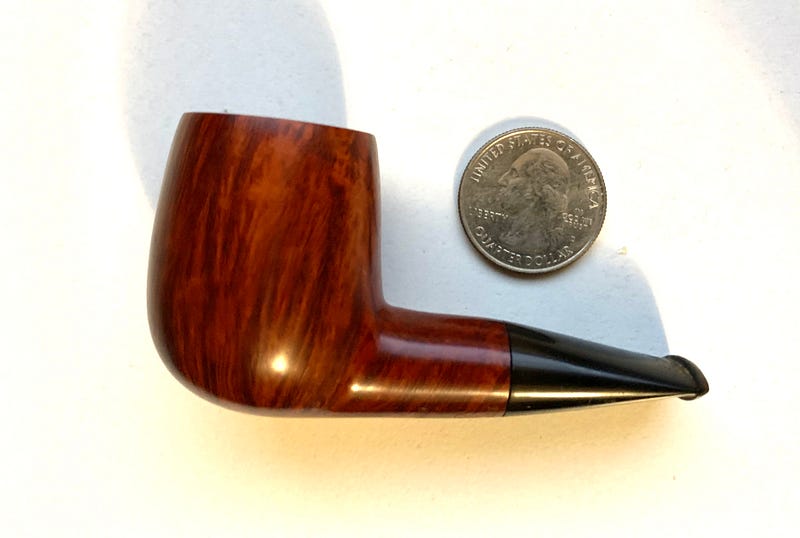
This is also called a golf pipe, as its short stem and shank allow golfers to swing their clubs with no risk of smacking it.
Although unlit (I do not smoke indoors), I have filled the pipe with some mellow Scottish Mixture that occasionally wafts through when I puff on the stem.
Pipe and cigar smoking are two great examples of how nuance has been lost in the discussion about tobacco products. Both pipe tobacco and cigars (especially when handmade) are very different from industrial cigarette tobacco. For one thing, the latter is acidic, which makes it easier to tolerate in the lungs. Most sane cigar and pipe smokers don’t inhale as they smoke, while the majority of cigarette smokers do. Also, a large part of the danger from commercially-made cigarettes comes from the paper used to wrap the tobacco. That paper is coated in a bunch of toxic chemicals.
Oh, and for the most part, pipe and cigar users are not addicted to their products the way cigarette smokers are.
The landmark 1964 Surgeon General’s report on smoking and health changed how society viewed cigarettes, helping people finally understand the dangers of smoking one and two packs a day. But that report cited ample statistical differences on health and mortality between cigarette smokers and those who favored pipes and cigars. Here are some quotes from that report:
▹ The death rates for pipe smokers are little if at all higher than for non-smokers, even for men who smoke 10 or more pipefuls a day and for men who have smoked pipes more than 30 years.
▹ The risk of developing cancer of the lung for the combined group of pipe smokers, cigar smokers, and pipe and cigar smokers is greater than for non-smokers, but much less than for cigarette smokers.
(The study also concluded that pipe smokers have a greater likelihood of suffering from throat and mouth cancers than nonsmokers.)
I have been told that the 1964 report also mentioned that pipe smokers live longer than non-smokers, but I downloaded and searched the document and couldn’t find that reference anywhere. There is something about the ritual of smoking a pipe that is very relaxing, so maybe sitting down for a bowlful in the evening to contemplate the doings of the day or read a good book helps pipe smokers de-stress. I know it does for me, especially when paired with a good whisky.
Since 1964, the data about cigarettes has been confirmed numerous times in studies done across the world. So has the data about pipe and cigar users, especially by those who are occasional smokers like I am.
But the anti-tobacco frenzy has lumped everything into one category by always using “tobacco” and rarely referring to products by their type.
I’m not advocating for any type of smoking, tobacco or marijuana, legal or illegal. The complicated history of cigarettes — with all the manipulation and lying done by tobacco companies — and its terrible health consequences over the years deserve to be acknowledged. So do safer (although not perfectly safe) alternatives.
Okay, now that I’ve had my chance to rant, let’s get on with our word of the day.
Giniginige
I’m not just throwing random words at you today. Giniginige, or kinikinige, is the Ojibwa word meaning “he mixes by hand” or “o mix something animate with something inanimate”, depending on the source. The Ojibwe are also known as the Chippewa, an amalgamated tribe of Algonquian-speaking Native Americans. They were primarily established in southern Canada and the northern Midwestern United States.
From that Ojibwa term we get kinnikinnick, which is one of those words that I just love saying and hearing. Like Ronkonkoma, which apparently comes from the Algonquin meaning “the boundary fishing place”.
Kinnikinnick is less fun to type, however, as I keep losing track of the number of n’s and k’s. So I’ve resorted to copying and pasting the word throughout today’s column as I write it.
American and Canadian natives had different combinations of leaves, barks, and other natural materials that they smoked. Today the word kinnikinnick is used as an umbrella term for those mixtures.
James Hammond Trumbull, a 19th-century American scholar and philologist, is quoted as saying: “I have smoked half a dozen varieties of kinnikinnick in the North-west — all genuine; and have scraped and prepared the red willow-bark, which is not much worse than Suffield oak-leaf.”
And in his 1911 book The Ethno-botany of the Gosiute Indians of Utah, Ralph Chamberlain mentions this:
“The inner bark of this plant, most commonly called kinnikinnick in the West, was formerly much smoked as a tobacco. It was commonly mixed with ordinary tobacco when the latter was procurable. The effect is described by one Gosiute as not a little like that of opium. The wood was also used in making snow-shoes. The name refers to the red color of the shoots.”
Pick a plant, any plant
By extension, many plants used in the kinnikinnick mixture became known by the same name.
Or friend Chamberlain mentions the taxonomical name on page 345 of his book:
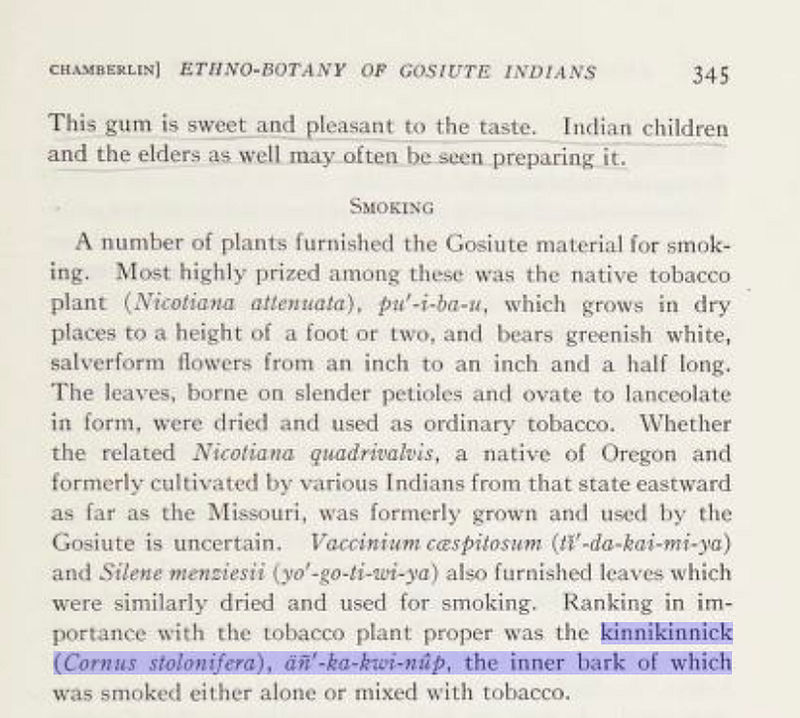
Cornus stolonifera is no longer used, but the plant he was writing about is known as the red osier or the red-osier dogwood (Cornus sericea). This plant is referred to as kinnikinnick in Minnesota and Wisconsin.
Other plants that go by that nickname are:
- Silky cornel (Cornus amomum)
- Canadian bunchberry (Cornus canadensis)
- Evergreen sumac (Rhus virens)
- Littleleaf sumac (Rhus microphylla)
- Bearberry (Arctostaphylos spp.)
That last one, bearberry, seems to be the one most commonly called kinnikinnick. The bearberries are three species of dwarf shrubs:

Yeah, I think they all look the same, too.
Anyway, if you happen to run into any of the three, smoke some leaves and let me know how it went.
Or, if you prefer the red osier (red willow) kinnikinnick, you can follow the description given by Charles L. Cutter in his book Tracks that Speak: The Legacy of Native American Words in North American Culture:
“For this ceremony I observed he was making unusual preparation, and I observed as I ate, that after he had taken enough of the k’nick-k’neck or bark of the red willow, from his pouch, he rolled out of it also a piece of the “castor” [an extract from beaver glands], which it is customary amongst these folks to carry in their tobacco-sack to give it flavour; and shaving off a small quantity of it, mixed it with the bar, with which he charged his pipe. This done, he drew also from his sack a small parcel containing a fine powder, which was made of dried buffalo dung, a little of which he spread over the top (according also to custom), which was like tinder, having no other effect than that of lighting the pipe with ease and satisfaction.”
I bolded the main ingredients to make things easier for you.
Could it be that the New York Times thought that kinnikinnick was really that obscure? Yesterday they accepted lamellae and two days ago, palapa, which isn’t even in the dictionary! As a Spanish speaker, I know what a palapa is, but doesn’t it sound obscure to you?
Or perhaps the Times did not like the association of kinnikinnick to smoking.
Whatever the case, the editors of the Spelling Bee puzzle have decided that kinnikinnick is a dord.*
You can check out my previous entry on another dord* here:
*What the heck is a dord, you ask? Here’s the answer: