avatarAvi Kotzer

Free AI web copilot to create summaries, insights and extended knowledge, download it at here

3795

Abstract

m/v2/resize:fit:800/0*XfbYaQwMPND6ZbF8.jpg"><figcaption>Photo by Marie-Lan Nguyen</figcaption></figure><p id="5f51">While <i>algology</i> is the study of pain, <i>algiatry</i> is the practical application of said studying; in other words, pain management. Notably for those suffering chronic or terminal pain. Professionals involved in this field may include physicians of different specialties, pharmacists, psychologists, physiotherapists, occupational therapists, physician assistants, nurses, and dentists.</p><p id="45a1">Others involved in helping patients with chronic or severe or terminal pain are your neighborhood massage salon (with and without happy endings) and your local marijuana dealer.</p><p id="4660">I’m not joking, and if you haven’t been living under a rock for the past twenty years or so, you’ve probably heard how more and more doctors are recommending weed for their patients who suffer from pain that cannot be eradicated or alleviated by any other means.</p><p id="0311"><a href="https://onlinelibrary.wiley.com/doi/abs/10.1111/fcp.12008">Study</a> after <a href="https://pubmed.ncbi.nlm.nih.gov/28983880/">study</a> after <a href="https://www.painnewsnetwork.org/stories/2021/4/10/harvard-study-finds-cannabis-effective-treatment-for-chronic-pain">study</a> shows that Mary Jane not only helps patients deal with chronic pain, but also improves their mood, lowers their anxiety, helps them sleep better, and generally improves their quality of life.</p><p id="9b2c">At this point, whatever your overall position on drug use, it’s hard not to recognize the benefits of this natural pain reliever gifted to us by nature. Especially when you’ve seen or heard of terminal patients who have had a measure of dignity restored to the final days of their tortured lives.</p><p id="0409">Don’t judge. I hope you’ll never need to resort to marijuana for chronic or severe pain relief. But if you do find yourself in that situation, and you live in the U.S., be glad that the laws are slowly but surely changing.</p><h2 id="cdda">See weed?</h2><p id="203c">Back to the first <i>algology</i>, the study of algae. The <b>algo-</b> in this case comes from the Latin <i>alga</i>, meaning… correct! Alga.</p><p id="ae09">Our helpful friends define an alga as “any of various plant or plantlike organisms that are mostly photosynthetic, are usually found in aquatic environments, and include a diverse variety of single- and many-celled forms”.</p><p id="e815">The <b>giant</b> <b>kelp</b>, which can grow to about 160 feet (50 meters) in length is an alga. So is the <i>micromona pusilla</i>, which has one cell.</p><p id="98bd">Besides serving as decorative edibles on your sushi plates, algae have a ton of uses. Among them:</p><p id="4834">▹ Carbon dioxide removal, or scrubbing, from the atmosphere, which can help counter some of the effects of climate change</p><p id="4a16">▹ Wastewater treatment and filtration of ponds and lakes.</p><p id="0b33">▹ As a biofuel and fertilizer</p><p id="86b4">▹ The production of agar (especially by red algae), a medium used to grow bacteria and mold.</p><p id="652f">▹ Creating bioplastics and natural pigments and food additives (carrageenan)</p><p id="bdc8">One of the foremost <i>algologists</i> in the United States was Isabella Abbott (June 20, 1919 — October 28, 2010), who was also the first native Hawaiian woman to ever receive a PhD in science.</p><figure id="0978"><img src="https://cdn-images-1.readmedium.com/v2/resize:fit:800/0*EkzbFHmrFFlZdKgY.jpg"><figcaption>Credit: wscc.historichawaii.org</figcaption></figure><p id="ce4a">Abbott first took interest in algae when her mother taught her about the edible seaweeds on the island. In an interview with PBS, Abbott explained that the “women were the ones who knew the Hawaii

Options

an names” (of the plants).</p><p id="a192">Dr. Abbott graduated as a botanist from the University of Hawaii in 1941, obtained a master’s degree from the University of Michigan a year later, and completed her a PhD in botany at the University of California, Berkeley, in 1950.</p><p id="069b">Her work on plants included eight books and over 150 articles published. She was acknowledged as one of the world’s experts on marine algae, especially the kind known locally in Hawaii as <i>limu</i>. This alga has had important and traditional culinary, cultural, and medical uses in the greater Polynesian area.</p><p id="b00b">Here is the interview Dr. Abbot gave to PBS. I read the transcript and highly recommend it.</p> <figure id="79f2"> <div> <div> <img class="ratio" src="http://placehold.it/16x9"> <iframe class="" src="https://cdn.embedly.com/widgets/media.html?src=https%3A%2F%2Fwww.youtube.com%2Fembed%2F4qvIXFS5k-k&amp;display_name=YouTube&amp;url=https%3A%2F%2Fwww.youtube.com%2Fwatch%3Fv%3D4qvIXFS5k-k&amp;image=http%3A%2F%2Fi.ytimg.com%2Fvi%2F4qvIXFS5k-k%2Fhqdefault.jpg&amp;key=a19fcc184b9711e1b4764040d3dc5c07&amp;type=text%2Fhtml&amp;schema=youtube" allowfullscreen="" frameborder="0" height="480" width="854"> </div> </div> </figure></iframe></div></div></figure><p id="8417">Okay, so we’ve covered two very important meanings of the word <i>algology</i>.</p><p id="61f6">But don’t tell that to the editors of the Spelling Bee puzzle. Because they decided that <i>algology </i>is a<b> <a href="https://www.merriam-webster.com/words-at-play/dord-a-ghost-word">dord</a>.</b></p><p id="412c">As a coda, here is Patrick Swayze’s philosophical take on <i>algology</i>:</p> <figure id="7389"> <div> <div> <img class="ratio" src="http://placehold.it/16x9"> <iframe class="" src="https://cdn.embedly.com/widgets/media.html?src=https%3A%2F%2Fwww.youtube.com%2Fembed%2FE_RNZFm1mls%3Ffeature%3Doembed&amp;display_name=YouTube&amp;url=https%3A%2F%2Fwww.youtube.com%2Fwatch%3Fv%3DE_RNZFm1mls&amp;image=https%3A%2F%2Fi.ytimg.com%2Fvi%2FE_RNZFm1mls%2Fhqdefault.jpg&amp;key=a19fcc184b9711e1b4764040d3dc5c07&amp;type=text%2Fhtml&amp;schema=youtube" allowfullscreen="" frameborder="0" height="480" width="854"> </div> </div> </figure></iframe></div></div></figure><p id="f5a7">You can check out my previous entry on another <b>dord </b>here:</p><div id="5ab9" class="link-block"> <a href="https://readmedium.com/kame-9c882ea21964"> <div> <div> <h2>Kame</h2> <div><h3>A glacier and a turtle hermit</h3></div> <div><p>medium.com</p></div> </div> <div> <div style="background-image: url(https://miro.readmedium.com/v2/resize:fit:320/0*WpFG2v9PkP-uovPC)"></div> </div> </div> </a> </div><p id="fc9a">*What the heck is a <b>dord, </b>you ask? Here’s the answer:</p><div id="0806" class="link-block"> <a href="https://www.merriam-webster.com/words-at-play/dord-a-ghost-word"> <div> <div> <h2>'Dord': A Ghost Word</h2> <div><h3>One of the questions people like to ask lexicographers is this: Can you sneak something into the dictionary? Can you…</h3></div> <div><p>www.merriam-webster.com</p></div> </div> <div> <div style="background-image: url(https://miro.readmedium.com/v2/resize:fit:320/0*aLOI7kPNZWmH5L8Z)"></div> </div> </div> </a> </div></article></body>

Algology

No pain… no seaweed?
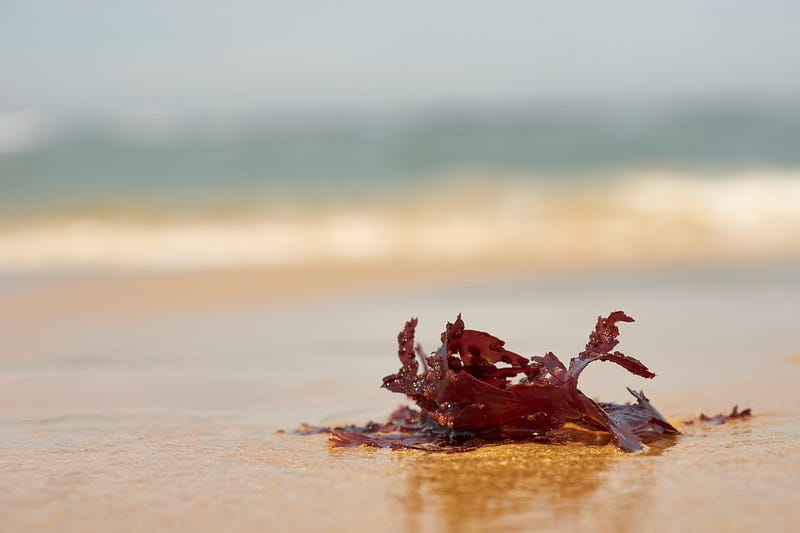
Photo by Wolfgang Hasselmann on Unsplash

Today’s New York Times Spelling Bee letters:
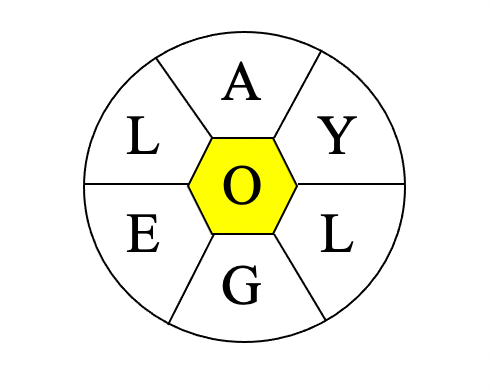
Art: Iva Reztok

A, D, E, G, L, Y, and center O (all words must include O).

Merriam-Webster says…
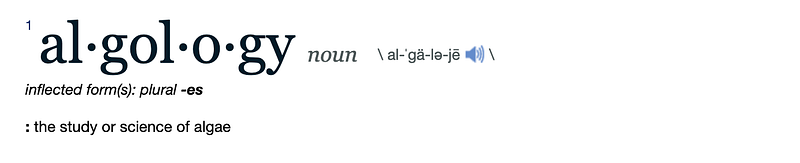
Credit: merriam-webster.com

Silly little dictionary! Don’t you know that algology can’t possibly be a word if the New York Times says it ain’t?

For further fascinating facts, check out the Spelling Bee Master.

What’s your favorite dord* from today’s puzzle?

My Two Cents

The collegiate version of the dictionary is the one that I provide in the link when I type “Merriam-Webster says…” It shows only one definition for algology, and not one that clarifies a lot, unless you happen to know what phycology means. I provide that link because it’s the free online version. The unabridged version, to which you need a paid subscription (as I have), actually provides two meanings. The first one is the one I already included above: “the study or science of algae”.

The second one has to do with a Greek deity.

Pain don’t hurt

If you know what movie that quote is from, you’re either about my age or a Patrick Swayze fan.

Algology’s second definition, according to Merriam-Webster, is this:
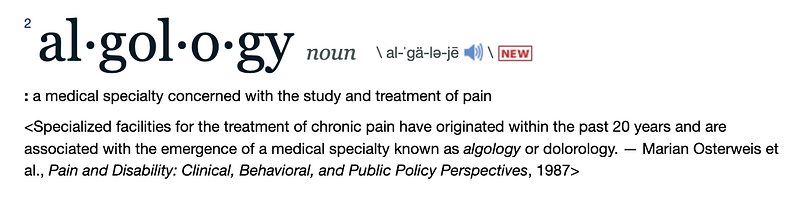
Credit: merriam-webster.com

The example sentence is from 1987, but the first known use in the above sense was in the 1950s, around the time Patrick Swayze was born. Coincidence? Who knows. You’ll have to watch Road House to find out.

Now, both meanings of algology use the suffix -logy, which means “theory” or “science”. But their prefixes are different. The one related to pain is algo-, from the Greek algos, “pain” or “ache”. It’s more commonly used as the suffix -algia, for example, in the words neuralgia (nerve pain) and nostalgia (ache for returning home).

The Algae were Greek deities that personified pain, daughters of Eris, the goddess of discord and strife. The three Algae were Lupe (pain), Achos (grief), and Ania (sorrow). If you think that’s bad, take a gander at the other siblings: o Lethe (oblivion), Limos (starvation), Horkos (curse of false oaths), and Ponos (hardship).

The Algae were described by Greek poet Hesiod. Below is a photo of a bronze portrait of him. You can clearly see by the expression on his face that he was well-versed (bad pun intended) in pain, grief, and sorrow.
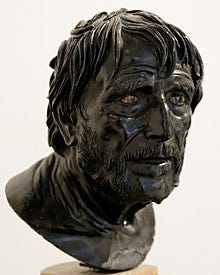
Photo by Marie-Lan Nguyen

While algology is the study of pain, algiatry is the practical application of said studying; in other words, pain management. Notably for those suffering chronic or terminal pain. Professionals involved in this field may include physicians of different specialties, pharmacists, psychologists, physiotherapists, occupational therapists, physician assistants, nurses, and dentists.

Others involved in helping patients with chronic or severe or terminal pain are your neighborhood massage salon (with and without happy endings) and your local marijuana dealer.

I’m not joking, and if you haven’t been living under a rock for the past twenty years or so, you’ve probably heard how more and more doctors are recommending weed for their patients who suffer from pain that cannot be eradicated or alleviated by any other means.

Study after study after study shows that Mary Jane not only helps patients deal with chronic pain, but also improves their mood, lowers their anxiety, helps them sleep better, and generally improves their quality of life.

At this point, whatever your overall position on drug use, it’s hard not to recognize the benefits of this natural pain reliever gifted to us by nature. Especially when you’ve seen or heard of terminal patients who have had a measure of dignity restored to the final days of their tortured lives.

Don’t judge. I hope you’ll never need to resort to marijuana for chronic or severe pain relief. But if you do find yourself in that situation, and you live in the U.S., be glad that the laws are slowly but surely changing.

See weed?

Back to the first algology, the study of algae. The algo- in this case comes from the Latin alga, meaning… correct! Alga.

Our helpful friends define an alga as “any of various plant or plantlike organisms that are mostly photosynthetic, are usually found in aquatic environments, and include a diverse variety of single- and many-celled forms”.

The giant kelp, which can grow to about 160 feet (50 meters) in length is an alga. So is the micromona pusilla, which has one cell.

Besides serving as decorative edibles on your sushi plates, algae have a ton of uses. Among them:

▹ Carbon dioxide removal, or scrubbing, from the atmosphere, which can help counter some of the effects of climate change

▹ Wastewater treatment and filtration of ponds and lakes.

▹ As a biofuel and fertilizer

▹ The production of agar (especially by red algae), a medium used to grow bacteria and mold.

▹ Creating bioplastics and natural pigments and food additives (carrageenan)

One of the foremost algologists in the United States was Isabella Abbott (June 20, 1919 — October 28, 2010), who was also the first native Hawaiian woman to ever receive a PhD in science.
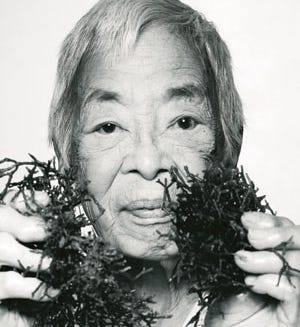
Credit: wscc.historichawaii.org

Abbott first took interest in algae when her mother taught her about the edible seaweeds on the island. In an interview with PBS, Abbott explained that the “women were the ones who knew the Hawaiian names” (of the plants).

Dr. Abbott graduated as a botanist from the University of Hawaii in 1941, obtained a master’s degree from the University of Michigan a year later, and completed her a PhD in botany at the University of California, Berkeley, in 1950.

Her work on plants included eight books and over 150 articles published. She was acknowledged as one of the world’s experts on marine algae, especially the kind known locally in Hawaii as limu. This alga has had important and traditional culinary, cultural, and medical uses in the greater Polynesian area.

Here is the interview Dr. Abbot gave to PBS. I read the transcript and highly recommend it.

Okay, so we’ve covered two very important meanings of the word algology.

But don’t tell that to the editors of the Spelling Bee puzzle. Because they decided that algology is a dord.*

As a coda, here is Patrick Swayze’s philosophical take on algology:

You can check out my previous entry on another dord* here:

*What the heck is a dord, you ask? Here’s the answer:

Spelling Bee
Language
Science
Cannabis
Culture
Recommended from ReadMedium