Kazakhstan & China Need Each Other For Energy Security Despite Sanctions On Russia
Sanctions on Russia are bringing global commodities to the forefront of geopolitics

Intro
If you haven’t been following the energy markets this year, then you have missed out on a lot of content about market volatility and geopolitical trends, including how sanctions on Russia are bringing global commodities to the forefront of geopolitics, and thus revealing the changes to industrial polices among the world’s core areas and critical producers.
Upstream already published an in-depth report about Kazakhstan’s increased interest in developing partnerships with China National Petroleum Corporation (CNPC) on 7 June 2023.
This signals two parallel developments: 1.) Kazakhstan is not giving up on the economy power of its oil and gas trade; 2.) China is becoming the top player as opposed to Russia in the country’s oil and gas business.
I say this because the CNPC is China’s largest investment firm in the country’s oil and gas sector. It will undoubtedly be prepared to invest a lot of money in Kazakhstan’s oil and gas, and thus it will be a critical player in Kazakhstan’s energy exports, making the industrial policy more favorable to China’s geopolitical objectives.
To know more about what’s going in here, read about what happened in Kazakhstan, in the aftermath of Russia’s invasion of Ukraine, last year.
How Russia Disrupted the Caspian Pipeline Consortium (CPC) and Global Supplies in 2022
I wrote this story due to a report on 3 June 2022 that Kazakhstan would change the name of its vital oil exports to Kazakhstan Export Blend Crude Oil (KEBCO) to avoid the USA’s and Europe’s sanctions risks on oil originating from Russian sea ports.
In the fray of the Russia-Ukraine conflict narratives it was easy to miss what has been happening with Kazakhstan’s oil export crises during these tumultuous times for the oil & gas industry. I compiled a list of events about the Caspian Pipeline Consortium (CPC) below.
The CPC is a 1,500km pipeline beginning at the Tengiz field in Kazakhstan. Big international companies such as USA’s Chevron (15%) and ExxonMobil (7%) each have stakes in the crude oil capacity of the CPC.
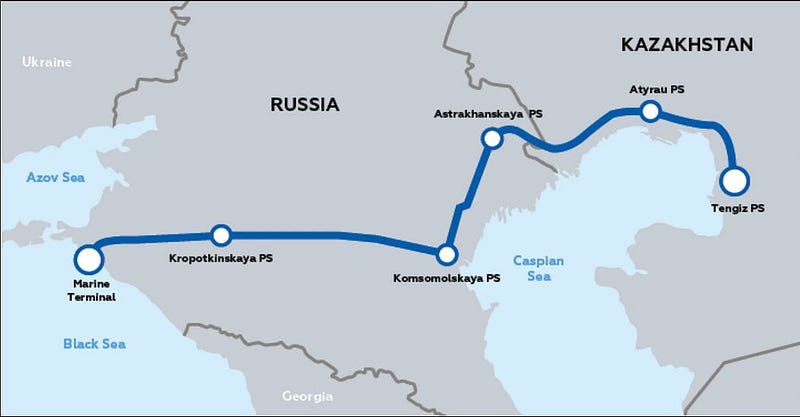
Key Events During CPC Crisis
23 March 2022 — The CPC warned that disruption to oil shipments were very likely following storms in the Black Sea during March that required major repairs and equipment replacements — “an emergency set of replacement hoses”. Oil tanker loadings were stopped at the Novorossiysk terminal but continued to accept oil while onshore storage facilities filled up space. Deputy prime minister of the Russian parliament Duma said that CPC’s foreign shareholders should get ready for repairs by international companies, as they were blamed for the disruptions.
28 March 2022 — The CPC began to resume oil tanker loadings. This was less than 5 days after announcing disruptions to operations from storm activity on the Black Sea. However, repairs were still needed desparately by foreign companies, for which the USA and European sanctions might have come into play. It was stated by the Kazakh Association of Oilfield Services Companies that the country could lose over $1 billion in revenues if the repairs were not finished within a two-month time frame.
29 March 2022 — Kazakhstan’s Energy Ministry said that daily oil output would be cut back by 320,000 barrels. They also announced that this cutback was a planned way for the country to meet OPEC compliance measures.
13 April 2022 — Rostekhnadzor, a state technical compliance institution of Russia, began carrying out unscheduled inspections of certain segments of the foreign-operated oil export pipelines of the CPC in Kazakhstan. During this time it was reported that oil terminal bottlenecks had been removed and that large international companies were able to partially lift restrictions on their production.
25 April 2022 — The CPC announced that oil operations would resume at full capacity at the Novorossiysk terminal in Russia.
Interestingly, Kazakhstan was seeking to sell exploration and production rights for 60 blocks to international investors on 21 March 2022.
It isn’t irrational to assume that Russia used this moment after the Black Sea storm to ensure Kazakhstan its control over the Novorossiysk terminal was critical to the operation of the CPC oil exports.
Moreover, some of the most intense fighting in Ukraine occurred at Mariupol whereby oil tanker businesses at the Novorossiysk terminal were able to acquire a “war risk insurance premium” — a sign that the Russian war effort was indeed having an impact on the CPC and Kazakstan’s crude oil exports.
What Does This Mean For The Future Of The CPC?
Kazakhstan’s government understands that both Western oil interests and Russian oil exporters matter a great deal to the country’s own ability to export crude oil and increase oil production revenues. Just because Kazakhstan changed the name of its vital oil exports to Kazakhstan Export Blend Crude Oil (KEBCO) doesen’t mean it will be able to avoid the USA’s and Europe’s sanctions on oil originating from Russian sea ports.
The ultimate test of USA and Europe sanctions will be playing out in areas such as Kazakhstan and the wider Central Asia region, where those countries are the most susceptible to Russian influence, yet need Western oil imports and international investors to decrease reliance on Russia. I don’t see this problem getting solved in the near-term.
For Kazakhstan, the long-term problem is going to come down to the success of Russia’s political leverage and military strength to ensure that their economic interests, particularly crude oil exports from the CPC, stay intact in the future without any interruptions from USA and European sanctions.
Check out a catalouge of my content published in The Geopolitical Economist below. Sign up for GPE World Today and be part of our diverse writing community exploring geopolitics, economics, and current events in the world today.


