avatarAvi Kotzer

Free AI web copilot to create summaries, insights and extended knowledge, download it at here

3267

Abstract

nnica describes its family thusly:</p><blockquote id="37f1"><p><b>Nelumbonaceae</b>, the lotus-lily family of the order Proteales, consisting of two species of attractive aquatic plants. One of these species is the sacred lotus of the Orient (Nelumbo nucifera) and is found in tropical and subtropical Asia. The other species is the American lotus, or water chinquapin (N. lutea, or N. pentapetala), found in the eastern United States and southward to Colombia.<i> </i>The family is further characterized by circular, centrally stalked, slightly hairy leaves, up to about 60 cm (2 feet) across, that are funnel- or cup-shaped. The leaves extend, in the Asian species, as much as 2 m (6.5 feet) above the water instead of floating on it. The large, attractive flowers also stand high above the water on strong, leafless stalks. They may be up to 25 cm across and have a number of petals, which close at night. The flowers of the sacred lotus, which stand as much as 1.8 m above the water, are pink or rose-coloured and fragrant. The American lotus has pale yellow flowers that rise about 60 cm above the water.</p></blockquote><figure id="4f79"><img src="https://cdn-images-1.readmedium.com/v2/resize:fit:800/0*R9kt8YgSlTGJ8RkX.jpg"><figcaption>Photo by T.Voekler</figcaption></figure><p id="c1fd">It’s a very pretty flower. That’s why the I posted the image in a large format.</p><p id="ddf4">The lotus has <b>rhizomes</b>, or creeping root stalks, that are eaten like vegetables in many Asian countries. Tea can be made using the pips, leaves, and flowers; the stems are used in Vietnamese salads. The dried seed head (the bright yellow part in the middle of the above flower) is used in flower arrangements.</p><p id="c897">In the Nelumbonacea family, the <i>Nelumbo nucifera</i> in particular is a sacred flower in both Hinduism and Buddhism, and represents the path to spiritual awakening and enlightenment. In Christianity the lotus flower has been linked to the apostle Thomas and his coming to India. In ancient Egypt the <i>kamala</i> was also an important icon, symbolizing the path from death to rebirth to the afterlife.</p><h2 id="d704">The other kamala</h2><p id="ea18"><i>Mallotus philippensis</i> has several nicknames, including <b>kamala tree,</b> <b>red kamala</b>, and <b>kumkum tree</b>, due to its fruit covering that yields a red dye. This <i>kamala</i> belongs to the spurge family (Euphorbiaceae), so it is completely unrelated to the lotus we just discussed . The spurges include the cassava plant (whose root is known as <b>yuca</b> in Spanish), the castor oil plant, and the poinsettia, which is widely used in Christmas floral displays.</p><p id="d5da">The <i>kamala</i> tree can be the size of a bush or reach a height of more than 80 feet (25 meters). The trunk is fluted and irregular at the base, and can be quite thick. The grey bark is smooth, or with wrinkles or bumps, while the branches don’t tend to be very long. The flowers are yellow-brownish in color; male and female flowers grow on separate trees. Fruit may appear at any time of the year, around three months after the flowers do. The fruit is covered in a powdery red substance than when dissolved in alcohol produces a red dye used in silk and wool.</p><figure id="453d"

Options

<img src="https://cdn-images-1.readmedium.com/v2/resize:fit:800/0*H_3whTqDmCpunRtO.jpg"><figcaption>Credit: Franz Eugen Köhler, <i>Köhler’s Medizinal-Pflanzen</i></figcaption></figure><p id="5393">The 1911 Encyclopedia Britannica records other uses for the powder, which is also called <i>kamala</i>:</p><blockquote id="3104"><p><b>KĀMALĀ,</b> a red powder formerly used in medicine as an anthelmintic and employed in India as a yellow dye. It is obtained from <i>Mallotus philippinensis</i>, Müll., a small euphorbiaceous tree from 20 to 45 ft. in height, distributed from southern Arabia in the west to north Australia and the Philippines in the east. In India kāmalā has several ancient Sanskrit names, one of which, kapila, signifies dusky or tawny red. Under the name of wars, kanbil, or qinbil, kāmalā appears to have been known to the Arabian physicians as a remedy for tapeworm and skin diseases as early as the 10th century, and indeed is mentioned by Paulus Ægineta still earlier. The drug was formerly in the British Pharmacopoeia, but is inferior to many other anthelmintics and is not now employed.</p></blockquote><p id="703f">(An anthelmintic is an anti-parasitic medicine that helps kill and expel worms from your bowels.)</p><p id="42a2">Here is black-crested bulbul feeding on the red <i>kamala</i> in India. And if you want to learn more about the word <i>bulbub</i>, you can do so <a href="https://readmedium.com/bulbul-bb49881cae34">here</a>.</p><figure id="4dbf"><img src="https://cdn-images-1.readmedium.com/v2/resize:fit:800/0*qmqFONFc40PEHzpc.jpg"><figcaption>Photo by J.M.Garg</figcaption></figure><p id="98a2">Now you know. If you’re ever in India and want to see a beautiful native lotus flower, ask the locals to show you a <i>kamala</i>. Don’t be surprised if they google a picture of Vice President Harris, though… because the editors of the Spelling Bee decided that <i>kamala </i>is a dord*.</p><p id="9d68">You can check out my previous entry on another <b>dord* </b>here:</p><div id="534e" class="link-block"> <a href="https://readmedium.com/gyppo-a1baa5557656"> <div> <div> <h2>Gyppo</h2> <div><h3>Logging on before the internet</h3></div> <div><p>medium.com</p></div> </div> <div> <div style="background-image: url(https://miro.readmedium.com/v2/resize:fit:320/0*OFQ8wC276QwoLj-Y)"></div> </div> </div> </a> </div><p id="bb52">*What the heck is a <b>dord, </b>you ask? Here’s the answer:</p><div id="50b1" class="link-block"> <a href="https://www.merriam-webster.com/words-at-play/dord-a-ghost-word"> <div> <div> <h2>'Dord': A Ghost Word</h2> <div><h3>One of the questions people like to ask lexicographers is this: Can you sneak something into the dictionary? Can you…</h3></div> <div><p>www.merriam-webster.com</p></div> </div> <div> <div style="background-image: url(https://miro.readmedium.com/v2/resize:fit:320/0*riIXODoC2p1eaC2p)"></div> </div> </div> </a> </div></article></body>

Kamala

Don’t worry; we won’t talk about the vice president
Photo by Elena Mozhvilo on Unsplash

Today’s New York Times Spelling Bee letters:
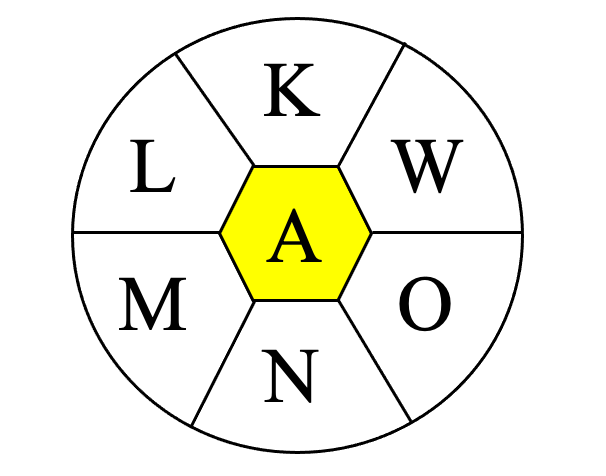
Art: Iva Reztok

K, L, M, N, O, W, and center A (all words must include A)

Merriam-Webster says…
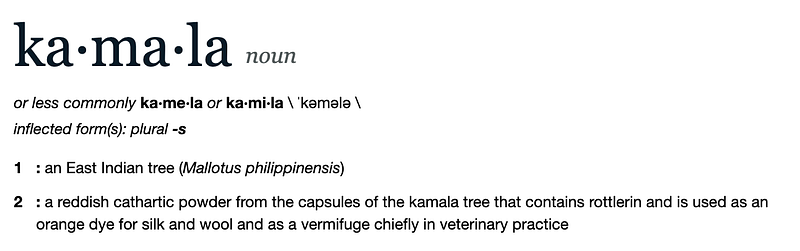
Credit: merriam-webster.com

Silly little dictionary! Don’t you know that kamala can’t possibly be a word if The New York Times says it ain’t?

For further fascinating facts, check out the Spelling Bee Master.

What’s your favorite dord* from today’s puzzle?

My Two Cents

Okay, okay, I lied just a little bit. I am going to briefly discuss Kamala Harris. Not her political views or her career as district attorney. Just her name. We here at Silly Little Dictionary have enough trouble getting readers, so no need to alienate anyone by delving into polarizing politics. Although, perhaps if did exactly that and took a controversial stand we’d get enough reads to earn four figures a month, not four figures a decade. There is something to be said for the famous Howard Stern ratings paradox.

Back to Harris’s name… as a 2021 piece from ABC News explains, “Kamala means ‘lotus flower,’ a plant holding deep meaning in Indian culture.” Also, according to the article, “Harris describes the flower in her memoir as growing underwater, with flowers that rise above the surface, with roots planted firmly in the river’s bottom.” I had no idea Harris had written a memoir. The Truths We Hold was published in 2019, before she became Biden’s running mate. Around the same time, she came out with a children’s book called Superheroes Are Everywhere.

In any case, considering the New York Times has been covering Harris extensively at least since the 2020 primaries, if not before, it’s surprising the editors of the Spelling Bee rejected kamala as a word.

Lotus position

Our friends at Merriam-Webster tell us that kamala was borrowed from the Sanskrit kamala, probably of Dravidian origin and akin to the Kanarese kōmaḷe, kōvaḷ. But they fail to list the lotus flower in their entries for the word kamala. Which is weird.

Wikipedia mentions Nelumbo nucifera as the lotus called kamala, and the online Britannica describes its family thusly:

Nelumbonaceae, the lotus-lily family of the order Proteales, consisting of two species of attractive aquatic plants. One of these species is the sacred lotus of the Orient (Nelumbo nucifera) and is found in tropical and subtropical Asia. The other species is the American lotus, or water chinquapin (N. lutea, or N. pentapetala), found in the eastern United States and southward to Colombia. The family is further characterized by circular, centrally stalked, slightly hairy leaves, up to about 60 cm (2 feet) across, that are funnel- or cup-shaped. The leaves extend, in the Asian species, as much as 2 m (6.5 feet) above the water instead of floating on it. The large, attractive flowers also stand high above the water on strong, leafless stalks. They may be up to 25 cm across and have a number of petals, which close at night. The flowers of the sacred lotus, which stand as much as 1.8 m above the water, are pink or rose-coloured and fragrant. The American lotus has pale yellow flowers that rise about 60 cm above the water.
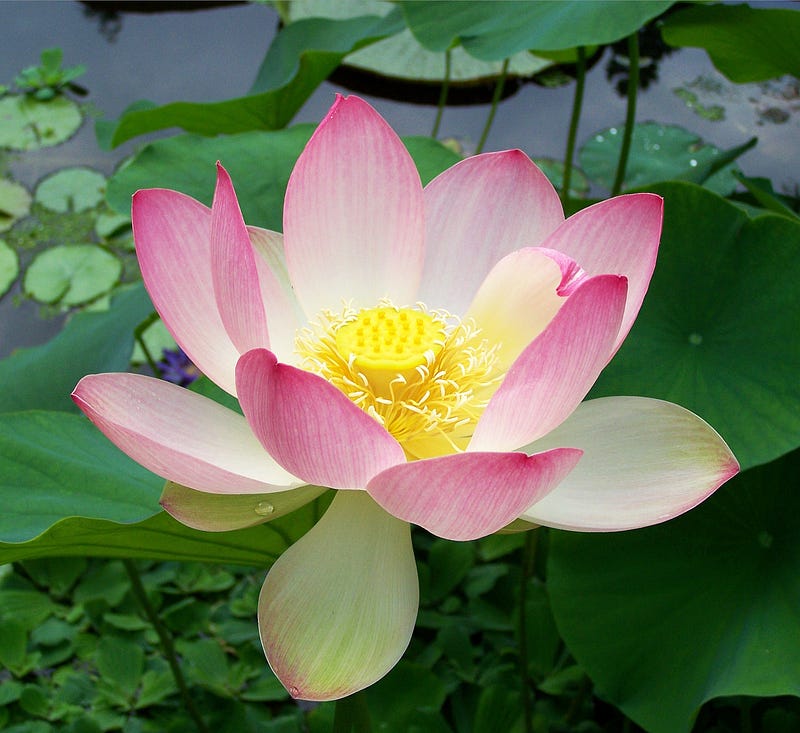
Photo by T.Voekler

It’s a very pretty flower. That’s why the I posted the image in a large format.

The lotus has rhizomes, or creeping root stalks, that are eaten like vegetables in many Asian countries. Tea can be made using the pips, leaves, and flowers; the stems are used in Vietnamese salads. The dried seed head (the bright yellow part in the middle of the above flower) is used in flower arrangements.

In the Nelumbonacea family, the Nelumbo nucifera in particular is a sacred flower in both Hinduism and Buddhism, and represents the path to spiritual awakening and enlightenment. In Christianity the lotus flower has been linked to the apostle Thomas and his coming to India. In ancient Egypt the kamala was also an important icon, symbolizing the path from death to rebirth to the afterlife.

The other kamala

Mallotus philippensis has several nicknames, including kamala tree, red kamala, and kumkum tree, due to its fruit covering that yields a red dye. This kamala belongs to the spurge family (Euphorbiaceae), so it is completely unrelated to the lotus we just discussed . The spurges include the cassava plant (whose root is known as yuca in Spanish), the castor oil plant, and the poinsettia, which is widely used in Christmas floral displays.

The kamala tree can be the size of a bush or reach a height of more than 80 feet (25 meters). The trunk is fluted and irregular at the base, and can be quite thick. The grey bark is smooth, or with wrinkles or bumps, while the branches don’t tend to be very long. The flowers are yellow-brownish in color; male and female flowers grow on separate trees. Fruit may appear at any time of the year, around three months after the flowers do. The fruit is covered in a powdery red substance than when dissolved in alcohol produces a red dye used in silk and wool.
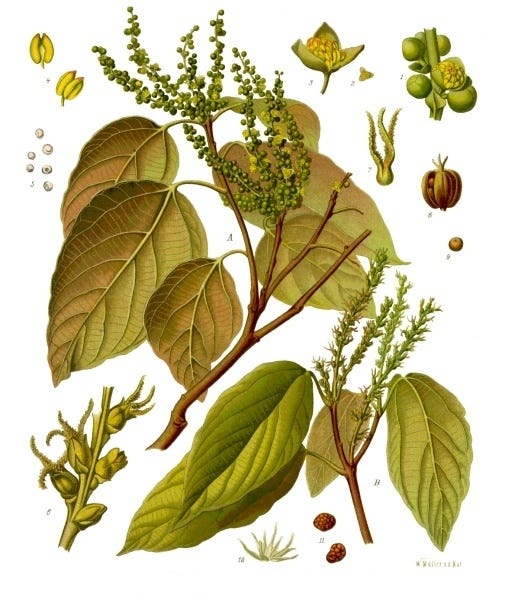
Credit: Franz Eugen Köhler, Köhler’s Medizinal-Pflanzen

The 1911 Encyclopedia Britannica records other uses for the powder, which is also called kamala:

KĀMALĀ, a red powder formerly used in medicine as an anthelmintic and employed in India as a yellow dye. It is obtained from Mallotus philippinensis, Müll., a small euphorbiaceous tree from 20 to 45 ft. in height, distributed from southern Arabia in the west to north Australia and the Philippines in the east. In India kāmalā has several ancient Sanskrit names, one of which, kapila, signifies dusky or tawny red. Under the name of wars, kanbil, or qinbil, kāmalā appears to have been known to the Arabian physicians as a remedy for tapeworm and skin diseases as early as the 10th century, and indeed is mentioned by Paulus Ægineta still earlier. The drug was formerly in the British Pharmacopoeia, but is inferior to many other anthelmintics and is not now employed.

(An anthelmintic is an anti-parasitic medicine that helps kill and expel worms from your bowels.)

Here is black-crested bulbul feeding on the red kamala in India. And if you want to learn more about the word bulbub, you can do so here.
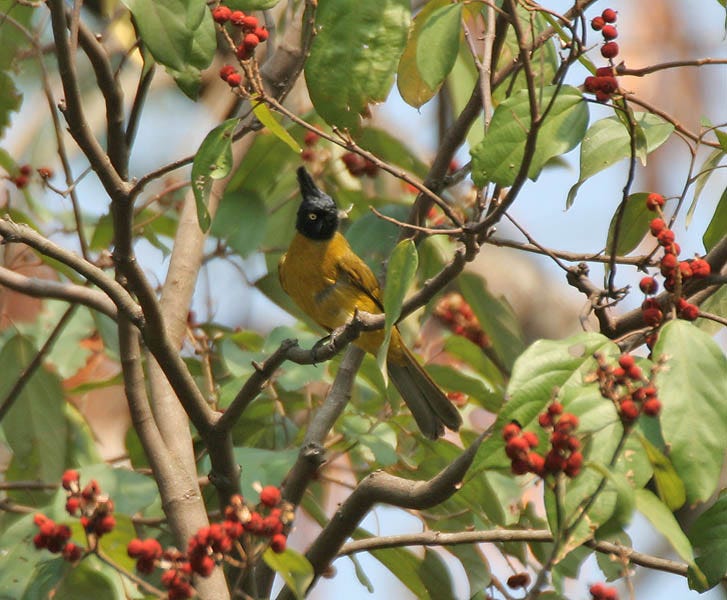
Photo by J.M.Garg

Now you know. If you’re ever in India and want to see a beautiful native lotus flower, ask the locals to show you a kamala. Don’t be surprised if they google a picture of Vice President Harris, though… because the editors of the Spelling Bee decided that kamala is a dord*.

You can check out my previous entry on another dord* here:

*What the heck is a dord, you ask? Here’s the answer:

Spelling Bee
Language
Lotus
Plants
India
Recommended from ReadMedium