
K Fold Cross Validation with Pytorch and sklearn
The post is the sixth in a series of guides to building deep learning models with Pytorch. Below, there is the full series:
- Pytorch Tutorial for Beginners
- Manipulating Pytorch Datasets
- Understand Tensor Dimensions in DL models
- CNN & Feature visualizations
- Hyperparameter tuning with Optuna
- K Fold Cross Validation (this post)
- Convolutional Autoencoder
- Denoising Autoencoder
- Variational Autoencoder
The goal of the series is to make Pytorch more intuitive and accessible as possible through examples of implementations. There are many tutorials on the Internet to use Pytorch to build many types of challenging models, but it can also be confusing at the same time because there are always slight differences when you pass from one tutorial to another. In this series, I want to start from the simplest topics to the more advanced ones.
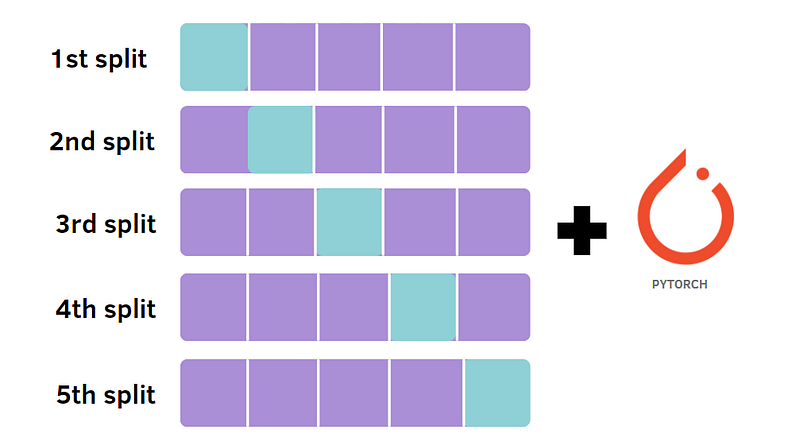
K fold Cross Validation
- K fold Cross Validation is a technique used to evaluate the performance of your machine learning or deep learning model in a robust way.
- It splits the dataset into k parts/folds of approximately equal size. Each fold is chosen in turn for testing and the remaining parts for training.
- This process is repeated k times and then the performance is measured as the mean across all the test sets.
Implementation with Pytorch and sklearn
The K Fold Cross Validation is used to evaluate the performance of the CNN model on the MNIST dataset. This method is implemented using the sklearn library, while the model is trained using Pytorch.
Let’s start by importing the libraries and the dataset:
We define the Convolutional neural network architecture with 2 convolutional layers and one fully connected layer to classify the images into one of the ten categories. We add two Dropout layers in the model to limit the risk of overfitting.
We initialize the Cross-Entropy loss function for the classification, the device to utilize the GPU on the code and we set a fixed random number seed.
Later, we concatenate the training and the test sets into a unique dataset by applying the ConcatDataset function.
Moreover, we generate 10 folds using the Kfold function, where we have random splits and replicable results with random_state=42 . So, it divides the dataset into 9 parts for training and the remaining part for testing.
I defined the functions to train and evaluate the model before applying the K Fold Cross Validation. In particular, in the training function, we perform the forward pass and the backward pass.
Now, we can finally build the k fold cross validation procedure by iterating over folds.
In the first for loop, we sample the elements from train_idx and from val_idx and then we convert these samplers into DataLoader objects with batch size equal to 128. We also initialize the model and pass it to the GPU. In the end, we also initialize the Adam optimizer with 0.002 as the learning rate.
In the second loop, we train and evaluate the CNN model passing the functions defined before. The functions will return the loss and the accuracy for the training and test sets selected. We save all the performances into a dictionary, called history. After the training and the evaluation of the model are terminated, all the scores of the specific fold (into the dictionary history ) are memorized in the dictionary foldperf .
In the end, the model is stored using the torch.save function.
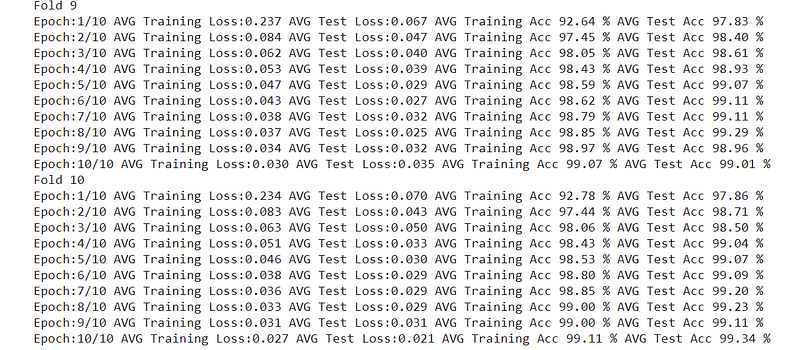
We can see the performances of the last two folds. The results seem pretty good, with 99% of accuracy in both training and test sets. Moreover, there is no evident difference between training and test accuracies, so we are not overfitting.
We can calculate the average performances to have a more generic overview with two steps:
- we calculate the average score in every fold
- once the average score is obtained for every fold, we calculate the average score over all the folds.

We reached good results, as we noticed before without making any average calculations.
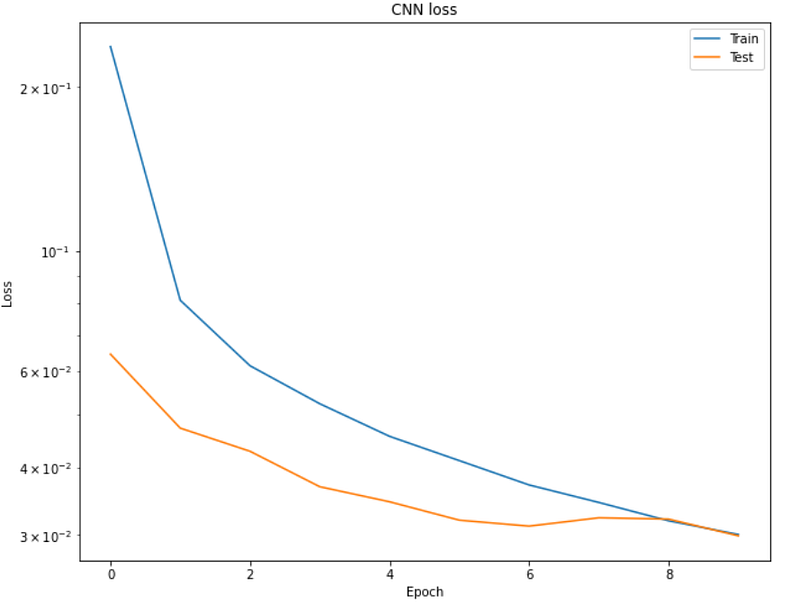
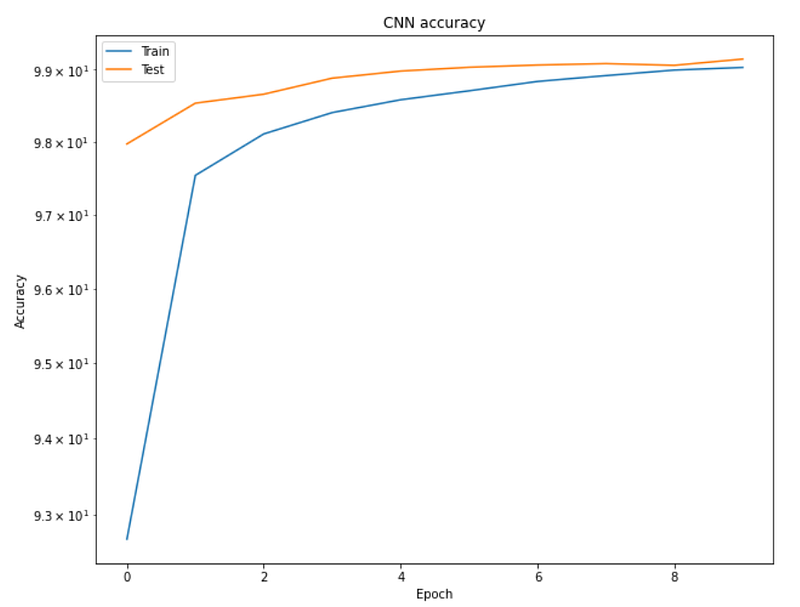
To have additional confirmation, we can plot the average loss/accuracy curves across the ten cross-validation folds for the CNN model. In the first 4 epochs, the accuracies increase very fastly, while the loss functions reach very low values. Both curves converge after 10 epochs.
Final thoughts:
Congratulations! Now, you are able to implement the K fold Cross Validation with a model defined using Pytorch. It’s a hard task when you don’t understand the basics of this technique.
In this tutorial, I showed the simplest version of this technique, but there are also variations depending on the type of problem and the data. For example, some other approaches are the Stratified K fold Cross Validation and the Time Series Cross Validation.
The GitHub code is here. Thanks for reading. Have a nice day.
Did you like my article? Become a member and get unlimited access to new data science posts every day! It’s an indirect way of supporting me without any extra cost to you. If you are already a member, subscribe to get emails whenever I publish new data science and python guides!


