
PHOTOGRAPHY
Just a Bunch of Fun Facts About Blue Chamomile
This flower’s tragic role in Greek mythology earned it its very own tarot card
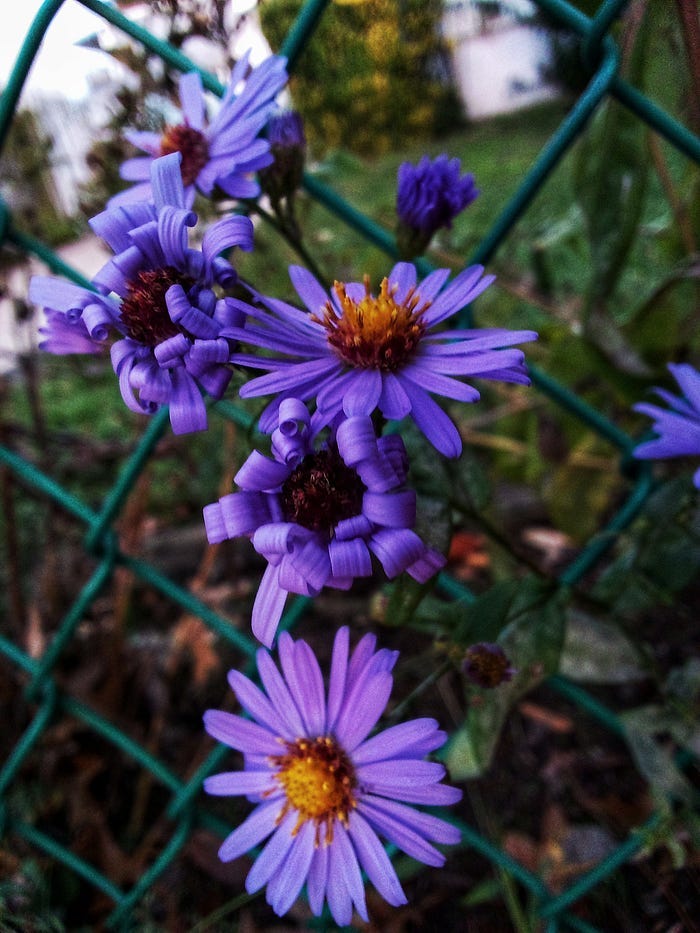
(Disclaimer: This particular flower goes by many different names; I will use them in correlation to the information embedded throughout the article. I will primarily refer to it as ‘Blue Chamomile’ because it’s the name I like best. I want to give you a heads-up so I don’t confuse you.)
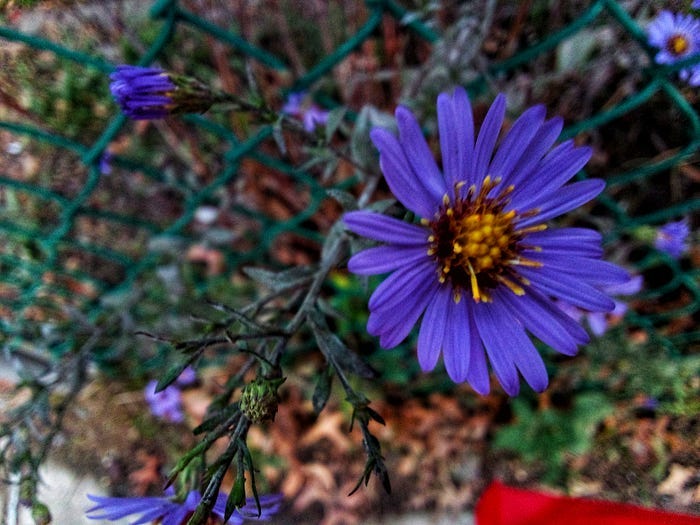
These are Blue Chamomile.
(Also called the Blue Daisy and the New York Daisy, and as a native New Yorker, I am pleased to share this with you.)
Their botanical name is Aster Novi-Belgii.
There are over 250 species of the plant. They are a hybrid of Aster cordifolius and Aster novi-belgii.
They prefer the sun and will die if placed in too much shade. They are a favorite among bees because of the rich nectar that they produce. If plucked, they have a vase life of 5 to 10 days.
Blue Chamomiles are often confused for chrysanthemums; this makes sense because the two are relatives (only the Blue Chamomiles can withstand winter weather).
They are also related to Sunflowers
and Daisies.
The relation is in their yellow center (their eye), which nearly all the Daisy family have.
The plant is named the Blue Daisy and even Blue Chamomile (my favorite) because all Chamomile plants are Daisies.
They have a vase life of 5 to 10 days.
Asters play a role in Greek mythology.
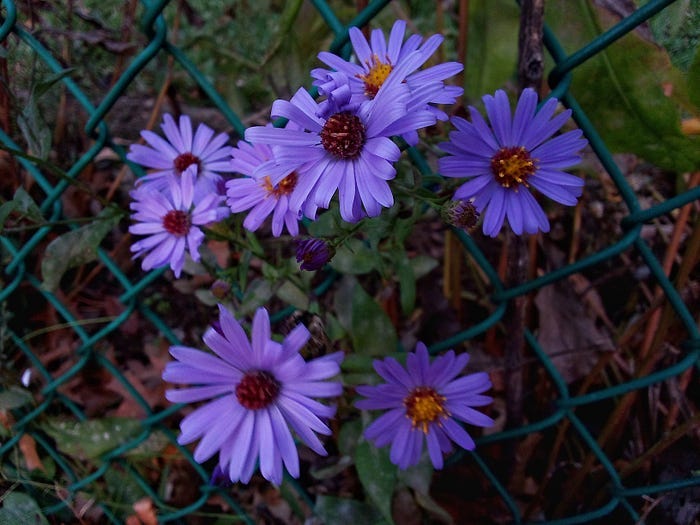
The Blue Chamomile is an Aster.
Aster stems from the word astrum, which means ‘star’ in Latin. The flowerheads of Asters resemble stars and gained their name from their cosmic appearance.
The flower plays a vital role in Greek mythology, specifically, the Greek legend surrounding the flower’s connection to the goddess Astrea, the virgin goddess of justice (also called The Starry Maid).
The legend goes:
Astraea left the earth and became the constellation Virgo (her scales became Libra) when the world turned too violent and degenerate for the gods to bear.
when she saw there were no stars upon the earth, the flowers then sprouted from her tears.
For this reason, people also refer to Asters as Astraea’s tears. This legend might also explain why another name for the flower is Starwort.
(I should probably mention that the narrow and long shape of the leaves has also garnered the flower the name Willow Aster.)
Asters symbolize justice.
In tarot decks, asters are on the Justice card.
Astrea inspired the figure on the card.
Blue Chamomile was nicknamed ‘Michaelmas’ after Archangel Michael.
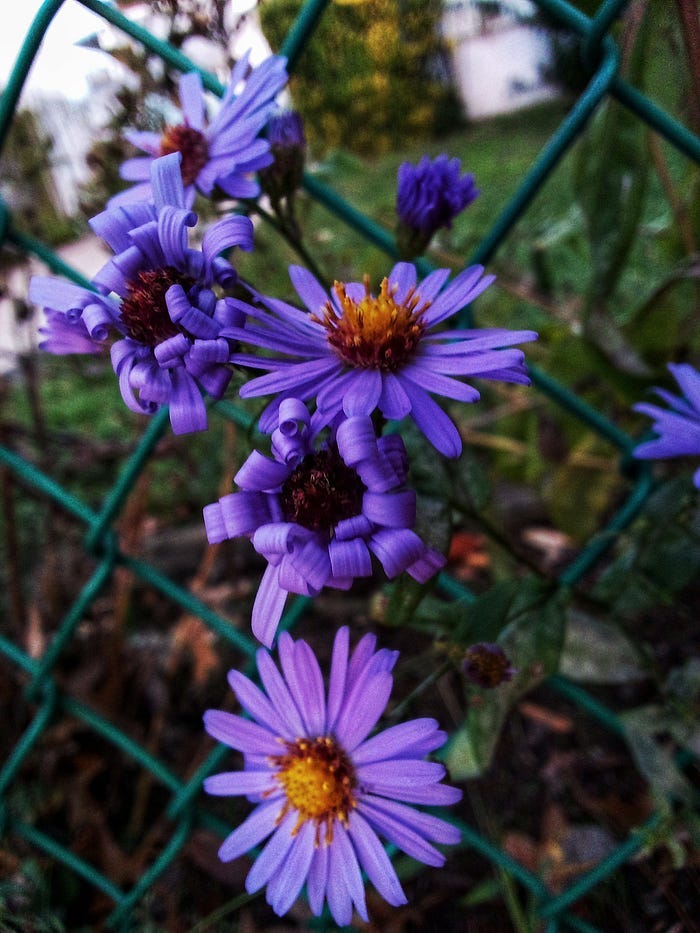
Blue Chamomile is the official birth flower for September, partially because it blooms from the beginning of September into November. This blooming time is also why it was named ‘Michaelmas Daisy.’
September 29th is the feast day of St. Michael.
In Ireland and England, people believe eating goose on Michaelmas will bring them good luck for the remainder of the year.
When given or received on Michaelmas Day, Blue Chamomiles are a way of saying goodbye and symbolizing farewells and departure.
Learn more about Michaelmas: Here.
Blue Chamomiles are edible.
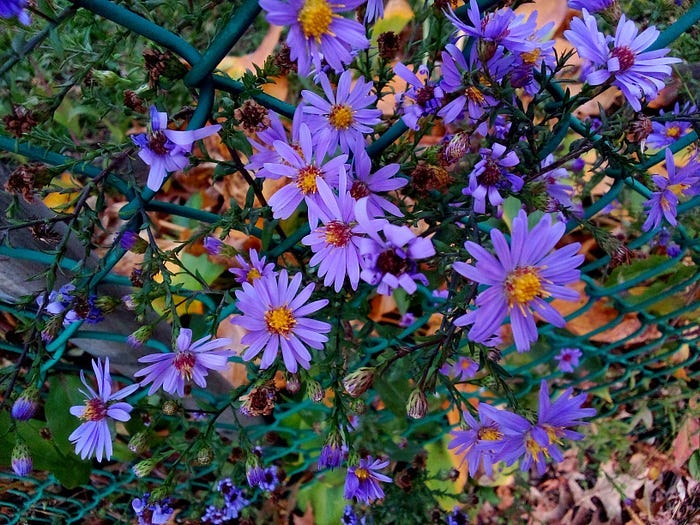
Different parts of the flower have different culinary uses.
The leaves are highly nutritious, containing,
- vitamins A and C
- thiamin (B1)
- riboflavin (B2)
- and niacin (B3)
- calcium
- iron
- potassium
When cooked lightly, they can be used as greens, added to fresh salads, and used as a garnish.
Boil the petals to make Chamomile tea. Steep the petals into a wine and boil the roots into a soup.
Although the flower has a sweet fragrance, it tastes slightly bitter. If you make tea out of it, add honey.
The flower also produces a fruit called an achene.
a small, dry one-seeded fruit that does not open to release the seed.
The achene is often dispersed by the wind or other means, helping the plant to reproduce. The seeds of the plant are an ingredient in birdseed. It is not harmful or poisonous to pets.
Blue Chamomile has holistic properties and artistic uses.
Blue Chamomiles are herbaceous plants; they are great for detoxes because they eliminate toxins from the body.
In Medieval periods, people treated ‘hysteria’ and epilepsy with Blue Chamomile; they treated the onset of scurvy because they are in vitamins A and C.
They have anti-inflammatory properties that shrink tumors and treat respiratory illnesses, coughs, and fevers.
Blue Chamomile treats digestive issues, like obstruction of the bowels, by being turned into a laxative when combined with an herb called Bloodroot.
Blue Chamomile has antiseptic properties.
They can be applied topically to maintain skin health by treating boils and snakebites (because of the tisane in the plant).
An Old Wives Tale even states:
when beaten with old hogs grease and applied, that aster was good for “the biting of a mad dogge.”
When applied topically, the root can alleviate headaches.
Asters were resourceful in occult practices.
Native Americans took the dried leaves of Blue Chamomile and burned them to ward off evil spirits, just like they did with sage. They used the dried roots for hunting magic to attract prey. The roots were also used as love charms to attract mates.
You can use Blue Chamomile in art projects.
Blue Chamomile are known for their beauty.
They come in shades of red, pink, lavender, blue, and white. Purplish-blue tends to be the most common color. Their vibrant colors made them perfect candidates for art projects.
The dried leaves of the flower can make garlands, potpourri, and wreaths. They are a popular choice for flower arrangements, specifically for bridal arrangements, making them the symbol of love and elegance.
(People commonly use Blue Chamomiles in wetland restoration projects.)
Thanks for reading ❤
© Linda Sharp 2024. All Rights Reserved.
Check out this writer:
Let me tell you something.
Chrysa stergiou is a precious human being. She penned a phenomenal article questioning the humanity left in humans called We Are Fighters.
I want to tell you more about this piece but I can’t without giving its essence away; what I can tell you is that it brought me to tears and left me reeling with some very sobering thoughts about the state of our existence as a society. It’s a beautiful existential crisis gift wrapped in a reality check.
Please give this a read.
And then ask yourself,
How will you join the fight?
Published by Annelise Lords. I enjoyed this and was also educated too. I didn’t know these beautiful flowers had medicinal properties.


