
Jump Off the Creator FOMO Train — These 2 Google Docs Can Help
There’s an easier way to smash your goals

I spent months building a following on BitClout.
What’s BitClout? I hear you ask.
Exactly. The platform is pretty much dead.
I’ve wasted time on other stuff too. Coding, day trading, Mandarin — you name it.
Time was never the problem. My focus was (or rather a lack of it). Even with a 6-month plan, my focus drifted from one project to the next, getting swept up by the latest trend.
At the root of this problem was impatience.
And the square root of impatience is FOMO.
You see other creators living their best lives, building followings on platforms. They’re making money. They’re getting attention.
As a creator, if you want to jump off the FOMO train, the following Google docs can help. They’ve helped me put in hours of deep work over the last 12 months.
This deep work has opened the door to opportunities, including scalable income streams. I’m now making enough money online to quit my corporate job.
I’m confident the same can happen to you.
Your focus may still get pulled now and again. We’re only human. However, you’ll have tools to help you get back on track.
Let me show you.
Before I show you…
Consider the following questions.
Number one.
Before you say yes to something, ask yourself this: can you commit to this new project for at least three years?
Gaining traction usually takes this long — if not longer. If you’re just in it for the money, you’ll be disappointed. You may be better off with a part-time job.
I’ve been writing online for the past two years. One to two hours pretty much every day. (I’ve missed a week or two tops.)
This sh*t takes time.
I’m not the only one saying this. One of my favourite YouTubers says you shouldn’t think about money until you’ve made one video a week for two years.
Outside of content, there are examples everywhere.
Stan Lee created his first comic at age 39. Ray Croc bought a burger joint when he was 52 (it later became Mcdonald’s). Samuel L. Jackson got his Hollywood break at 43.
And question number two.
How long has this technology been around?
“Something that’s been around for a year will probably be around for another year. Something that’s been around for fifty years will probably be around for another fifty years…
“Old technologies aren’t exciting because they aren’t changing as fast. But they’re more important. Cryptocurrency versus water filtration. Virtual reality versus air conditioning. Which gets more media attention? Which is more important?”
— Derek Sivers, Author of How To Live
If you’re going to build somewhere, you don’t want it to disappear tomorrow.
With this being said, let me show you the Google docs.
Feel free to copy them.
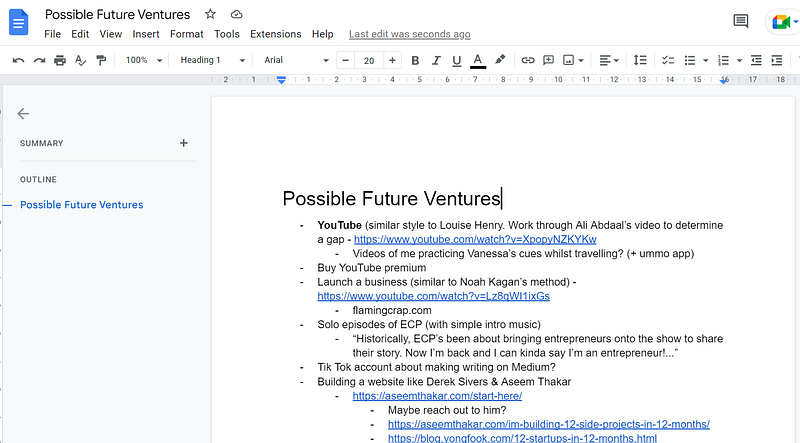
Google Doc #1: Future Projects List
New ideas are flashy.
They’re exciting.
Instead of jumping into the excitement, write the idea on a Google doc. Then, when you complete your current project, open up the Google doc. Which idea could you take a stab at next?
Like Steven Bartlett says, you should stick future projects on the “someday shelf”.
This has two benefits:
- You won’t forget that “killer idea”
- Your focus isn’t pulled away
Capture is the key.
I have a pen and paper beside my bed to write down ideas. I have a whiteboard pen to write on my bathroom tiles.
When convenient, I’ll transfer these ideas onto post-it notes or scraps of paper.
I also collect ideas on my phone and in plastic tubs that I put around my home. Then, on Sunday mornings, I pick out the best ones and stick them in this Google doc:
Google Doc #2: 100 Goals List
Now it’s time for some fun!
Open another Google doc and write down 100 goals. Get everything on screen. Don’t edit. You can always change your mind and delete goals later.
Some of these goals may come from your Future Projects List (i.e. Google doc #1).
Once you’ve got 100, ask yourself the following:
- On a scale of 1–10, how excited am I by this goal?
- Will achieving this goal make other goals easier or unnecessary?
This will help you choose five goals,
“…based on five different categories: Work, Relationships, Location, House, and Hobbies…
“Go on a road trip out West with my Dad. That’s relationships.
“Go to Europe. That’s a location.
“Get 1,000 email subscribers. That’s work.” — Tom Kuegler
It’s then a case of attending Google University and putting a plan in place:
- Take a snapshot of where you’re currently at by writing a prologue for your 6-month plan. Your finances, your relationships, how happy you are — everything.
- Google the steps you need to take to smash your goals.
- Work backward from these goals and decide what actions you need to take each week/month.
I review my 100 Goals doc regularly.
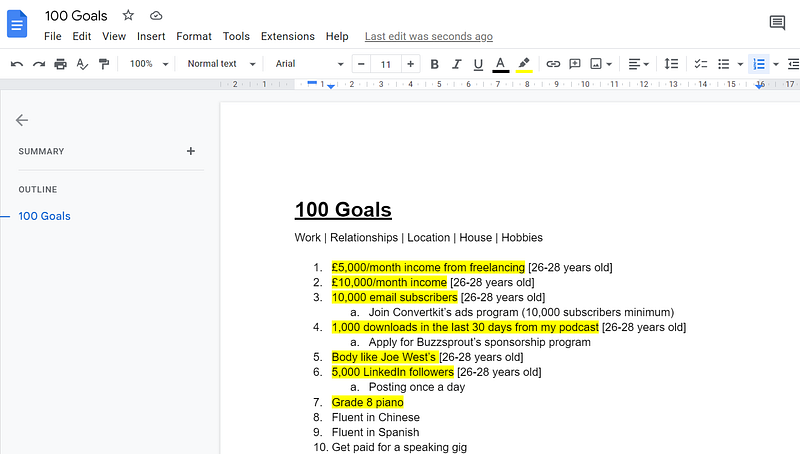
I also attach years to these goals. These are the ones I’m currently working towards.
For example, for the goals I’ve highlighted yellow, I’d like to achieve them by the time I’m 28:
Takeaways
“If you’re a knowledge worker, three hours of focused work each day without any distractions is a huge competitive advantage.” — Tim Ferriss
We know we need to tap into deep work if we’re to create anything meaningful.
But we’re human.
The smallest thought will nag us. Bother us. Consume us.
We have to let it out.
This is where these Google docs come in:
- Google doc #1: Future Projects List — Capture your ideas and stick them on a virtual “someday shelf”. You don’t need to tackle something straight away. Let them stew.
- Google doc #2: 100 Goals List — Write down 100 life goals. Let it all out. Have fun! You can then start to assign years to each of them.
Want to ditch the 9–5? Get my free 19-page guide: Everything I Did to Quit My 9–5 Job & Transition Into Profitable, Sustainable Solopreneuring :)


