
How to Create Passive & Scalable Income Streams From 6 pm — 8 pm
A proven roadmap you can follow

In November 2020, I launched my first online course. It made $305.13 in its opening 12 days.
I now have nine courses in total with another in the pipeline. I’ve put them together between the hours of 6 pm and 8 pm (plus weekends), and they’re averaging $500 a month. One of my goals for 2022 is to 10X this.
Best of all? Now they’re set up, they deliver money whilst I sleep. All I have to do is respond to student messages and thank people for reviews. This takes less than an hour a week.
I’ve gone with online courses because there’s no limit to the money you can make. Students can learn in their own time and I don’t have to be present. They’re scalable.
However, I don’t host the courses myself. I use platforms like Udemy and Skillshare. This means I don’t have to find students for my courses. They’re already there.
Here’s a proven roadmap you can follow to create passive income streams between the hours of 6 pm and 8 pm.
Step #1: Put Out Content for 12 Months
A YouTube channel, a podcast, a blog — it doesn’t matter which. Your first 100 pieces of content will probably suck.
And that’s okay.
It’s not just me saying this. One of my favourite YouTubers, Ali Abdaal, preaches consistency.
He goes one step further. Ali says you shouldn’t think about making money until you’ve put out one video a week for two years.
It’s different for other platforms. For podcasting, you can secure partnerships before releasing a single episode. This is what Sam did. However, she’d already built an audience on Instagram and Facebook.
If you’re just starting out, Ali’s advice is golden.
Produce, improve, repeat.
Hone in on quality. It might take one year to get there. It could take five. As creators, our role is to keep our standards high.
“‘…move the shaker back each time and let them know what you stand for. Let them know what excellence looks like to you.”
— Danny Meyer
Step #2: Build Friendships, Not Networks
Networking is phony.
Conference rooms fill with business cards. Attendees collect them like tokens. They then strike up conversations with people they want help from.
Ick.
Instead of these events, start a podcast.
One of my favourite conversations was with a fellow writer. I reached out to him because I love his work. We’re now friends and help each other with projects.
Whenever I can, I reinforce bonds. It’s not because I want anything. It just feels nice.
I keep notes in an Excel doc. I reach out to friends when they’ve got tests. I message people if we haven’t spoken in a while.
Anyone can write a birthday message, but how many people take the time to send handwritten cards?
Details matter.
Step #3: Look For Gaps in The Market
Note: Steps one and two are ongoing.
There’s no denying it. The world of online courses is crowded. However, this doesn’t mean there isn’t room.
A couple of weeks ago, I was chatting with one of my friends. He tutors maths and wants to make an online course. Is this is a good idea?
I ran some searches on Udemy. The first was for “maths”. This proved too competitive to rank for.
I then dug deeper by searching “iGCSE maths”:
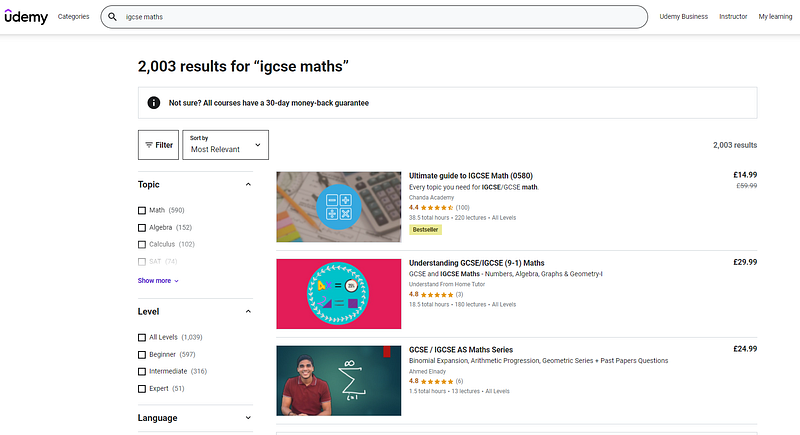
The top course has 100 reviews and was last updated in 2017. The second-highest-ranking course only has three reviews.
To me, this suggests one of two things. There are either not enough people searching for this keyword to make it worthwhile, or there’s a gap in the market.
I think it’s the latter.
I’ve encouraged my friend to make a course. If he gets 20+ reviews and follows the steps for a successful launch, his course should rank on page one.
The best time to start was ten years ago. The next best time is today.
Step #4: Create Your First Course
Keep it simple
My tech consists of a laptop, a Blue Yeti mic, and some free editing software. That’s it. No fancy equipment.
If you’re going to invest in anything, make it a mic. Sound is king. Otherwise, a few well-placed lamps will do the trick.
As long as you’re providing value, people are forgiving.
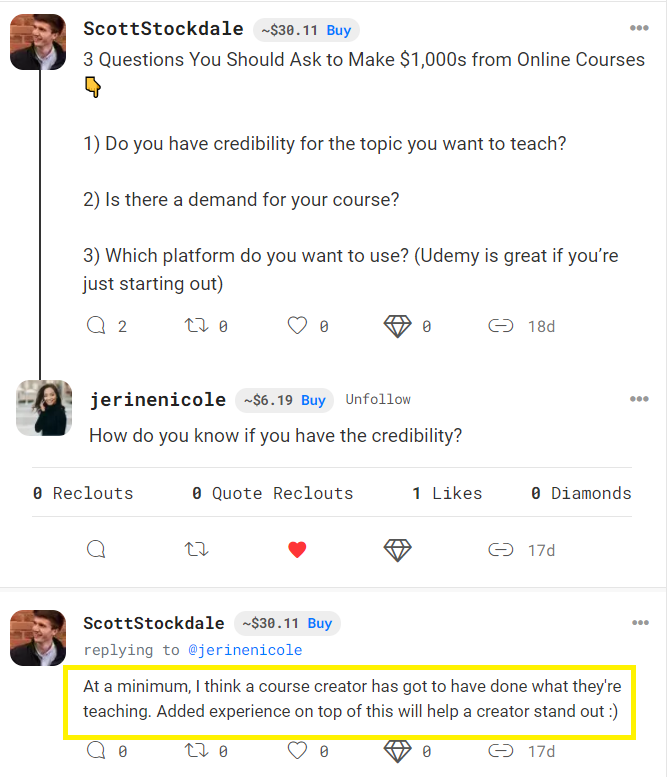
Be the right person to teach your course
Nail the launch week
Remember steps one and two?
This is where friends can help.
You can’t launch a course and hope people find it. Push hard. Ask your friends to check out your course if you think it could help them. Getting reviews is important for Udemy SEO.
“Hey [NAME], I hope you’re well! I think you might be interested in this course I’ve created, and using my exclusive discount code, you can get it today for FREE. If you like what you see, it would be great to see you there!”
After launching my courses, I do very little. That’s because they’re ranking in positions 1–3 on Udemy for their target keywords.
My worst-performing courses are the ones I didn’t push hard enough.
Treat your first course as a test run
Accept the fact it may not be good. It may not make much money. Go after a tiny niche and use it as a dummy run.
Remember Ali’s advice:
Produce, improve, repeat.
Step #5: Give Your Course Away for Free at Every Opportunity
I email newsletter subscribers a Google form using ConvertKit. This is automatically sent after they’ve received three of my weekly emails.
The form asks them questions about the emails, such as what they like and how they can be improved. In return, subscribers get free access to one of my courses.
I get useful feedback, and they get access to an online course worth £59.99. Win-win.
Another example is on BitClout. If a user purchases my coin, I send them a link with free access to one of my courses.
When they do, I tag them in a post:
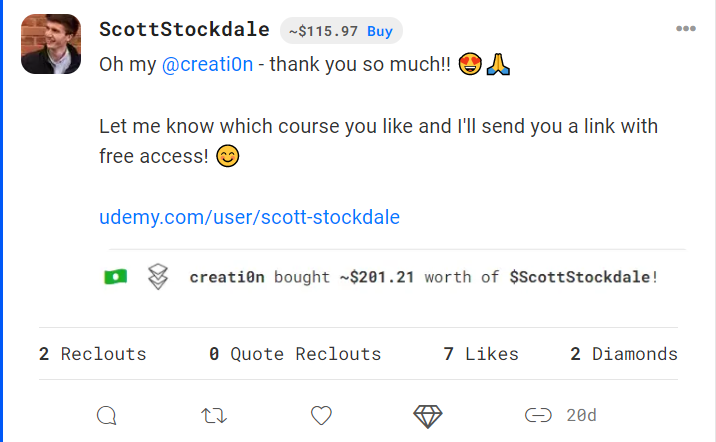
Sidenote: On 13th December 2021, the BitClout coin, $DESO, was listed on Coinbase. This means 73 million people will have access to it for the first time.
2022 could be huge for this decentralised platform.
Step #6: Unexpected Opportunities May Arise
I’ve recently partnered with Zero To Mastery — a global academy of 500,000+ developers.
The head of product found my courses on Udemy and asked if I’d like to collaborate. I ignored his first email. To his credit, he followed up a week later.
After some back and forth, we agreed to work together. Our first course went live in September and has made me over $700 to date.
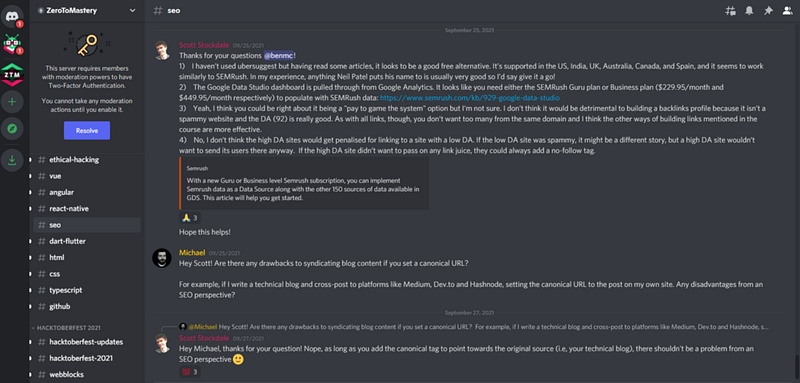
Unlike other courses I’ve released, there’s more interaction with students. There’s a private Discord channel where students can ask me questions and leave feedback.
We’re currently working on a more detailed and advanced SEO course.
Takeaways
This time last year, the thought of making money online seemed a million miles away. Passive income? Forget it.
Now, just over 12 months later, I’m making money in my sleep. (About $15 per day.)
Here’s a proven roadmap you can follow:
- Put out content for 12 months — Don’t ask anyone for anything. Give, give, give.
- Build friendships, not networks — Reinforce these bonds at every opportunity.
- Look for gaps in the market — The world of online courses is crowded, but there’s always room.
- Create your first course — Produce, improve, repeat.
- Give your course away for free at every opportunity — Added benefit? These people are more likely to leave positive course reviews.
- Unexpected opportunities may arise — You often can’t predict the best ones.
Want to ditch the 9–5? Get my free 19-page guide: Everything I Did to Quit My 9–5 Job & Transition Into Profitable, Sustainable Solopreneuring :)


