
Going Part-Time Is an Underrated Life Choice
3-days employee, 2-days solopreneur

At one point or another, you’re told to sacrifice.
Freedom or security. The choice is yours.
Sorry — that’s just how it is.
It’s drilled into you by your family, friends, colleagues, and teachers. They’re well-intentioned, but they’re wrong.
Your career doesn’t have to be:
- Sacrificing evenings and weekends to get ahead
- Working 40 hours a week for someone else
- Being miserable
And it doesn’t have to be:
- Going full-time as a solopreneur
- Living with your parents
- Stressing about $$
There’s a middle ground. A grey area. You can be financially secure and have schedule freedom.
I’ve spoken with my good friend Charlie about this, and he agrees. Spending two days a week making your dreams come true and three days building someone else’s?
It’s a perfect balance.
Part-Time Job + Part-Time Hustle = Full-Time Bliss
Since January 2022, I’ve been working three days a week as an SEO manager.
On the other days, I’ve been building up my freelance writing business. I’ve also built scalable income streams. These include an 11-hour course with Zero to Mastery.
- Part-time job (three days a week) = paying your bills
- Side-hustles (two days a week) = building scalable income sources
Here’s how you can make it happen too.
Step #1: Be so good that they can’t say no
Most companies will want you to work full-time.
The antidote?
Make it difficult to replace you.
Build your skills and build your leverage. This way, you can dictate the terms you want.
Your employer would rather have you part-time than not at all.
If you can link these skills to a revenue-generating role, even better.
Here are some examples:
- Product — Designer, Developer
- Sales — Business Development, Account Management
- Marketing — SEO, Email Marketing, PPC, Paid Social, Organic Social
Step #2: Patience is your friend
Mastering a skill takes time, so work with someone else first.
You’ll learn about the industry.
You’ll make mistakes.
I had two years of SEO experience before my current role. I now have a skill that’s in demand. I have leverage. This is clear by the number of recruiters who slide into my DMs.
This isn’t the only way, though.
You could start your own business and learn those along the way. This is what Charlie did. He ran five-figure projects, scaled a 39-person team, and delivered for over 100 clients.
You don’t need to specialise from day one.
Start broad.
Step #3: LinkedIn is also your friend
I landed one job the “traditional” way. Seeing an ad. Sending a CV. Being interviewed.
For the others, recruiters slid into my DMs.
I don’t post much, but I keep my profile up to date. A professional headshot. Engaging sections.
You know the drill.
Recruiters will be throwing themselves at you when you follow these tips.
Step #4: Negotiate like a pro
If you’ve built your skills and a recruiter reaches out, you’ll get an interview.
Be friendly. Do your research. Answer their questions.
Once you ace the interview, it’s time to negotiate.
The chances are you’re in a strong position. You’ve probably got other interviews lined up. You want a job, but you’re in no rush.
You’re willing to walk away.
Tell hiring managers this when they reach out. The time pressure makes them more likely to offer you a job (providing you do well in the interview!)
Know your worth. Previous roles will give you a sense of a realistic salary. Add at least 20% when asked.
Find out how long the position you’re applying for has been open. The recruiter will let you know.
If it’s been open a while, they’ll want someone through the door.
My employer had been waiting seven months.
Tell them what you want. I wanted a part-time role (three days a week with remote working) with complete autonomy.
They agreed.
Your other two days — what should you do?
Focus on what you enjoy
Spend time with family and friends. Lean into hobbies.
If you’re happy and you can pay your bills, you don’t have to hustle.
But if you want to…
Build passive & scalable income streams
Once you’ve made $1 online, you can make $10,000.
The jump isn’t as big as you think.
There are countless ways to do this. Ebooks, PDFs, flipping on eBay — you name it.
Personally, I love making online courses that are pre-recorded. I host them on Udemy and Skillshare. Charlie’s making money through paid Substack subscriptions.
Test, test, test.
Build an email list
According to Pat Flynn, there are only two things you can own on the internet: an email and a website. Everything else is rented — including social media.
Tim Denning’s view on this is simple. You need to write a lot, build the list, and email the list.
Here’s my approach.
I’ve created landing pages with ConvertKit, and each has a box where people can claim my free resources. All they have to do is enter their email address.
One of these resources is my five-day outsourcing course.
For this course, I’ve set up an email sequence. Users receive these emails automatically at certain intervals when they subscribe.
The first email describes how I went from not having enough hours in the day to making passive income on Udemy. It also details what a subscriber can expect moving forward:
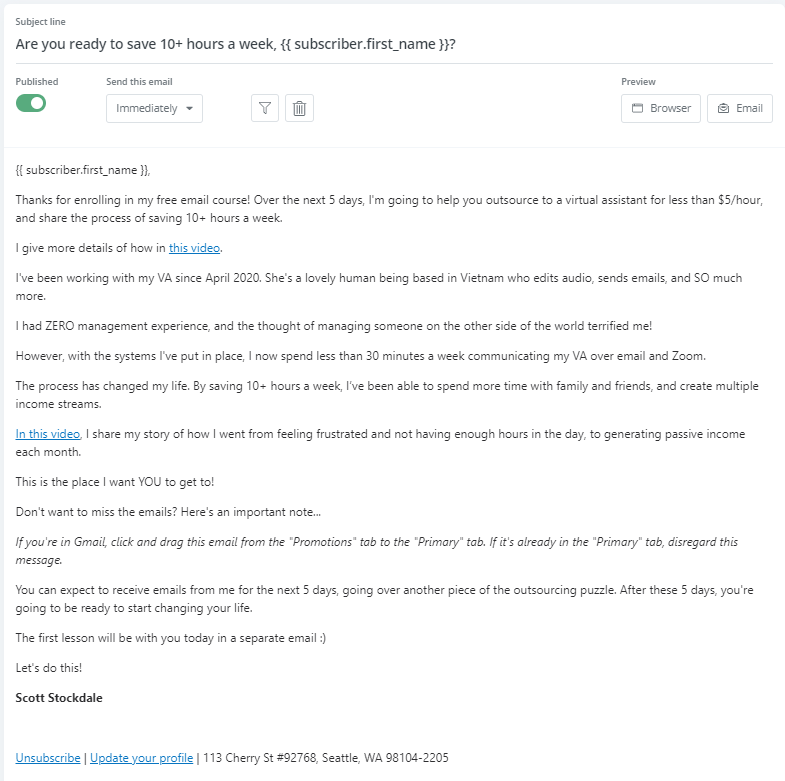
Over the next five days, ConvertKit automatically sends the lessons. They’re all about outsourcing, and they include a link to a video lesson (unlisted videos on YouTube).
In the sixth email — which comes a day after the final lesson — I let subscribers know I’ll be sending emails twice a week. These are about entrepreneurship and making money online. The email also talks about the benefits of my paid outsourcing course.
If they’ve found value in my free course, I believe they’ll enjoy my paid one.
How do people find the landing page? At the end of every relevant article that I write, I leave a call to action.
You’ve now got a direct channel to your fans.
Takeaways
I’ll say it again:
Going part-time is an underrated life choice. You get the security of a regular paycheck and more time to build scalable income streams.
You’re not a failure for ditching full-time work.
You’re not a failure for not diving headfirst into solopreneurship.
You’re making an active choice. A choice that works for you right now. If it changes in the future and you want to go back to full-time work, that’s totally fine.
It’s just the next step in your squiggly career.
I don’t want to work for a company forever. I want to keep building my freelance writing business and do this full-time.
Until then, this part-time balance has worked well. It could work well for you too:
- Work for a company three days a week — say Tuesdays to Thursdays
- Use Mondays and Fridays for side hustles (plus weekends)
A part-time job can give you an anchor in choppy seas.
Your dreams will thank you.
Join 550+ subscribers who receive emails from me about writing & making money online :)


