
Jesus, Don’t You Dare Heal That Man’s Withered Hand!
You know what he was doing with it!
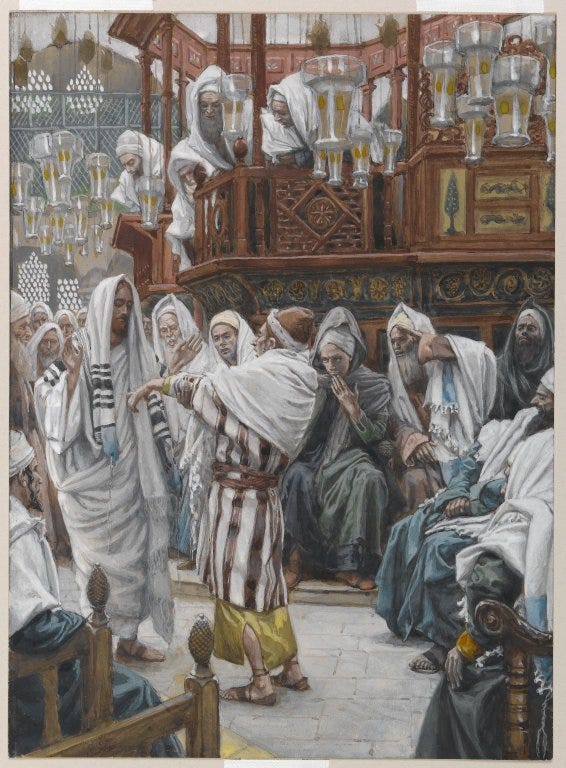
_-_James_Tissot_-_overall.jpg)
In this article, I will attempt to show how the synoptic Gospels were used to encrypt information. We will focus on one of Jesus’ lesser-known miracles, the healing of the man with the withered hand. This miracle is found in all three synoptic Gospels which makes it an ideal candidate for demonstrating the three-fold system of encryption.
There was something about the words Jesus had said and the actions He had taken, that stymied His enemies and locked them into a paradox which could only be resolved by revealing the significance of the miracle Jesus had just performed, and that they would never do.
We begin with Mark as it shows all the signs of being the first Gospel written. Mark lays down the basic text.
There are some basic assumptions that should be stated openly. The first is that the authors of the synoptic Gospels wrote these texts to both conceal and to reveal. They are designed to appear simple and obvious to the majority of readers, while also being fairly easy to unlock when approached with the proper intention.
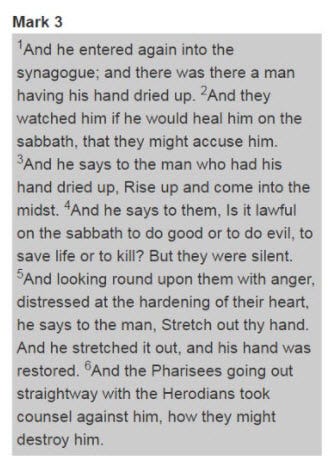
Mark gives us the first layer. Jesus enters the synagogue where he finds a man with a withered hand. The Pharisees are watching Jesus to see if he will heal the man on the sabbath. Then Jesus tells the man to rise up and come to the middle.
Jesus then asks if it is legal to do good or evil on the sabbath, was it okay to save life or to kill. The Pharisees apparently didn’t have a good comeback to that, so they kept quiet.
That made Jesus really angry, so he told the man to stretch out his hand and it was healed. The Pharisees hurried out together with the Herodians so that they could plan how to destroy Jesus.
Is It Legal to Do Good or Evil on the Sabbath?
Taken by itself, the most interesting part of the scene is the question Jesus asks. Is it legal to do good or evil on the sabbath? This is not just an empty rhetorical question.
32 And while the children of Israel were in the wilderness they found a man gathering sticks on the sabbath day. 33 And they that found him gathering sticks brought him to Moses and Aaron, and to the whole assembly. 34 And they put him in custody, for it was not declared what should be done to him. 35 And Jehovah said to Moses, The man shall certainly be put to death: the whole assembly shall stone him with stones outside the camp. 36 And the whole assembly led him outside the camp, and stoned him with stones, and he died, as Jehovah had commanded Moses. (Num 15:32–36 DBY)
Here is an avid stick collector who was caught gathering sticks on the sabbath. The people that saw him doing this unlawful stick-gathering captured and delivered him to Moses and Aaron to be judged.
Let me repeat, these witnesses captured this man and delivered him to his fate on the sabbath. The text isn’t very clear, but they probably ended up stoning him on the sabbath as well.
Just as the Pharisees and Herodians were conspiring to eliminate Jesus, on the sabbath, for violating the sanctity of the sabbath.
Jesus seems to be suggesting that killing and doing evil on the sabbath is acceptable while doing good, technically, is not. Then Jesus heals the man’s hand. This is Jesus apparently doing good, which by what I am guessing his logic is, would be violating the sabbath. Still, if that were the case, they would have taken Jesus right there.
There was something about the words Jesus had said and the actions He had taken, that stymied His enemies and locked them into a paradox which could only be resolved by revealing the significance of the miracle Jesus had just performed, and that they would never do.
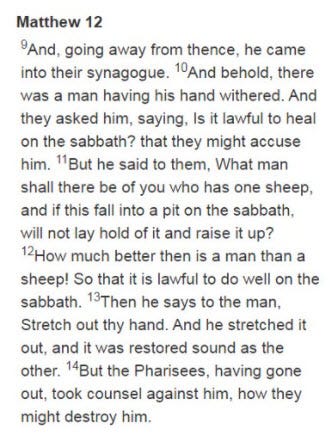
Matthew’s beginning is very close to Mark’s. The first significant change is the question. This time the Pharisees ask Jesus if it is legal to heal on the sabbath. They want to trap him because it is apparently illegal to heal on the sabbath.
Jesus doesn’t answer the question. Instead, he asks who among them, if they had a sheep and it fell into a pit, wouldn’t take hold of that sheep and lift it up?
Then he claims that a man is better than a sheep. He then states that this proves the legality of doing well. Here, Jesus doesn’t argue that saving the man is doing good, but rather that it is lawful to do what you are doing on the sabbath as long as you do it with skill.
Jesus then heals the man’s hand. The Pharisees leave to plot how best to destroy Jesus, this time without the Herodians.
Matthew has several significant changes from Mark: The question that is asked and who asks it, and the addition of the story of the sheep in the pit.
Finally, we come to Luke. The theory, as you will recall, is that Mark was written first, then Matthew was based on Mark. Matthew copied certain features of Mark while changing others. These changes highlight certain features of the texts, namely the questions and the addition of a sheep in a pit and the legality of doing things well.
Luke is the third text in the triad. It was based on both Mark and Matthew and all three texts were written with the same intention, to conceal from some while revealing to others the solution to the healing of the withered hand.
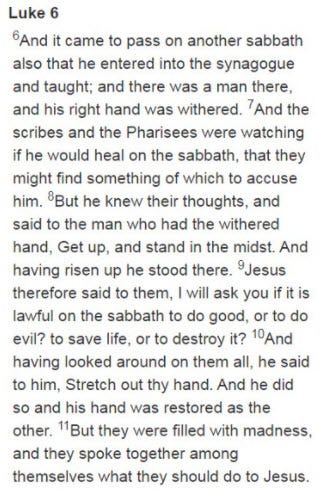
Things begin much the same as before. Jesus enters a synagogue on the sabbath and a man with a withered hand is there. The Pharisees are there as well, this time with their scribes, and they are watching to see if Jesus dares heal on the sabbath so that he can be charged with a crime.
Jesus knows what they are up to, so he tells the man to rise up and stand in the center. Then the man rose up and stood.
Jesus then asks the same questions as in Mark. Is it legal to do good or evil, to save life or destroy it? We have already seen that it is unlawful to do good, and again it seems that Jesus is giving us an either-or choice. If it is unlawful to do good then it is legal to do evil. Jesus then heals the man’s withered hand, which infuriates the Pharisees.
Once again, it almost seems as if Jesus is claiming that his healing of the man’s withered hand is actually an evil act. But, since it is evil and as he is not saving but actually killing a life then it is lawful to do on the sabbath. And that through his words and actions he has somehow outsmarted the Pharisees together with their lawyers and done it well.
Jesus Heals a Man With Dropsy
It turns out that Luke contains another parallel that isn’t often noticed.
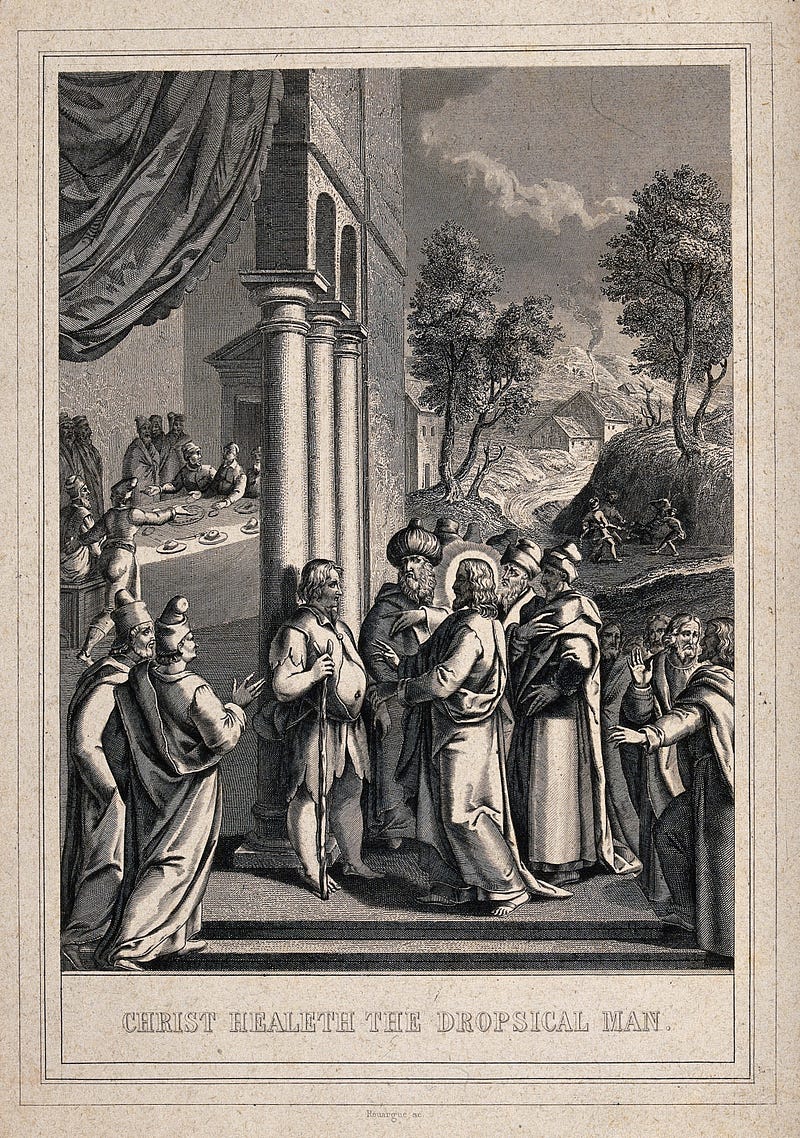
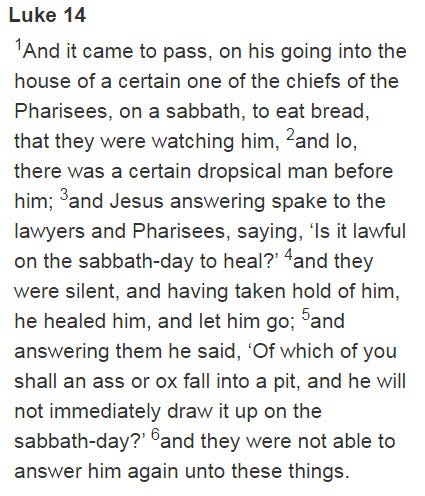
Jesus is about to go into the house of the leader of the Pharisees to eat on the sabbath. He meets a man with dropsy (swelling due to an internal accumulation of water) and asks the Pharisees and their lawyers if it is legal to heal on the sabbath. Jesus then heals the man of dropsy.
He then asks the Pharisees about the same hypothetical scenario from Matthew, only this time changing the animal from sheep to an ass or an ox. The Pharisees and their scribes are unable to answer. And that’s it.
No Pharisees hurrying off to conspire how to destroy Him. Nothing. They just go and have dinner. Later they talk against Jesus for eating with sinners, but that’s it.
What is Luke telling us with this parallel?
Jesus cures a man of dropsy, not in a synagogue, but rather on the way to dine with the leader of the Pharisees. He heals the man before a group of Pharisees and their lawyers, after first asking whether it is legal to heal on the sabbath, which it definitely isn’t if the other parallels are to be believed. He and the chief of the Pharisees then go on to feast with apparently no one conspiring against Jesus.
So what was different?
The affliction.
The Pharisees didn’t care if he cured someone of dropsy on the sabbath, but they went mad when Jesus cured a man’s withered hand.
There is another more subtle difference between these parallels.
In Matthew's version, the animal trapped in the pit is a sheep, while in Luke the animal is either an ass or an ox. Sheep are grazing animals while asses and oxen are working animals.
So the man with dropsy is having his suffering being compared to the rescue of working animals, while the man with the withered hand is having his ordeal associated with the grasping of an innocent sheep and raising it up from a pit.
There exists another level of parallels which we should consider.
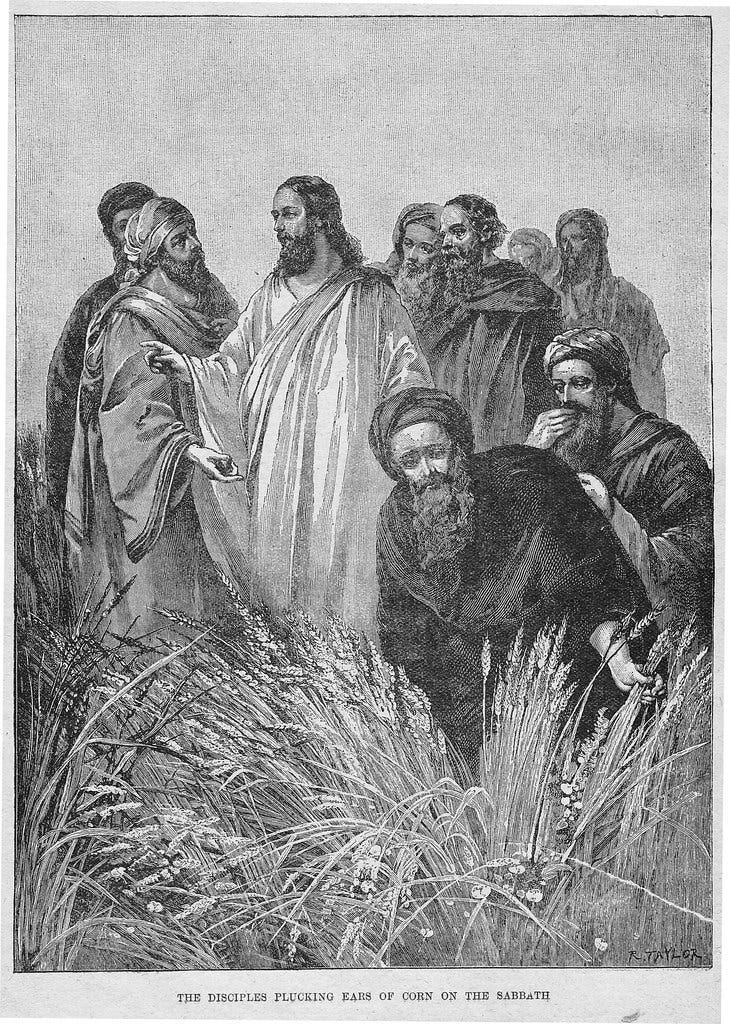
In all three synoptic Gospels, the healing of the man with the withered hand is proceeding by the story of the plucking of the grain.
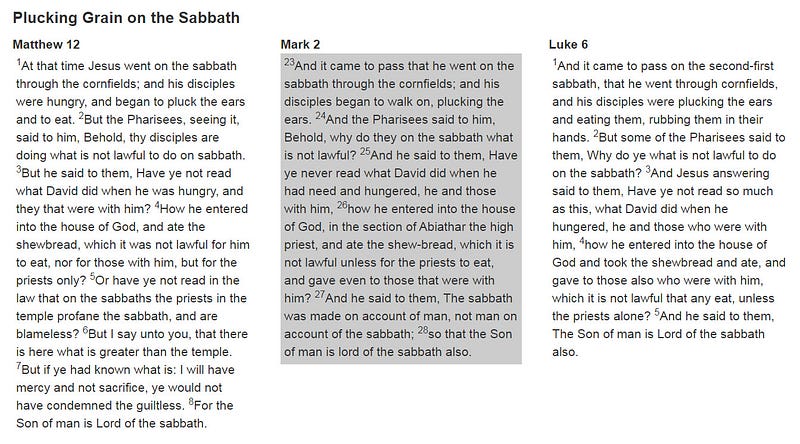
The first thing I want to look at is the progression of Mark chapter 2 to Mark 3. In Mark 2, the disciples are plucking the ears of grain and then in Mark 3, Jesus is healing a man’s withered hand.
In Matthew, the progression seems to connect the showing of mercy to the innocent to the sheep being raised up from the pit. In Luke, the disciples are rubbing the heads of grain in their hands and eating them which again seems connected to the man with the withered hand somehow.
Anyone familiar with my work recognizes the plucking the heads of grain from my article on the feeding of the multitudes:
And from there it all leads inevitably to our eviction from the Garden of Eden:
I make these two digressions in order to highlight a strange sort of relationship between the man with the withered hand and the tree of knowledge.
9 And out of the ground Jehovah Elohim made every tree grow that is pleasant to the sight, and good for food; and the tree of life, in the midst of the garden, and the tree of the knowledge of good and evil. (Gen 2:9 DBY)
1 And the serpent was more crafty than any animal of the field which Jehovah Elohim had made. And it said to the woman, Is it even so, that God has said, Ye shall not eat of every tree of the garden? 2 And the woman said to the serpent, We may eat of the fruit of the trees of the garden; 3 but of the fruit of the tree that is in the midst of the garden, God has said, Ye shall not eat of it, and ye shall not touch it, lest ye die. (Gen 3:1–3 DBY)
The tree of knowledge is described as growing in the midst of the garden. Notice how conspicuously the man with the withered hand is being directed to stand in Mark and Luke.
3 And he says to the man who had his hand dried up, Rise up and come into the midst. (Mar 3:3 DBY)
8 But *he* knew their thoughts, and said to the man who had the withered hand, Get up, and stand in the midst. And having risen up he stood there. (Luk 6:8 DBY)
As I noted in my article on the fruit of knowledge, the story of Eve being tempted by the serpent is often interpreted sexually. This use of sexual metaphor helps to veil the story from one sort of eyes while making it more enticing for the eyes of another sort.
In the instance of the man with the withered hand, my understanding is that the use of terms words translated as ‘midst’ is meant to remind us of the sexual connotations of the tree of knowledge.
Let’s look at each version again:
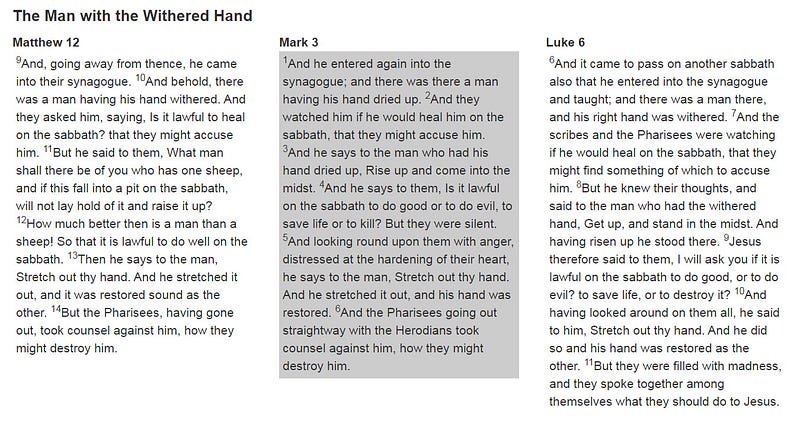
1 And he entered again into the synagogue; and there was there a man having his hand dried up. 2 And they watched him if he would heal him on the sabbath, that they might accuse him. 3 And he says to the man who had his hand dried up, Rise up and come into the midst. 4 And he says to them, Is it lawful on the sabbath to do good or to do evil, to save life or to kill? But they were silent. 5 And looking round upon them with anger, distressed at the hardening of their heart, he says to the man, Stretch out thy hand. And he stretched it out, and his hand was restored. 6 And the Pharisees going out straightway with the Herodians took counsel against him, how they might destroy him. (Mar 3:1–6 DBY)
9 And, going away from thence, he came into their synagogue. 10 And behold, there was a man having his hand withered. And they asked him, saying, Is it lawful to heal on the sabbath? that they might accuse him. 11 But he said to them, What man shall there be of you who has one sheep, and if this fall into a pit on the sabbath, will not lay hold of it and raise it up? 12 How much better then is a man than a sheep! So that it is lawful to do well on the sabbath. 13 Then he says to the man, Stretch out thy hand. And he stretched it out, and it was restored sound as the other. 14 But the Pharisees, having gone out, took counsel against him, how they might destroy him. (Mat 12:9–14 DBY)
6 And it came to pass on another sabbath also that he entered into the synagogue and taught; and there was a man there, and his right hand was withered. 7 And the scribes and the Pharisees were watching if he would heal on the sabbath, that they might find something of which to accuse him. 8 But *he* knew their thoughts, and said to the man who had the withered hand, Get up, and stand in the midst. And having risen up he stood there. 9 Jesus therefore said to them, I will ask you if it is lawful on the sabbath to do good, or to do evil? to save life, or to destroy it? 10 And having looked around on them all, he said to him, Stretch out thy hand. And he did so and his hand was restored as the other. 11 But *they* were filled with madness, and they spoke together among themselves what they should do to Jesus. (Luk 6:6–11 DBY)
If it isn’t clear by now, the man with the withered hand was afflicted because he used that hand to pleasure himself. Jesus, therefore, was doing evil by healing the man’s hand because the man would then use it to pleasure himself again.
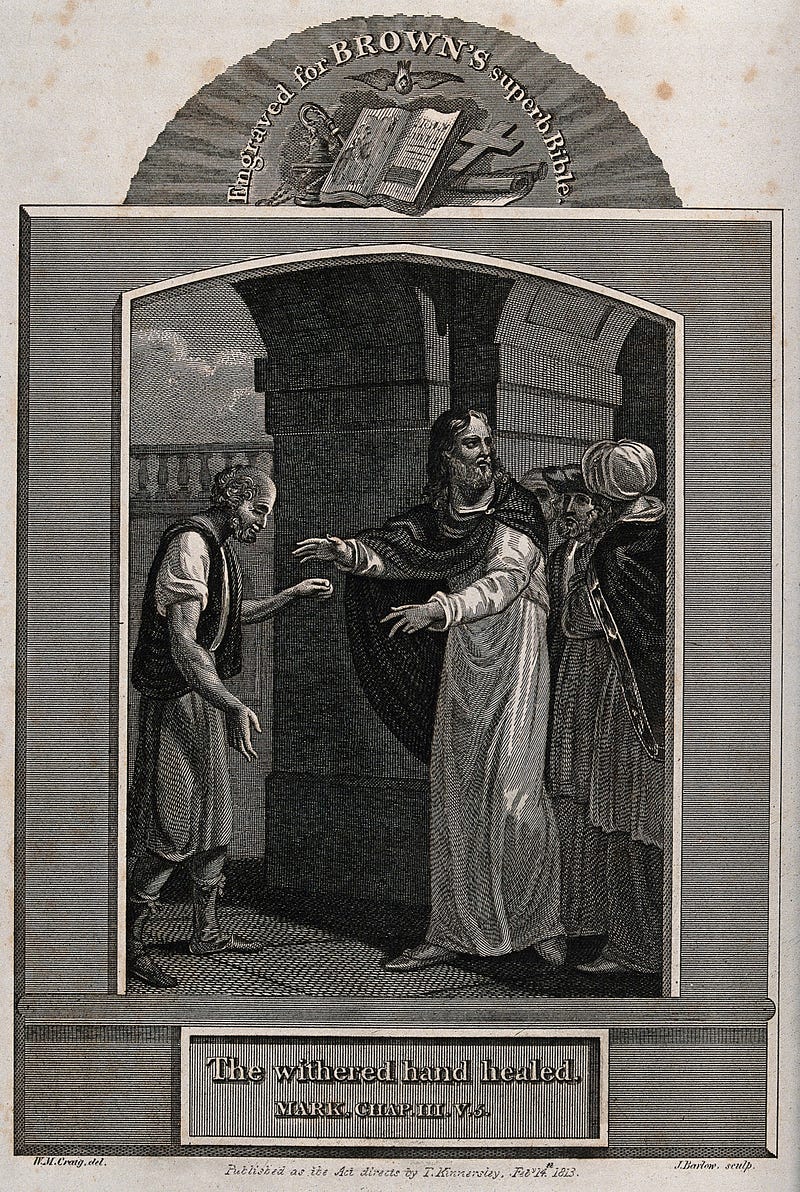
In Matthew, the whole bit with grabbing hold of the sheep in the pit and raising it up can be seen as a mechanical description of masturbation, while the line about a man being better than a sheep likely refers to the superiority of masturbation over bestiality.
The entire point of the miracle is that Jesus healed this man’s withered hand, allowing him to masturbate which angered the Pharisees. And, since that sort of healing was technically a bad thing to do, Jesus could not be charged with violating the sabbath, which angered them even further.