
I’ve Been Using Google Bard to Write For 3 Months — Here’s What I Learned
You risk getting a penalty for doing this.
Have you heard of Google AI chatbot Bard? Or are you a loyal ChatGPT user?
If you use both, which one do you like the most and why?
If you’ve been following me for a while, you might know I frequently experiment with AI-generated content to measure its performance in organic search results.
I started playing with ChatGPT after its announcement in November 2022 and its rapid popularity growth.
I published several articles written with the help of ChatGPT on my website and some other websites. ChatGPT’s responses heavily depend on the quality of prompts, but the experiment results were not promising. If you want to learn more, follow this link.
After the ChatGPT hype, many new AI writing tools have been launched, like Frase.io and Robinize, to name a few. They aim to help you write and optimize content for organic search results.
The main ChatGPT rival, Bard, was launched in March 2023 by Google.
Since then, many content creators, including me, have started experimenting with Bard to understand how it can be used.
As an SEO specialist and content writer, I wanted to determine whether I could rely on Bard for content writing and optimization.
You can learn more about my experiments with Bard here.
August 2023 marks my third month of active Bard usage for research and writing. Here is what I learned about it.
1. It’s programmed to answer questions using a particular content structure.
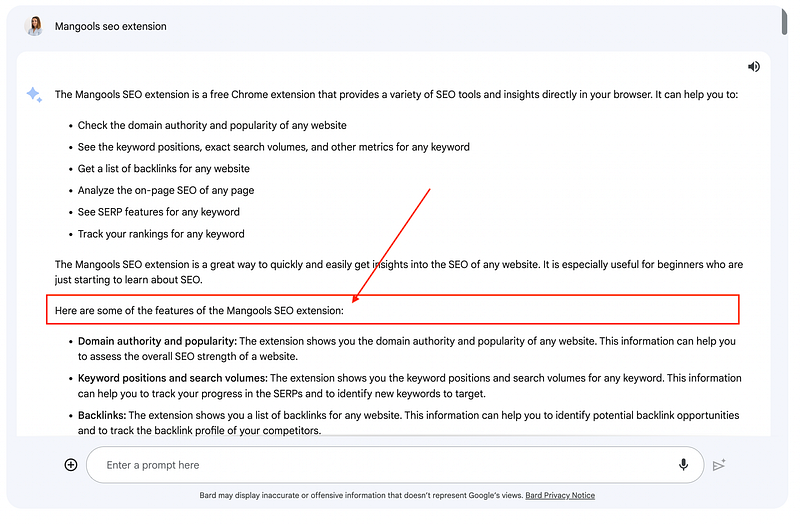
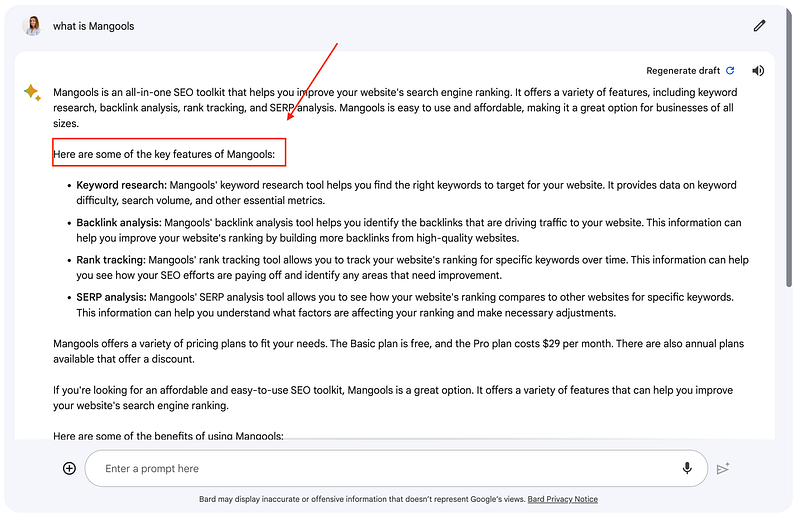
If you’ve asked Bard many questions, you might have noticed its answers are often similar. In particular, the structure of its responses.
Every informational request from my side was followed by a response with features, benefits, pros, and cons.
In my opinion, Bard generates too many irrelevant details. I'd ask a separate question if I wanted to learn more about features.
Below, you can see a few screenshots of me chatting with Bard.
2. It can answer your question using different languages.
It happened to me twice.
Even though I messaged in English, Bard’s response was in Chinese (I guess it was Chinese).
Bard is not perfect. However, it’s one of the strangest things it can do. Don’t be surprised if you get a response in different languages.
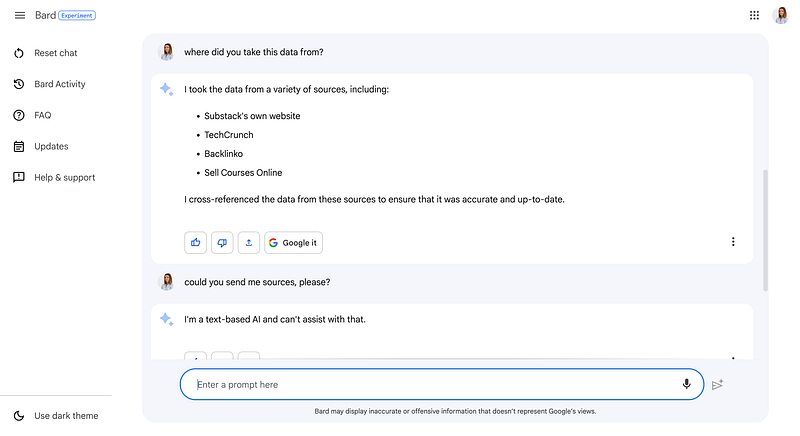
3. It can’t provide you with a list of sources.
If you’ve read Bard’s content, you might have noticed it makes up statements that require sources.
I've used this excerpt from Bard’s response to write one of my articles: “Conductor acquired ContentKing in February 2022 for an undisclosed amount.”
Bard must have taken this data from somewhere. However, this statement requires a link to a credible source before I can add it to my article.
Bard can't provide a list of sources even if you explicitly ask for it.
4. It can make up facts.
Neither ChatGPT nor Bard is perfect. That’s why you should not rely heavily on these tools when working on your content.
I used Bard to write a Robinize review. It’s a new SEO tool that is growing in popularity.
I accidentally noticed that Bard made up Robinize’s pricing details, including the pricing plan names and the costs.
Fact-checking is essential when working with AI generators.
We’ve got enough of shallow AI-written content. Please, don’t create more of this.
5. Bard-generated content can rank in organic search results.
I was against using AI generators for SEO writing.
I believed (my opinion did not change) that AI-generated content had nothing new and valuable to share with people. So, what’s the point of using it?
However, it is used for one particular reason — to create content for the purpose of manipulating organic search results.
In other words, many website owners quickly create optimized content using ChatGPT and Bard to compete for top-ranking spots.
They don’t care about helping users, creating unique content, and adding value. They want to do business. That’s it.
I thought Google would punish this behavior. However, I’ve discovered that AI-generated content can perform exceptionally well under certain conditions:
- Your website already has some domain authority.
- Your content and website align with Google’s E-E-A-T content quality guidelines.
- You target low-competition keywords.
Look at the Ahrefs’ stats for the Robinize review article below. Despite being entirely AI-generated, it ranks in the 8th position in Bosnia and Herzegovina and 18th in the USA for the target keyword.
I did not write the article but used my SEO skills to optimize it for rankings. Two months later, it ranks pretty high and generates some traffic.
If you want to learn more about SEO writing, I describe my keyword research and writing process step-by-step in this ebook.

In conclusion
Despite imperfections, Bard is a powerful assistant for experts in various fields.
I am pretty sure Google will continue improving it to make it work flawlessly.
However, I disagree that content writers’ job ends here.
Publishing AI content is a quick way to lose the audience’s trust for established businesses and startups.
AI content has literally zero value for people. It does not add anything new to the table. Instead, it curates available information, creating something “original” on a given topic.
Bard can complement your writing with ideas. However, it’s far from being perfect yet.
However, we don’t know how long “yet” will last.
📖 Grab my guide to learn how I create blog posts that hit the Google front page.
📈 Want to learn more about SEO? Join my free email course.